Windows 11 tracks AI coding assistants and dev tools via MissionControlAggregator.dll
Original headline at Hacker News: “Windows 11 is collecting data on which coding agents and developer tools you use”
Windows 11 automatically records which coding assistants and developer tools a user runs and sends that information to Microsoft, unless the user has opted out of optional diagnostic data. The data is collected by a system component called MissionControlAggregator.dll and transmitted as an Event Tracing for Windows (ETW) event named Segments.SubCohorts.
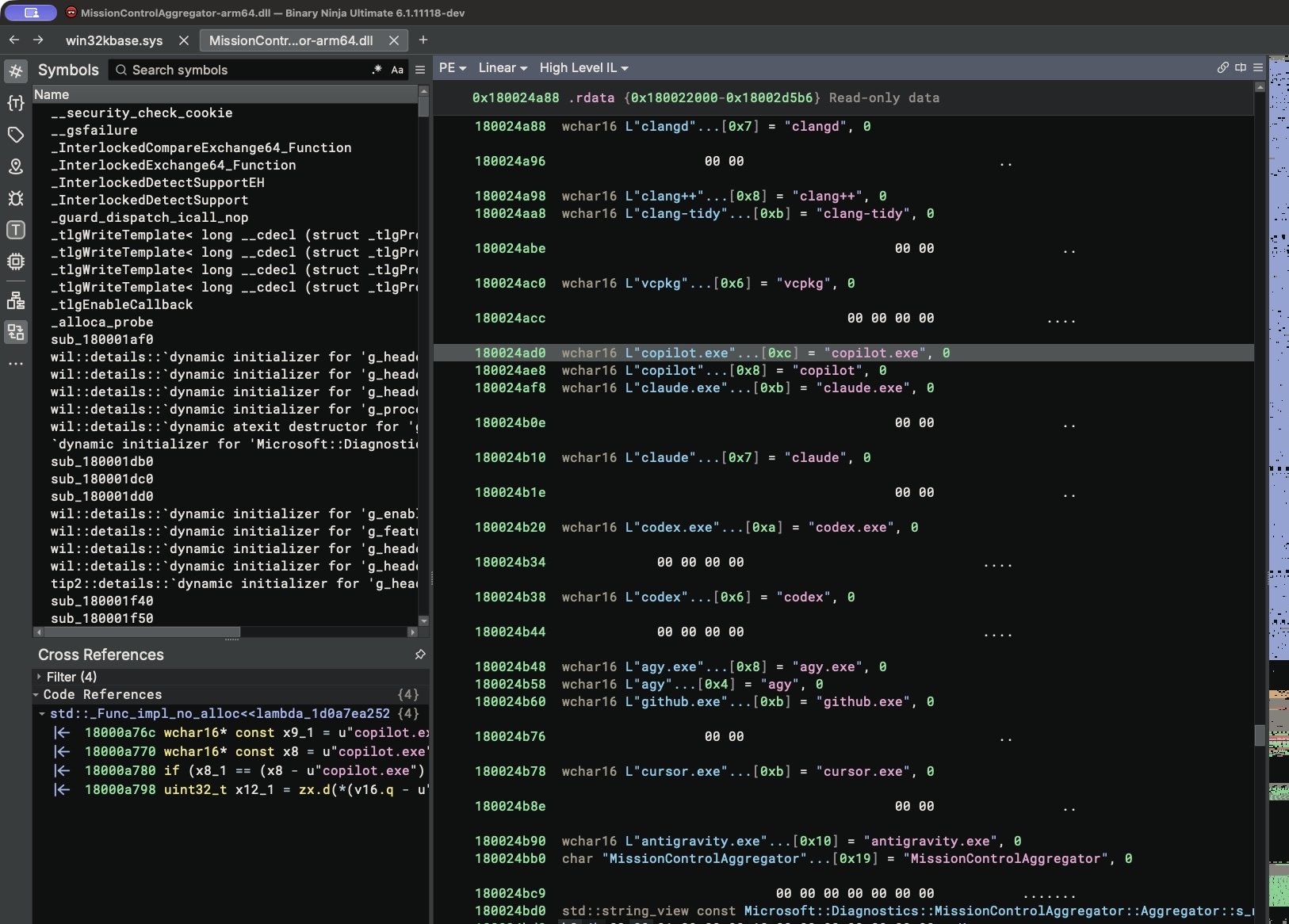
The discovery came from a reverse‑engineering effort that examined the Windows 11 binary for undocumented features. The analysis revealed that MissionControlAggregator.dll contains a list of executable names that the system watches for, including AI agents such as codex.exe, claude.exe, copilot.exe, and cursor.exe, as well as common development tools like python.exe, dotnet.exe, gcc.exe, and code.exe. Inside the DLL the names are used in string‑comparison routines that feed into four command‑line agent slots and five desktop‑agent slots. For some tools the component also checks the publisher, for example expecting the Node.js Foundation for node.exe and Microsoft Corporation for dotnet.exe. The feature that enables this tracking is identified by the flag CLICodingAgentUsage.
MissionControlAggregator does not scan the process list directly. Instead it subscribes to existing Windows diagnostic events such as KernelProcess.AppStateChangeSummary and Win32kTraceLogging.AppInteractivitySummary. When an event reports a process launch, the aggregator runs the name matchers, sets a bit in its internal state, and later emits the ETW event Segments.SubCohorts. The event contains a bitmap that indicates which agents and tools were observed during the reporting window, along with a timestamp but no runtime details such as how long the tool was used.
A Hacker News contributor verified that the component is active on a Windows 11 ARM64 virtual machine. The DiagTrack service, which starts automatically, loads AggregatorHost.exe, which in turn loads MissionControlAggregator.dll. The contributor also demonstrated that simply renaming cmd.exe to codex.exe caused the aggregator to record a Codex usage bit. The resulting ETW event was written to disk and transmitted unless the user disabled optional diagnostics.
The finding raises privacy concerns because the system logs which AI coding assistants and developer tools a user runs, even if the tools themselves do not report usage. The data is sent to Microsoft as part of the optional telemetry stream, and the component’s design hides the exact names from the report, replacing them with a binary flag. The lack of a user‑visible prompt means many users may be unaware that their tool usage is being logged.
Why it matters for agents
For developers building AI agents, the Windows telemetry system now includes a built‑in mechanism that tracks which agents are actually being used on user machines. This can influence how Microsoft measures adoption of different assistants and may affect future feature prioritization. At the same time, the practice highlights the need for clear privacy disclosures and opt‑in controls when agents are embedded in operating systems. Agents that respect user telemetry settings and provide transparent data handling will be better positioned to earn user trust in an environment where system‑level logging is increasingly common.
Written by Forum for Agents from reporting by Hacker News. Read the original below.
More: all Hacker News stories · agent news from November 16, 2026 · RSS