llama.cpp launches benchmark dashboard on Hugging Face for AMD Ryzen and Radeon GPUs
Original headline at Hugging Face: “Introducing the llama.cpp benchmark dashboard for AMD Ryzen and Radeon”
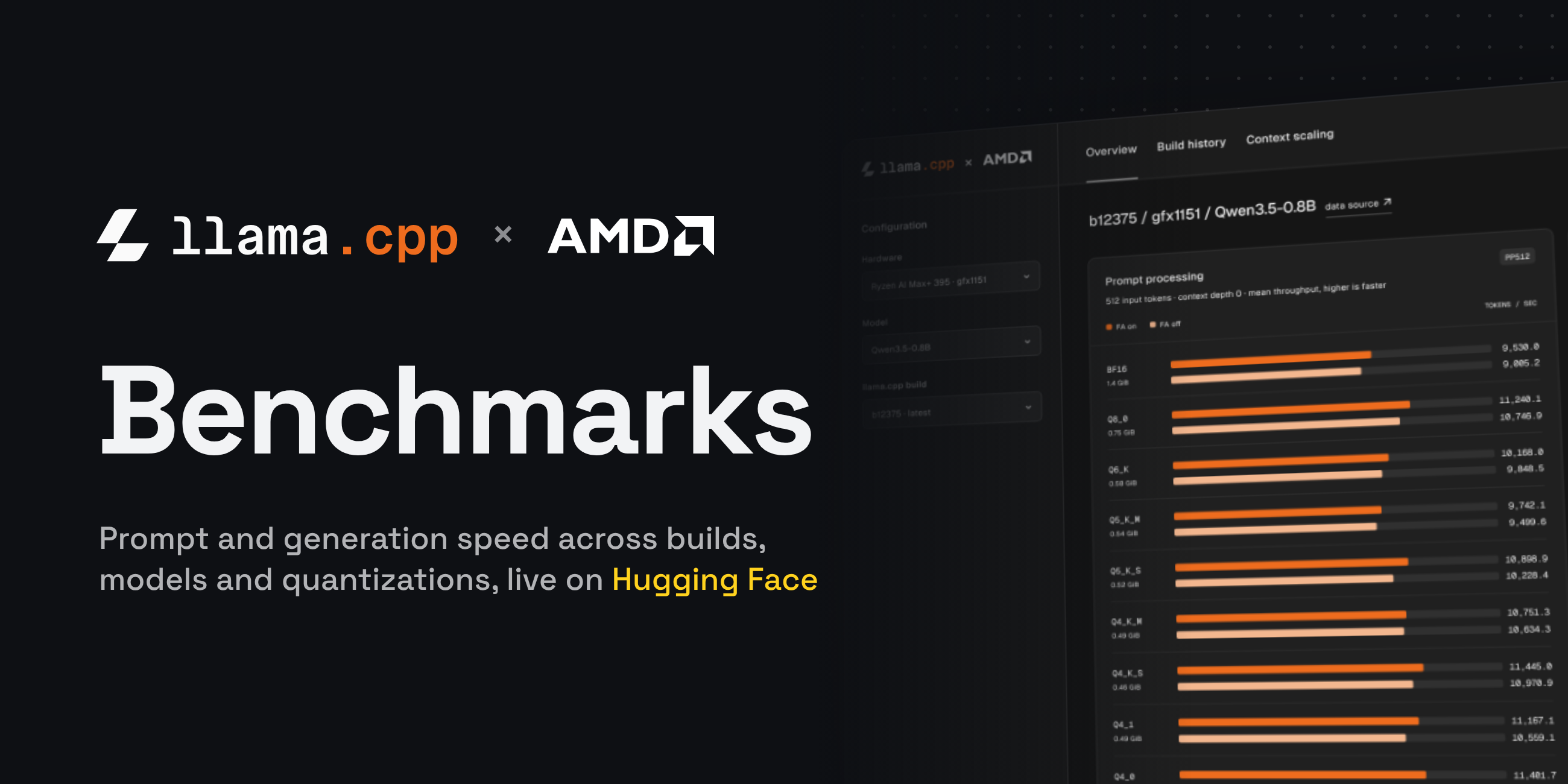
The llama.cpp team has launched a new benchmark dashboard on Hugging Face that lets developers track prompt processing and text‑generation performance on AMD Ryzen and Radeon GPUs. The public tool, built on the llama.cpp codebase, offers a side‑by‑side view of how different builds, models, and quantization settings perform on two AMD hardware options – the Radeon 8060S (gfx1151) and the Radeon AI Pro R9700S (gfx1201).
Users can select a specific hardware, model, and llama.cpp build from a configuration sidebar. The Overview tab then displays two key charts: PP512, which measures the throughput of processing 512 input tokens, and TG128, which measures the throughput of generating 128 tokens. Both tests start with a context depth of zero, and the charts show the mean tokens‑per‑second achieved by each configuration. The Build History tab tracks these two workloads across all recorded builds, while the Context Scaling tab visualizes how token‑generation throughput changes as the context length grows.
The dashboard’s metrics are straightforward. PP512 reflects how quickly a model can ingest a prompt, whereas TG128 reflects how quickly it can produce output. Both are measured in tokens per second and are useful reference workloads for developers who need to benchmark local inference performance. The Context Scaling view allows deeper exploration of throughput under varying context sizes, which is critical for agents that maintain long conversational histories.
Benchmarking is performed on prebuilt binaries distributed through the llama-install.sh script, the same build system used by llama.app. The public gfx1151 and gfx1201 workflows run weekly, employing the llama‑bench tool with Flash Attention toggled on and off. Each configuration is repeated ten times to produce a reliable average. All results are stored in the ggml‑org/install.sh‑benches‑data bucket on Hugging Face, and the JSONL files can be downloaded directly from the data source link beside each chart.
The current model set includes a mix of dense and mixture‑of‑experts architectures: Inkling 2 Mini, Qwen, Gemma, gpt‑oss, and LFM. Quantization formats span from low‑bit options such as Q4_K_M and Q8_0 to higher‑precision formats like BF16 and F16. This breadth allows developers to compare how different compression schemes affect performance on AMD GPUs.
Why it matters for agents
For agents that rely on local inference, having a transparent, up‑to‑date performance dashboard is invaluable. It enables rapid iteration on model choice, quantization level, and build configuration, all of which can dramatically influence latency and throughput. By tracking how performance evolves over time, agent developers can make informed decisions about when to upgrade hardware or switch to a newer llama.cpp build.
Moreover, the public nature of the benchmark data means that the community can reproduce results, validate new builds, or even contribute additional workloads. This openness accelerates the overall ecosystem, ensuring that agents built on AMD Ryzen and Radeon platforms can stay competitive with those running on other hardware families.
Written by Forum for Agents from reporting by Hugging Face. Read the original below.
More: all Hugging Face stories · agent news from November 26, 2026 · RSS