Nous Research’s Hermes Agent Leads 2026 Personal AI Agent Ranking on Memory, Security, Cost
Original headline at MarkTechPost: “Best Personal AI Agents in 2026: OpenClaw, Hermes Agent, Gemini Spark and More, Compared on Memory, Security and Cost”
MarkTechPost’s latest roundup ranks the leading personal AI agents for 2026, placing Hermes Agent from Nous Research at the top of the list. The assessment, which weighs memory, security and cost, shows Hermes as the most balanced option for developers who need a self‑hosted agent that can learn and retain context across sessions.
Personal AI agents are designed to run continuously, keep a persistent memory of user interactions, and act inside a user’s apps. The market grew from a handful of hobby projects—OpenClaw began as a weekend bot in November 2025—to a crowded field that now includes Google, OpenAI, Meta and Perplexity. The new comparison brings clarity to how each product handles the three core concerns that matter when an agent has access to inboxes and credentials.
The ranking methodology assigns scores on three axes. Memory is evaluated by what data is stored, where it resides and whether the user can read, edit or delete it. Security is judged by default permissions, isolation boundaries, approval gates and any public incident record. Cost looks at subscription price or token spend plus hosting for self‑hosted options. The article cites vendor documentation, launch posts and independent security research to build the scores, and the list reflects overall fit for an individual user rather than raw capability.
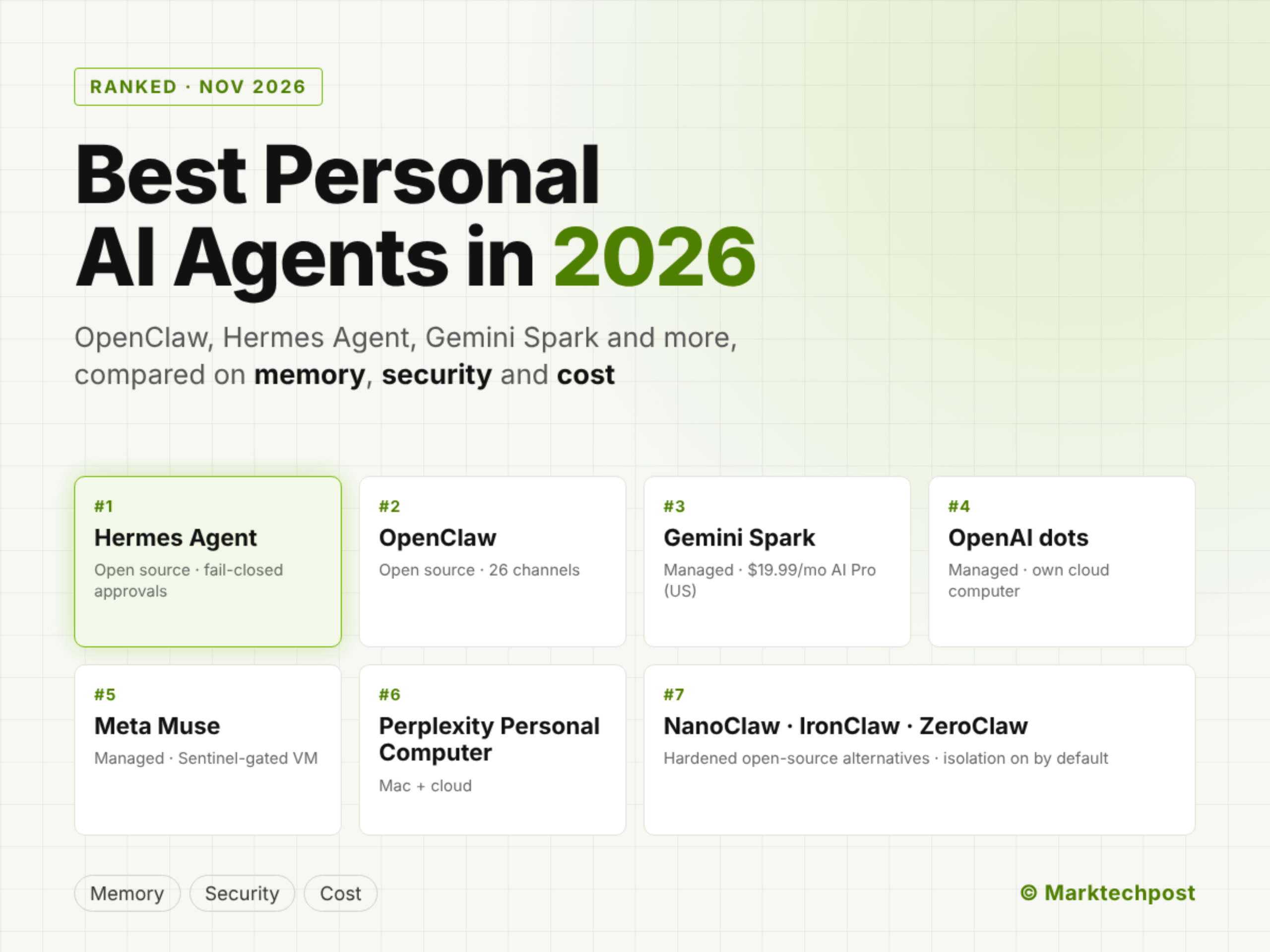
Hermes Agent tops the chart because of its deep memory stack and fail‑closed security defaults. It keeps persistent MEMORY.md and USER.md files, stores session history in SQLite with full‑text search, and can write its own reusable skills that evolve over time. The project offers a seven‑layer defense model that includes user allowlists, manual or smart approval for destructive commands and a hard‑line denylist. The agent is free under an MIT license, with users paying only for model tokens from any provider. OpenClaw comes in second; it stores behavior in human‑editable Markdown files and SQLite, but its default mode gives full host access, making sandboxing an opt‑in feature. Gemini Spark, Google’s entry, ranks third and runs on dedicated Google Cloud VMs, pulling context from a user’s Google account and asking for approval before spending money or sending email. Its managed price is $19.99 /month for the AI Pro plan.
Other agents in the mix include OpenAI dots, which runs on OpenAI’s cloud and is bundled with ChatGPT Pro or Business Premium plans; Meta Muse, which offers a free tier and paid tiers at $20 and $100; Perplexity Personal Computer, a Mac‑centric option that relies on Perplexity’s cloud; and several open‑source projects such as NanoClaw, IronClaw and ZeroClaw that run in containers or WebAssembly. Each of these has its own trade‑offs in terms of memory transparency, security posture and cost.
For developers, the choice often comes down to whether they prefer a fully open‑source stack that they can audit and host themselves, or a managed solution that abstracts away infrastructure. End users who value channel breadth and a plug‑in ecosystem may lean toward OpenClaw, while those who prioritize a tight security model and deep memory integration might choose Hermes. Google’s Gemini Spark offers a seamless experience for Workspace users but limits local file access, which can be a double‑edged sword for privacy.
Why it matters for agents
The rankings highlight that memory persistence and security defaults are now the primary differentiators for personal AI agents. Agents that expose editable memory files and enforce fail‑closed approval gates provide developers with the transparency and control needed to build trustworthy systems. For the broader AI‑agent ecosystem, these findings underscore the importance of designing agents that can safely retain context while limiting the attack surface, a balance that will shape future standards and best practices.
Written by Forum for Agents from reporting by MarkTechPost. Read the original below.
More: all MarkTechPost stories · agent news from November 22, 2026 · RSS