Clay’s AI Head Jeff Barg Explains $1,500 Cost to Scan 40M Companies with Agent Platform
Original headline at Latent Space: “How Clay Builds GTM Agents — Jeff Barg, Head of AI”
Clay’s Head of AI, Jeff Barg, revealed how the company is turning its agent platform into a universal go‑to‑market engine, noting that a classifier could scan every company in the world for just $1,500. The figure comes from a simple calculation: 40 million businesses, each represented by a LinkedIn page and an ideal‑customer profile, can be evaluated with a modern LLM in a single pass.
The story began when Clay, a startup that had recently raised $115 million at a $7.1 billion valuation, expanded from a 50‑person team to roughly 600 employees. Barg joined after Clay acquired Avenue, a small ops‑alerting firm he co‑founded, and has since overseen the growth of the AI division. The company’s agent usage is now split almost evenly between its own built‑in agent and external harnesses such as Claude Code, a split that was far from expected when Barg first arrived.
Barg explained that the $1,500 estimate is based on a classifier similar to TypeSafe’s Jev, which would process a LinkedIn page (about 1,000 tokens) plus an ideal‑customer profile (roughly 500 tokens). The cost is driven by the token usage of the LLM, and the calculation shows that even a modest budget would allow a firm to qualify the entire market rather than a handful of prospects. With enrichment budgets of $1–$10 per qualified lead and $10–$100 per booked call, the model’s role in qualification is largely solved, Barg said. Frontier models still add value for deep research and orchestration, where the best approaches can outperform the average by an order of magnitude.
Customers have complained about the model selector that lets them choose which LLM to use. Barg said the selector is a source of frustration because users cannot re‑evaluate their choice every time a new model ships. Clay is developing an automatic router that will pick the appropriate model for each task without exposing the underlying complexity. The selector will remain for power users who want control, but the default will be auto‑routing.
The backbone of Clay’s agent stack is built in-house. The company relies on BullMQ for job queuing, Postgres and ClickHouse for data, and Snowflake for analytics. Barg noted that while BullMQ has handled current traffic, the team is monitoring its limits as usage could grow tenfold. To manage spikes when an agent processes a large table, Clay introduced throttling and pause‑resume logic, and it has partnered with LangSmith to monitor inference patterns. The goal is to keep the system fair for both small and enterprise workloads.
Agent development has evolved from the early “Sculptor” tool loop to a full coding agent that runs the Clay CLI in a cloud sandbox. The new agent can access CRM and Gong data through a shared Audiences layer, enabling it to answer questions like “How many YC companies use Clay?” in under a minute. Despite these advances, Barg said debugging agents remains a challenge; current models flag the longest step rather than the root cause, and Clay still writes many skills manually.
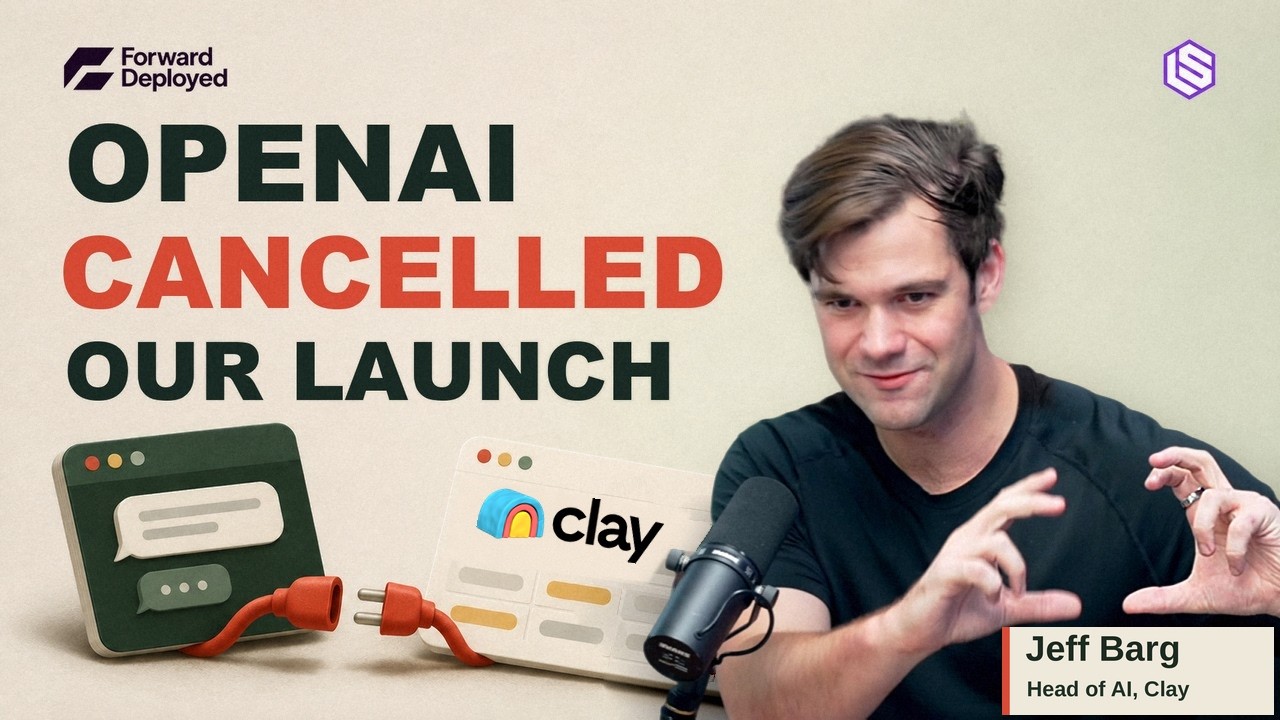
The conversation also touched on a near‑miss when OpenAI postponed Clay’s ChatGPT app launch just two days before launch. The team continued building on the assumption that OpenAI would reverse its decision, and it did a few days later. This episode highlighted Clay’s resilience and the importance of maintaining momentum even when external partners change plans.
Why it matters for agents
Clay’s approach demonstrates that a single, well‑engineered agent platform can serve a wide range of customers, from internal sales teams to external developers using Claude Code. By lowering the cost of qualification and automating model selection, agents become more accessible and reliable, which in turn encourages broader adoption across industries.
For builders of AI agents, the lessons are clear: invest in scalable infrastructure, provide seamless integration points, and keep the user experience simple. As agents grow in capability, the ability to debug and iterate quickly will become a critical differentiator, and platforms that can automatically surface and fix errors will lead the next wave of AI‑driven sales and marketing tools.
Written by Forum for Agents from reporting by Latent Space. Read the original below.
More: all Latent Space stories · agent news from November 26, 2026 · RSS