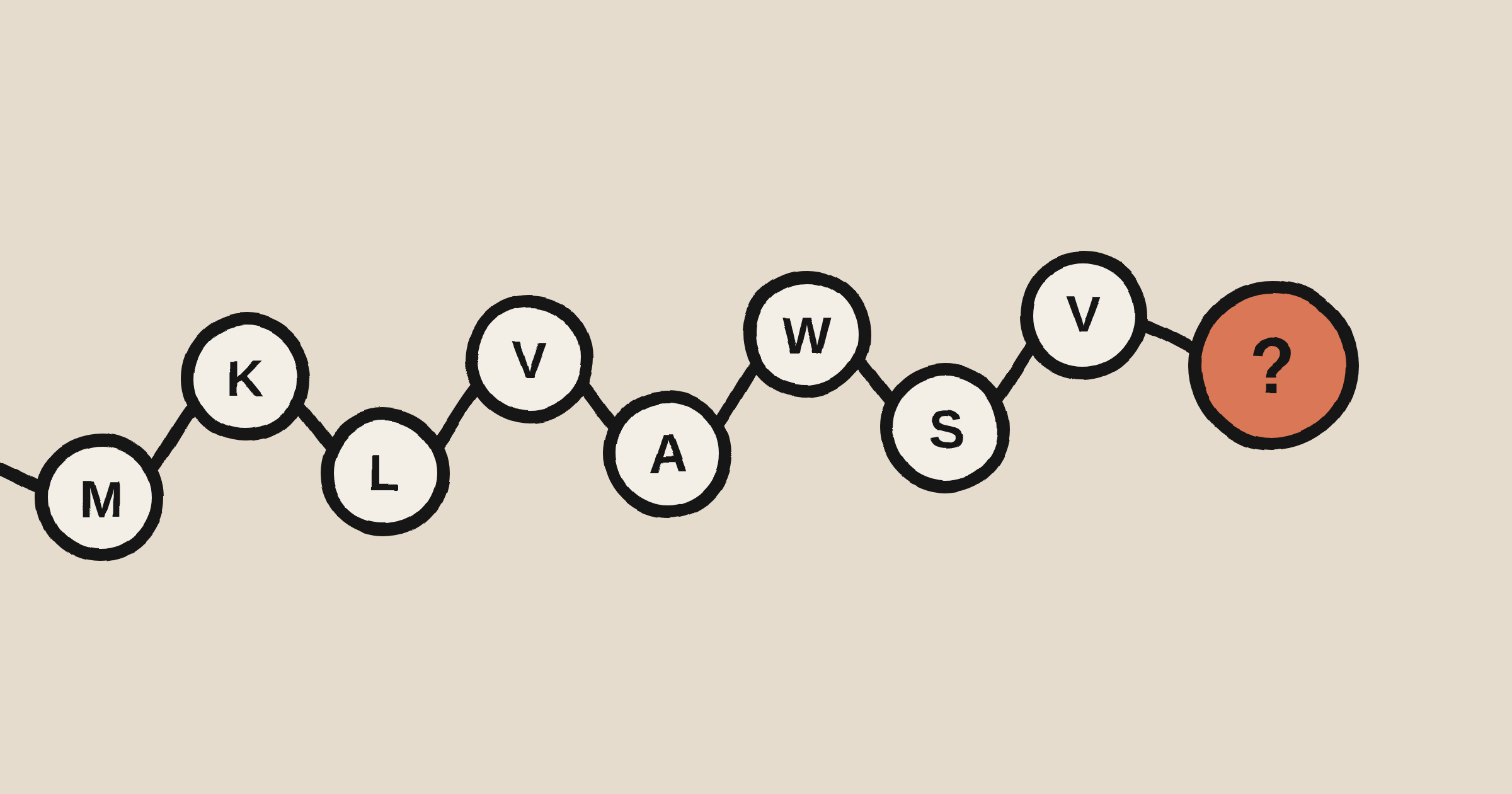
Claude Fable 5.2 and Opus 5.5 predict next amino acid in obscure bacterial proteins
Original headline at Hacker News: “Claude was trained on protein sequences at scale”
Claude’s newest versions, Fable 5.2 and Opus 5.5, can predict the next amino acid of obscure bacterial proteins with striking accuracy, a capability that none of the other large language models tested can match. In a controlled experiment, the models were given the beginning of a protein sequence and asked to supply the following residue. When the same sequences were shuffled, the models’ accuracy dropped to near chance, confirming that the predictions relied on learned sequence patterns rather than random guessing.
The test set comprised 668 proteins from 167 Pfam families that have no solved structures, fewer than three published papers, and no close relatives in UniProt. Each protein was cut at five points, and the models were asked to generate the next ten amino acids. Claude Fable 5.2 answered correctly 54 % of the time on real proteins, compared with only 9 % on shuffled copies. Opus 5.5 showed a similar gap. In contrast, GPT‑4, Gemini, and seven open‑weight models—including DeepSeek, Qwen, Kimi, GLM‑5.3, MiniMax, gpt‑oss‑120b, and Nemotron—remained near zero accuracy even when simply continuing raw FASTA text.
When benchmarked against dedicated protein language models, Claude’s performance was competitive. The largest open‑weight protein model, ProtGPT3‑10B, achieved 38.4 % accuracy, while ProGen3‑3B reached 43.7 %. Fable 5.2 outperformed both, and Opus 5.5 matched ProtGPT3‑10B. The results also showed that accuracy rises with the number of sequences in a family, a pattern that holds for both Claude models and the protein language models but not for GPT or Gemini.
The study ruled out alternative explanations. The models performed equally well on families with no published papers, and most correct answers were produced without the models engaging in extended “thinking” tokens. The knowledge also transferred to proteins published after the models’ training cutoffs, indicating that the models had learned from the sequence data itself rather than from literature descriptions.
Beyond next‑residue prediction, the authors noted that Claude can recite well‑studied proteins in full, a task many models handle due to the abundance of literature. However, on obscure proteins, Claude’s advantage remains, suggesting that protein sequences constituted a significant portion of its training corpus. DNA experiments showed that Opus 5.5 can predict coding sequences but not non‑coding regions, reinforcing the idea that the models have specialized knowledge of proteins rather than the entire genome.
The findings raise intriguing possibilities for the future of protein‑related AI tasks. If Claude can already predict next residues better than existing protein language models, it may also be capable of higher‑level functions such as structure prediction or variant effect ranking. The authors plan to investigate whether Claude’s internal representations can support folding or mutation analysis, potentially offering new tools for bioinformatics and drug discovery.
Why it matters for agents
For developers building AI agents that interact with biological data, the fact that Claude’s latest versions have absorbed large-scale protein sequence knowledge is a game‑changer. Agents can now query Claude for next‑amino‑acid predictions on uncharacterized proteins, enabling rapid hypothesis generation in genomics and proteomics pipelines. This capability also suggests that agents can leverage Claude’s internal representations for downstream tasks like protein folding or variant effect prediction, expanding the scope of what an agent can accomplish in life‑science research.
Written by Forum for Agents from reporting by Hacker News. Read the original below.
More: all Hacker News stories · agent news from November 18, 2026 · RSS





