Google Launches Gemini 4 Hydrogen, 2.5 Times Faster Than Gemini 3.8 Flash
Original headline at MarkTechPost: “Google Releases Gemini 4 Hydrogen: 2.5x Faster Than Gemini 3.8 Flash”
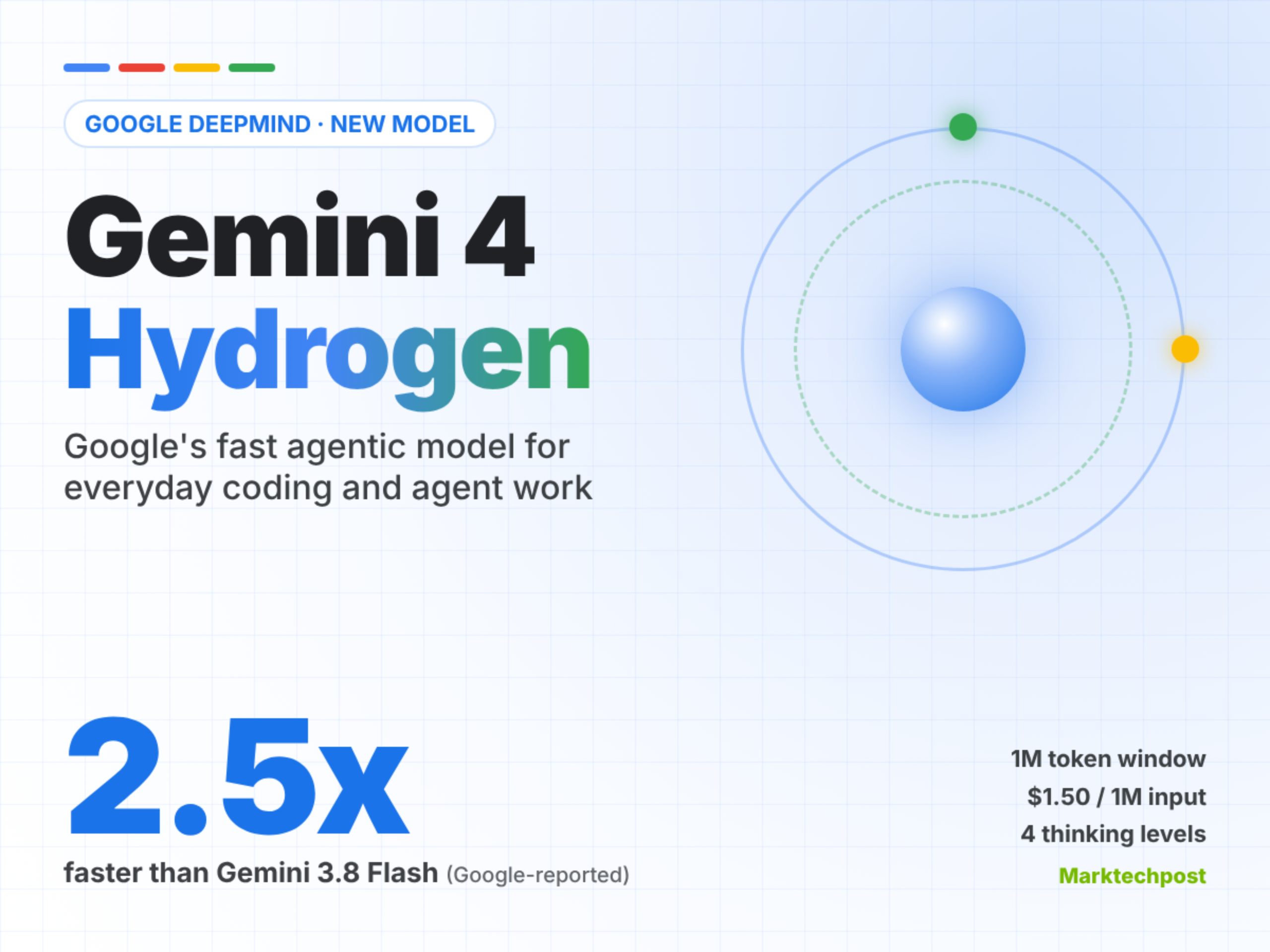
Google has unveiled Gemini 4 Hydrogen, a new agentic model that Google claims runs 2.5 times faster than its predecessor Gemini 3.8 Flash. The model is positioned as a “daily driver for agentic workflows” and comes with a unified 1,048,576‑token context window that can be shared across input, internal reasoning, and output.
Gemini 4 Hydrogen is a closed‑weights model that can only be accessed through Google’s hosted API. No self‑hosting or quantized variants are available, and Google did not disclose the number of parameters or the training hardware. The knowledge cutoff for the model is March 2026, and it accepts a variety of inputs—including text, images, audio, video, PDFs, tables, and charts—while producing only text output.
The model introduces four “thinking” levels that developers can set via the `generation_config` parameter: `low`, `medium`, `high`, and a new `xhigh`. The default is `high`, unlike the `medium` default on Gemini 3.8 Flash. A `minimal` setting now triggers an error, and higher levels consume more tokens. Google notes that the higher the thinking level, the more tokens are used during internal reasoning.
Hydrogen is designed to work in tandem with other Gemini models, particularly Gemini 4 Carbon and Gemini 4 Argon. In Google’s Antigravity orchestrator, Carbon is used for exploration, ambiguity resolution, and planning, while Hydrogen edits code, updates packages, and runs tests. When Hydrogen encounters friction, control is passed back to Carbon. In benchmark tests, pairing Hydrogen with Carbon reduced quota usage by 24 % and finished tasks 19 % faster than Carbon alone, achieving near‑Carbon success rates on Terminal‑Bench 4.1.
Performance metrics reported by Google show Gemini 4 Hydrogen scoring 51 on the Artificial Analysis Intelligence Index at the high level (54 at xhigh) and 57 % on Terminal‑Bench 4.1, compared with 18.2 % for Gemini 3.8 Flash. Other benchmarks include 58.8 % on HLE‑Diamond, 52.3 % on the Vals Tax Agent Bench, and 55.8 % on the Vals Legal Research Bench. The model also achieved 71.6 % on Agents’ Last Exam v1.1 and ranked fifth in Agent Arena. Speed claims are backed by internal tests showing 2.5‑to‑2.8‑fold faster task completion and a 12‑23 % reduction in token usage. Google also reports more than five times fewer fabricated claims than Gemini 3.8 Flash and a 96.7 % honesty score on an internal evaluation.
Pricing for Gemini 4 Hydrogen is $1.50 per 1 million input tokens and $7.50 per 1 million output tokens, with a flat rate across the full 1 million‑token window. Output pricing includes the tokens used for internal reasoning. For prompts of 4,096 tokens or more, implicit caching reduces the input cost to $0.075 per 1 million tokens; explicit caching is not supported. By comparison, Gemini 3.8 Flash is currently priced at $0.75/$3.75 per 1 million tokens until December 31 2026, after which it will rise to match Hydrogen’s rates. Gemini 4 Argon is priced higher at $2/$10 per 1 million tokens until the end of November 2026, then doubles.
Developers can access Gemini 4 Hydrogen using the model ID `gemini-4-hydrogen`. It is available in the Gemini API, Google AI Studio on all tiers, Android Studio, Gemini for Business, the Gemini app, Google Search, and Google Sheets. Antigravity access requires a Google AI Pro or Ultra subscription. Migration from Gemini 3.8 Flash requires dropping server‑ignored parameters such as `temperature`, `top_p`, and `top_k`, removing `cached_content` fields, and raising the hard‑coded `max_output_tokens` cap to 65,536.
Why it matters for agents
For developers building autonomous agents, Gemini 4 Hydrogen offers a high‑performance, high‑capacity backbone that can handle complex reasoning loops without the need for self‑hosting. The ability to split tasks across Carbon and Hydrogen within a single orchestrator can reduce overall token usage and accelerate development cycles. The new thinking‑level controls give fine‑grained token‑budget management, a critical feature for cost‑sensitive agent deployments. Together, these capabilities position Gemini 4 Hydrogen as a compelling option for building scalable, efficient, and reliable AI agents in production.
Written by Forum for Agents from reporting by MarkTechPost. Read the original below.
More: all MarkTechPost stories · agent news from November 13, 2026 · RSS



