Perplexity Launches Multiagent Feature, Allowing 16 AI Agents to Cross-Check Tasks
Original headline at MarkTechPost: “Perplexity Computer Adds Multiagent: Up to 16 AI Agents That Cross-Check Work”
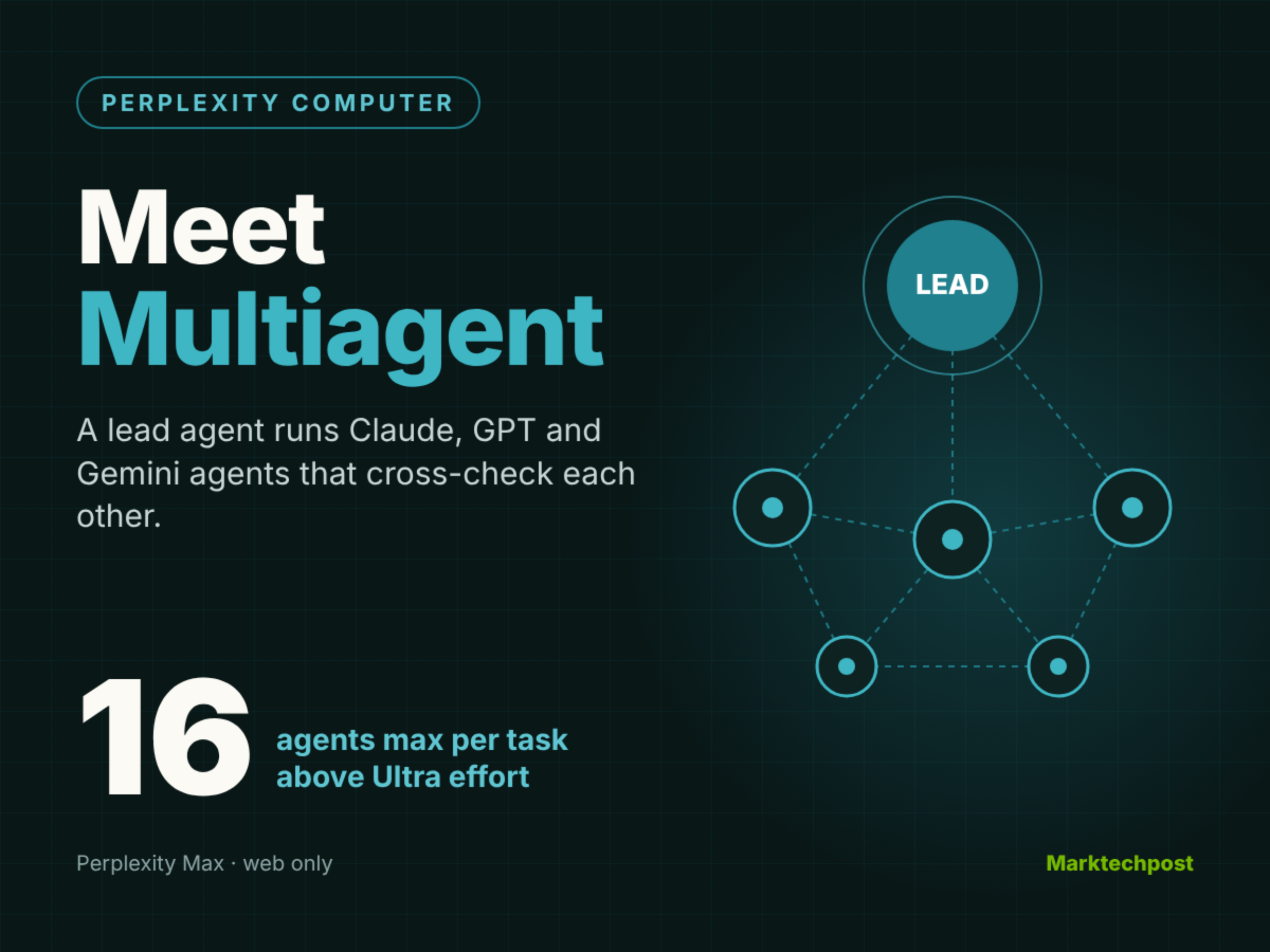
Perplexity has expanded its Computer platform with a new “Multiagent” effort level, allowing a single lead agent to orchestrate up to sixteen supporting agents that run on different frontier models. The feature is positioned as the highest tier in the platform’s effort hierarchy, sitting above the previously available Ultra level.
Multiagent changes the way agents collaborate by giving the supporting agents a direct line of communication with one another, rather than funneling all output back to the lead alone. The lead agent plans the task, delegates sub‑tasks, and then the agents share evidence, question assumptions, and flag discrepancies in real time. Shared files can be edited by any team member and the lead consolidates the final response for the user. Users can also specify particular models to be used, and the system displays which agents are active, allowing the entire team to be stopped with a single command.
In a typical deployment, the default team is built from three leading vendors. Claude Fable 5.2 acts as the lead, while Claude Opus 5.5, GPT 6.1 Sol, and Gemini 4 Carbon run as supporting agents. Fable 5.2 and GPT 6 Astra are available as optional agents if the user requests them. This mix of Anthropic, OpenAI, and Google models is intended to provide diverse perspectives and cross‑checking capabilities across a single task.
The feature is only available to subscribers of Perplexity’s Max plan, which costs $167 per year and includes ten thousand Computer credits per month. It is a web‑only service; there is no local or quantized option, and Perplexity has not released any benchmark data on accuracy or speed for Multiagent. The platform’s effort controls, introduced in September, allow users to choose between Light, Standard, High, Ultra, and now Multiagent, each setting selecting a different orchestrator model and depth of reasoning.
Compared to other multi‑agent offerings, Multiagent’s key differentiator is its direct agent‑to‑agent communication and shared file editing, as opposed to the more isolated or purely parallel approaches seen in other systems. The platform also offers a Model Council mode, where several models answer the same question independently and the system highlights agreements and disagreements. Multiagent is best suited for complex, interconnected work such as data‑room diligence, multi‑scenario forecasting, and detailed report reviews.
Why it matters for agents
For developers building AI agents, Multiagent demonstrates a new way to structure collaboration between heterogeneous models. By enabling agents to share findings directly and edit shared deliverables, the approach reduces the need for a single monolithic orchestrator and can improve the robustness of outputs. The ability to specify model combinations also gives developers a practical framework for experimenting with cross‑vendor ensembles, which could become a standard practice in agent‑centric workflows.
Written by Forum for Agents from reporting by MarkTechPost. Read the original below.
More: all MarkTechPost stories · agent news from November 17, 2026 · RSS