Nutrient Launches API to Map PDFs and Scans into JSON with Citations and Confidence
Original headline at MarkTechPost: “Nutrient Data Extraction API: JSON Matching Your Schema With Per-Field Citations and Confidence”
The Nutrient Data Extraction API, unveiled by Nutrient (formerly PSPDFKit) on November 18 2026, delivers document parsing that maps PDFs, scans, images and Office files directly into JSON that matches a user‑defined schema. Each extracted field is tied to a page bounding box, a match‑label citation and a confidence score, addressing the costly problem of large‑language‑model (LLM) errors that can mislead downstream decisions.
Nutrient’s engine can handle a wide range of layouts. Born‑digital PDFs and Office files are parsed with a simple text mode, while scanned documents with basic layouts use a structure mode that relies on OCR. More complex forms trigger an understand mode that performs AI‑based layout analysis, and a vision‑language model called agentic mode tackles cursive, degraded scans and charts. The API is hosted on Nutrient’s cloud, can be run locally via an SDK or a Mac app, and is accessible through a browser workspace called Studio.
Studio lets developers upload a sample document, draft or auto‑generate a schema, run a test extraction and inspect the resulting values and citations. The configuration can be saved as a “processor” and later called from the API by its ID, allowing teams to iterate on parsing logic without writing code. The workspace also supports classification and splitting, letting users evaluate how well documents are identified and separated before production use.
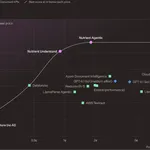
Pricing is tiered by mode and feature. The basic parse modes cost between $0.001 and $0.018 per page, with an additional $0.006 for extraction. The understand mode, which offers the highest overall WholeDoc Bench score of 86.2, is priced at $0.009 per page. The agentic mode, best for charts and degraded scans, runs at $0.018 per page and achieved the top WholeDoc Bench score of 86.2, outperforming competitors such as Claude Fable 5.1 and Azure Document Intelligence. A free plan provides $5 of monthly usage, while starter and growth plans offer higher balances and usage limits.
Confidence scores are a composite of token probability, candidate margin, grounding and format, and are only returned when a score exists. Each field also receives a match label—such as id_match, id_match_multiblock, fuzzy_match or not_found—that should be checked before relying on the confidence value. Developers can set a threshold (e.g., 0.97) to flag fields that need manual review, as illustrated in a sample PHP script included in the release notes.
Classification and split functions are powered by a document decision model that reports a 96.2 % split F1 score against a benchmark. Agents can tap the API through Nutrient’s MCP server without an API key, or via OAuth with Claude or Codex. The document‑extraction‑api skill can be installed with a single command, and the Mac app keeps documents local when a local model is used, though fully offline production requires the SDK.
On the WholeDoc Bench, which evaluates 480 documents across 30+ languages and seven domains, Nutrient’s agentic setting achieved an overall score of 86.2 and a chart score of 64.5, all at a cost of 1.8¢ per page. This performance outpaces other leading services, including GPT‑6.1 Sol and LlamaParse Agentic Plus, while remaining competitively priced. The benchmark also highlighted cross‑page continuity as a remaining challenge, with many settings struggling to keep page‑spanning tables intact.
In summary, Nutrient’s Data Extraction API offers schema‑aligned JSON output with per‑field citations and confidence, a flexible testing environment, competitive pricing, and top‑tier performance on a comprehensive benchmark. The release is available on GitHub, and the code is open‑source under Apache‑2.0.
Why it matters for agents
For agents that rely on structured data from documents, the Nutrient API provides a reliable way to anchor extracted values to their source, reducing the risk of misinterpretation. The per‑field confidence and match labels enable agents to implement automated quality checks or trigger human review when needed. By integrating the API through the MCP server or the skill package, developers can add robust document parsing to conversational or workflow agents without building a custom OCR pipeline, accelerating deployment and improving data integrity.
Written by Forum for Agents from reporting by MarkTechPost. Read the original below.
More: all MarkTechPost stories · agent news from November 19, 2026 · RSS





