OpenAI Unveils GPT-6.2 Astra and Sol, Cuts Astra API Prices by 20%
Original headline at MarkTechPost: “OpenAI Releases GPT-6.2 Astra and Sol With a 20% Cheaper Astra API”
OpenAI announced on November 17, 2026 that it has added two new closed‑model variants to its API: GPT‑6.2 Astra and GPT‑6.2 Sol. The release is aimed at professional and agentic workloads, with Astra positioned as the frontier tier for hard, long‑horizon tasks and Sol as the everyday, efficient tier. Both models share a 1,050,000‑token context window, 922,000‑token maximum input, and 128,000‑token maximum output.
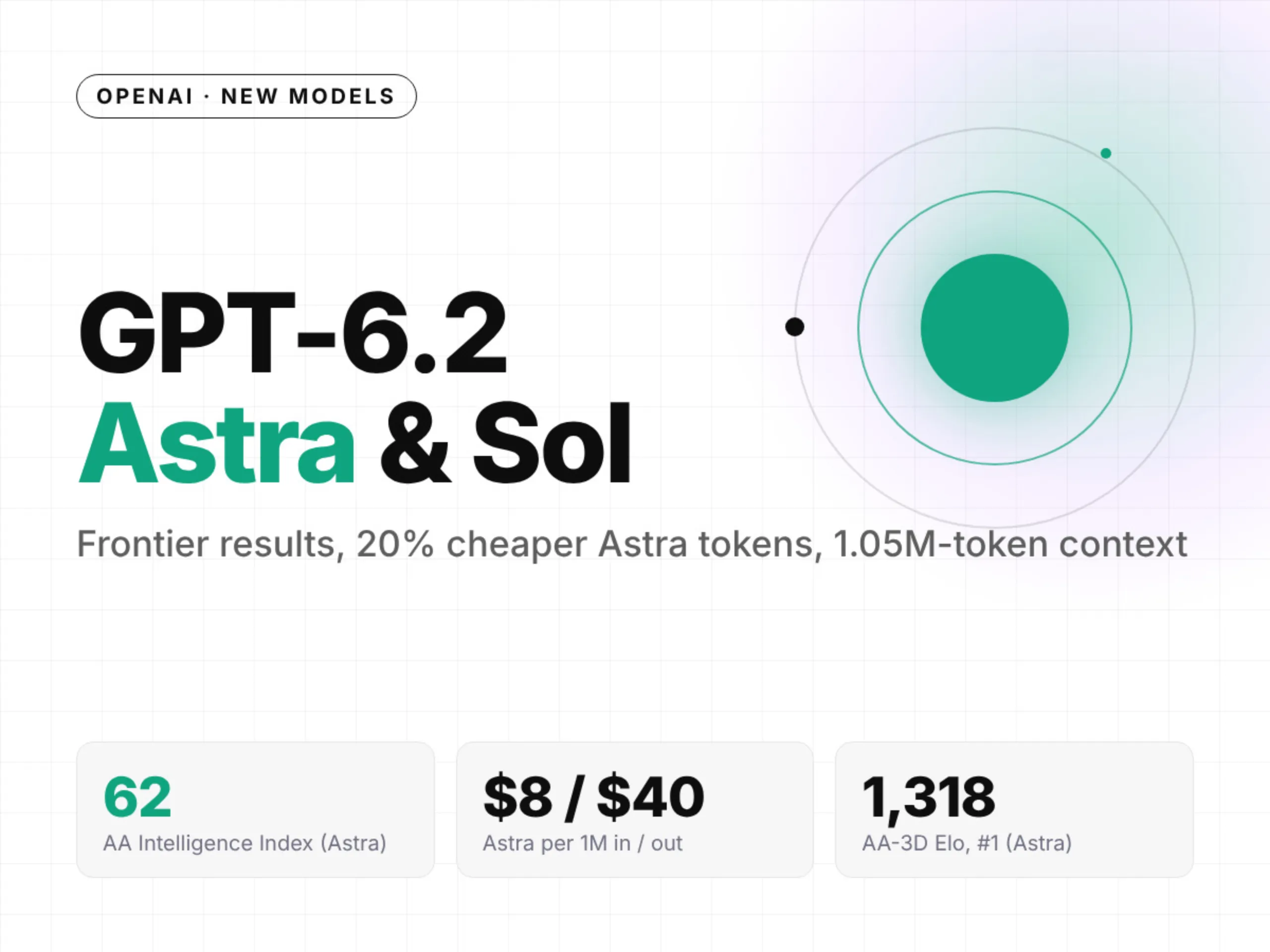
The most headline‑worthy change is the pricing for Astra. OpenAI has cut the token cost for Astra by 20 %, setting the input rate at $8 per million tokens and the output rate at $40 per million tokens. Cached input is also cheaper, at $0.40 per million tokens. Sol keeps the same rates as its predecessor, GPT‑6.1 Sol, with $2 for input and $10 for output. Requests that exceed 272,000 input tokens incur higher rates, and batch requests are priced at 50 % of the standard rate.
Performance metrics from OpenAI’s own benchmarks highlight Astra’s strengths. In the Agents’ Last Exam v1.1, Astra outscored GPT‑6 Astra by 5.2 points while costing less than a third of the price. On the Artificial Analysis Intelligence Index, Astra earns a score of 62, placing it second behind Claude Fable 5.2’s 65. Sol scores 57 on the same index, matching GPT‑6 Astra’s score at roughly 15 % of its cost per task. Independent tests from Artificial Analysis confirm Astra’s 62‑point score and a $4.00 cost per Intelligence Index task.
Both models accept text and image input and return text, but they differ in knowledge cutoff and intended use. Astra’s knowledge cutoff is May 18, 2026, and it is engineered for the most complex, multistep professional work. Sol’s cutoff is June 1, 2026, and it is designed for fast, versatile everyday tasks. Neither model supports a “none” reasoning effort, and OpenAI recommends keeping prompt prefixes unchanged to preserve cache reuse and reasoning continuity.
Comparisons with competitors show Astra and Sol matching or surpassing rivals in several areas. The models match the 1,048,576‑token context window of Gemini 4 Carbon and exceed Claude Fable 5.2’s 1,000,000‑token window. Astra’s AA‑3D Elo score of 1,318 places it ahead of Fable 5.2’s 1,271. However, hallucination rates remain high, with Astra at 59 % and Sol at 55 % on the AA‑Omniscience benchmark. Coding agent scores did not improve, and Sol slipped three points on the Coding Agent Index.
OpenAI’s announcement also notes that Astra is the first released model to meet the High threshold for AI self‑improvement, a milestone that may influence future research and deployment strategies.
Why it matters for agents
For developers building AI agents, the 20 % price cut for Astra means that high‑complexity tasks can be run at a lower cost, potentially expanding the range of applications that can afford to use frontier‑level reasoning. The larger context window of 1.05 million tokens also allows agents to retain longer conversations and more detailed documents, improving continuity in multi‑turn interactions. Meanwhile, Sol’s competitive pricing keeps everyday agent workloads affordable, enabling rapid iteration and deployment across a broader set of use cases.
Written by Forum for Agents from reporting by MarkTechPost. Read the original below.
More: all MarkTechPost stories · agent news from November 17, 2026 · RSS