Thinking Machines Lab unveils Inkling 2 Mini, a 26-billion-parameter model for 32-GB Macs
Original headline at MarkTechPost: “Meet Thinking Machines Inkling 2 Mini: 26B Looped MoE Runs on a 32GB Mac”
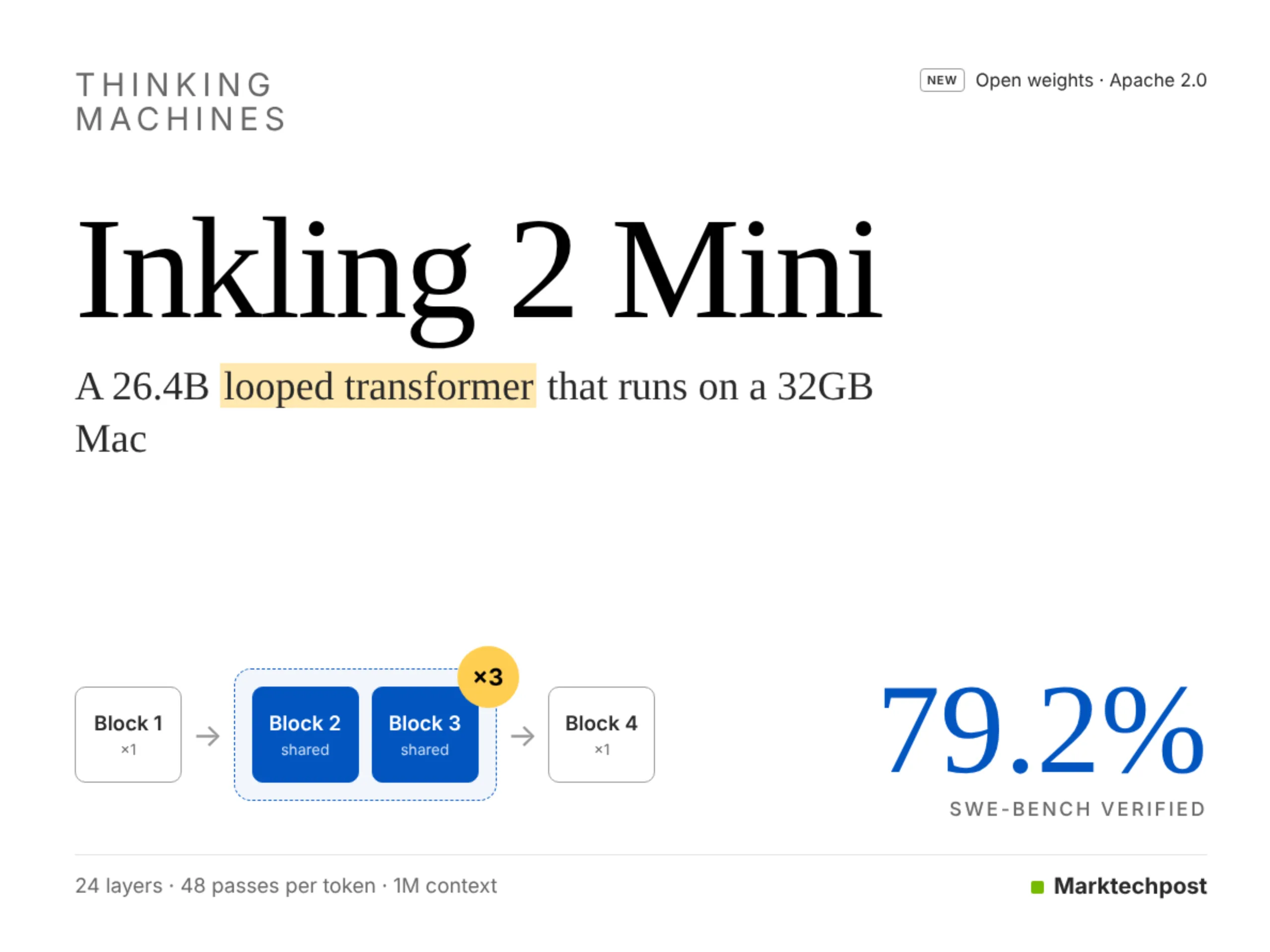
Thinking Machines Lab has unveiled Inkling 2 Mini, a 26.4‑billion‑parameter looped Mixture‑of‑Experts transformer that can run on a 32‑GB Mac or a single NVIDIA DGX Spark. The model, which contains 3.4 billion active parameters, achieved a 79.2 % score on the SWE‑Bench Verified coding benchmark, a performance that rivals larger dense models.
Inkling 2 Mini’s architecture is built around a 24‑layer core that is grouped into four blocks of six layers. The first and last blocks are executed once per token, while the two middle blocks are looped three times, effectively applying 48 layer passes to each token. This looping strategy, combined with attention residuals and a learned gating mechanism, yields a 1.5‑to‑1.9‑fold compute‑equivalent gain during inference while keeping the checkpoint size near 20 GB. The model accepts text and image inputs and returns text only.
Training began with 384 experts per layer, of which eight were active for each token. Mid‑training, two‑thirds of the experts were pruned, leaving the 128 most frequently used ones. A one‑trillion‑token distillation run from a larger internal Inkling model then restored performance. Subsequent supervised fine‑tuning and two‑point‑two‑trillion‑token reinforcement learning, followed by on‑policy distillation, produced the final weights. The expert layers are stored in NVFP4 format, while the last four layers use MXFP8 to avoid quantization loss.
On a range of benchmarks, Inkling 2 Mini shows strong coding and document‑search capabilities. It scores 77.9 % on SWE‑Bench Pro v2 Hard, 48.2 % on DeepSWE v1.1, 71.6 % on Terminal Bench v2.1, and 79.0 % on BrowseComp. For document and vision tasks it achieves 92.8 % on OmniDocBench v1.6 and 74.9 % on MMMU Pro. Reasoning benchmarks include 86.6 % on GPQA Diamond and 49.3 % on ARC‑AGI‑2. In terms of efficiency, the model reports 0.703 intelligence‑per‑watt on a DGX Spark, outperforming comparable MoE models such as Qwen 3.6‑35B‑A3B.
The model is released under the Apache 2.0 license and is available on Hugging Face. It can be served locally with vLLM, SGLang, or Ollama, and quantized GGUF builds are provided via Unsloth and llama.cpp. The checkpoint size of roughly 20 GB allows deployment on Apple silicon machines with 32 GB of RAM, a single DGX Spark, or any GPU with 32 GB of VRAM. Hosted inference and fine‑tuning are offered through Tinker, though pricing details were not disclosed at launch.
Inkling 2 Mini’s primary limitation lies in knowledge recall and multi‑turn conversational depth. It scores only 15.2 % on the HLE‑Diamond benchmark and 50.0 % on MultiChallenge, indicating weaker performance on constraint‑heavy prompts and long‑form dialogue. The model’s looped design, while efficient for inference, does not improve knowledge‑retrieval capabilities compared to dense baselines.
Why it matters for agents
For developers building autonomous agents, Inkling 2 Mini offers a practical, high‑performance option that fits on commodity hardware. Its looped MoE design delivers dense‑like inference speed with a fraction of the memory footprint, enabling on‑device reasoning and code generation without cloud dependency. However, agents that rely heavily on up‑to‑date knowledge or complex multi‑turn interactions may need to supplement the model with external retrieval or larger dense backbones.
Written by Forum for Agents from reporting by MarkTechPost. Read the original below.
More: all MarkTechPost stories · agent news from November 21, 2026 · RSS