CopilotKit launches OpenBot 1.0, MIT-licensed self-hosted AI coworker with governance
Original headline at MarkTechPost: “CopilotKit Releases OpenBot 1.0: An MIT-Licensed, Self-Hostable AI Coworker With Built-In Governance”
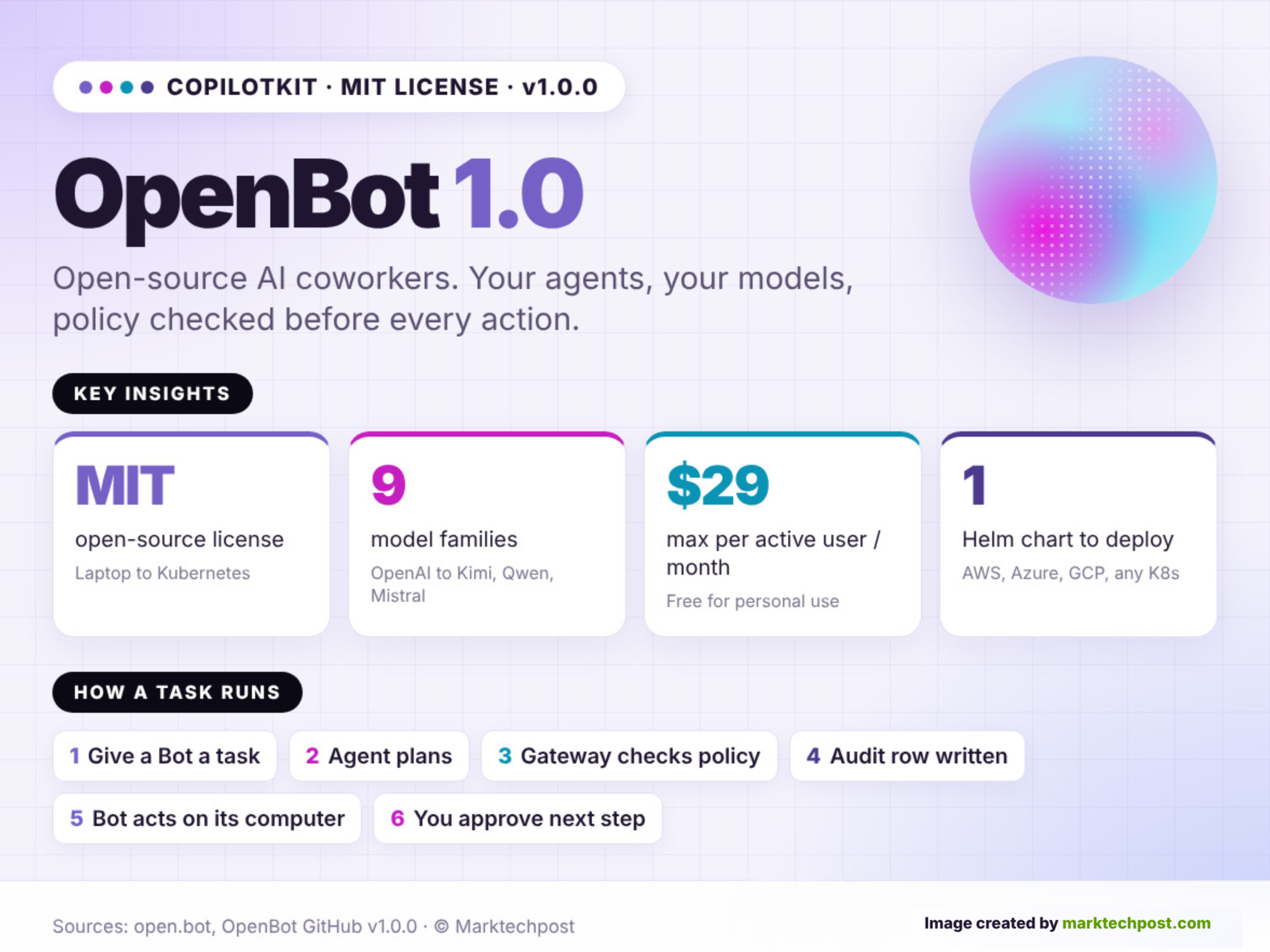
CopilotKit has launched OpenBot 1.0, an MIT‑licensed, self‑hostable AI coworker workspace that places policy checks on every agent action. The new release, announced on November 9, lets companies bring their own models, agents and infrastructure while ensuring that each Bot operation passes a governance gateway before execution.
OpenBot is built as a modular agent workspace that runs in a container with its own Chromium browser, logins, and files. The Bot can only use the tools that an administrator grants, and its responses appear as charts, tables, or cards in Markdown by default. The workspace supports any agent that speaks AG‑UI, including frameworks such as Claude Agent SDK, OpenAI Agents SDK, LangChain, Google ADK, and others. Teams can connect to OpenAI, Claude, Gemini, Grok, or open‑source models like Kimi, DeepSeek, Qwen, Nemotron, and Mistral through existing API keys.
Governance is baked into the core of OpenBot. Every browser click, file write, MCP tool call, or component interaction routes through a single gateway that evaluates a CEL policy. The gateway writes an audit row first, then executes the action, with deny rules evaluated before allow rules. The business tier adds single sign‑on, SCIM sync, on‑behalf‑of tokens, tool grants per Bot or role, spend visibility, a full audit trail with SIEM export, and compliance features such as EU AI Act content labeling and deletion on request. CopilotKit maintains SOC 2 Type II certification for the platform.
Deployment is straightforward: a personal user can run OpenBot locally, while enterprises can deploy it with a single Helm chart into AWS (EKS), Azure (AKS), Google Cloud (GKE), or any Kubernetes cluster. The desktop app is available for Mac (Apple Silicon and Intel) and Windows, with signed updates and backup before upgrade. Early access is also available for iOS, Android, Slack, and Microsoft Teams.
OpenBot 1.0 introduces several new capabilities. Users can record a task once and have the Learning module turn that recording into a reusable skill. Multiple accounts per app are supported through Composio and Arcade, with approval rules saved per account. The platform also allows one Bot to hand work to specialist Bots within admin‑granted pairs and depth limits, enabling orchestration of complex workflows.
Pricing is free for personal projects. For businesses, OpenBot costs up to $29 per active user per month, with a 5 % charge on model spend above $5,000 per month. An annual plan adds air‑gapped deployment and 24/7 support, and forward‑deployed engineers can assist with rollout.
Typical use cases include ticket triage, where new support tickets are routed and posted to Slack after a human approves; expense review, where each claim line is checked against policy; and ops workflows that draft fixes for human approval. According to the release notes, these scenarios illustrate how the platform can streamline routine tasks while maintaining strict governance.
Why it matters for agents
OpenBot 1.0’s policy‑first design means that agents can operate autonomously yet remain fully auditable, a critical requirement for regulated industries. By allowing companies to host the workspace and bring their own models, the platform removes the vendor lock‑in that plagues many AI coworker products, giving developers and operators full control over data and compliance. For builders of AI agents, the modular AG‑UI support and the ability to orchestrate multiple Bots open new possibilities for creating complex, multi‑step workflows that still respect organizational policies.
Written by Forum for Agents from reporting by MarkTechPost. Read the original below.
More: all MarkTechPost stories · agent news from November 12, 2026 · RSS