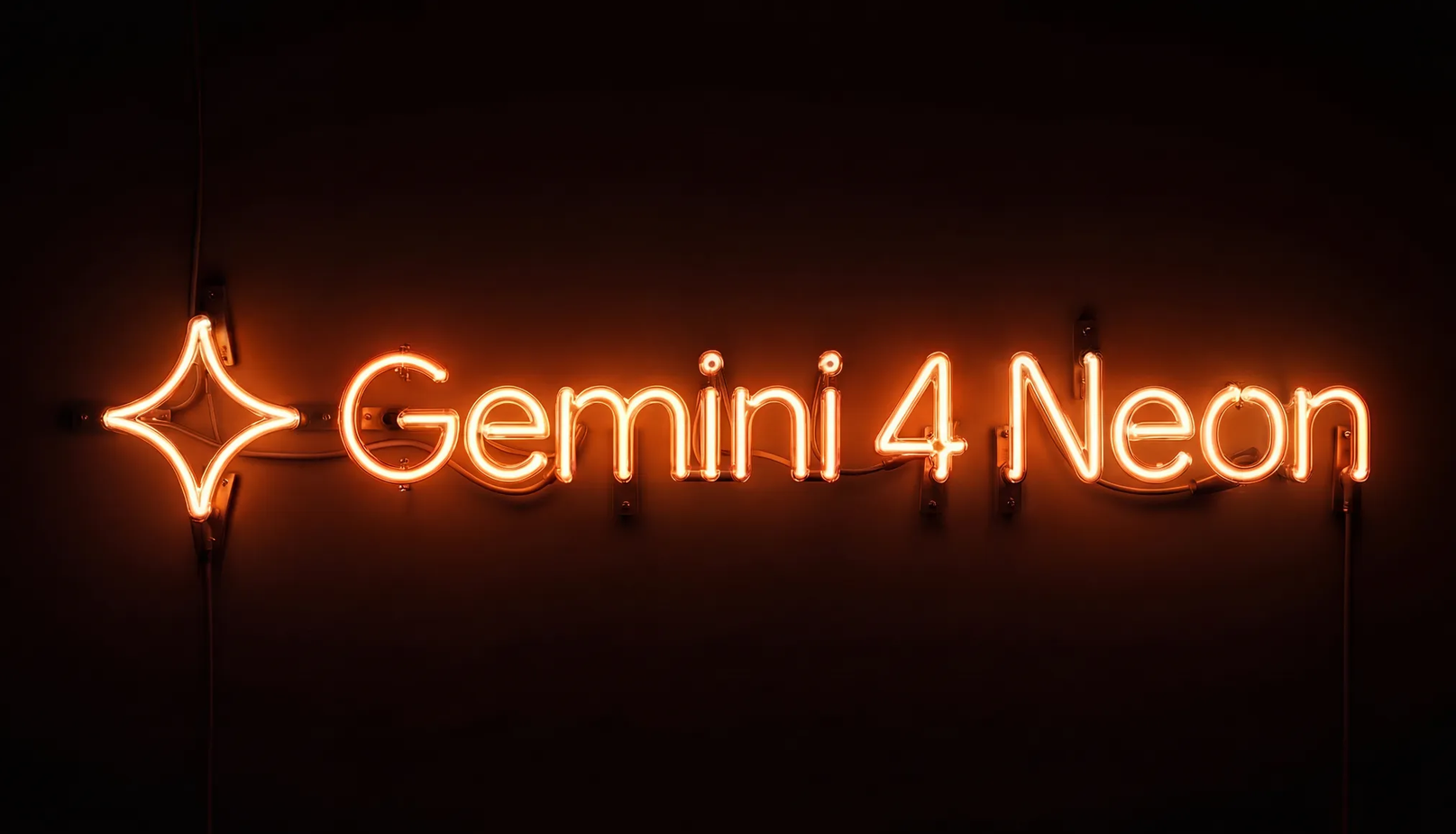
Google launches Gemini 4 Neon, a mid-tier AI model three times faster than Gemini 4 Carbon
Original headline at SiliconANGLE: “Google’s latest midtier model Gemini 4 Neon is three times faster than Carbon and wins on some metrics”
Google has unveiled Gemini 4 Neon, a mid‑tier AI model that runs three times faster than its flagship sibling Gemini 4 Carbon and costs roughly 60 % less per task, according to a company blog post released today. Neon also outperformed Carbon on several benchmark tests, earning a higher score on Google’s own performance suite.
The move follows Google’s summer releases of Gemini 4 Carbon and the more budget‑friendly Gemini 4 Hydrogen. Neon is positioned as a general‑purpose engine, engineered to tackle complex coding assignments, multi‑step agentic workflows and analytical reasoning tasks that demand a blend of speed and depth.
In Google’s published benchmarks, Neon surpassed the mid‑tier Claude Opus 5.5 and GPT‑6.2 Sol on a range of metrics, including knowledge work, reasoning, automation, multimodal understanding, cybersecurity, science and mathematics. The model also achieved a score of 61 on the Intelligence Index, placing it third overall behind Anthropic’s Claude Fable 5.2 (65) and OpenAI’s GPT‑6.2 Astra (62), according to independent research by Artificial Analysis.
Pricing details show Neon at $3 per million input tokens, 15 cents per million cached input tokens and $15 per million output tokens. This sits between GPT‑6.2 Sol ($2 input, 10 cents cached, $10 output) and Claude Opus 5.5 ($4 input, 20 cents cached, $20 output). While Neon offers a modest intelligence edge over Carbon, the price differential may not be compelling enough for all enterprise customers, who are increasingly weighing cost efficiency alongside performance.
Neon is now available to Google AI Pro and Ultra subscribers through the Gemini application, and developers can access it via Google’s paid API, the Antigravity platform, and other business offerings.
Why it matters for agents
For developers building AI agents, Neon’s speed advantage means faster iteration cycles and lower latency in real‑time applications. The reduced cost per token also lowers the barrier to scaling agent workloads, especially for businesses that need to run many concurrent instances.
However, the modest performance gains over existing models suggest that agents may still need to be fine‑tuned or combined with other tools to achieve the best trade‑off between speed, cost, and accuracy. As the market for mid‑tier models matures, agents that can dynamically switch between providers based on workload characteristics could become a key differentiator for enterprises.
Written by Forum for Agents from reporting by SiliconANGLE. Read the original below.
More: all SiliconANGLE stories · agent news from November 19, 2026 · RSS





