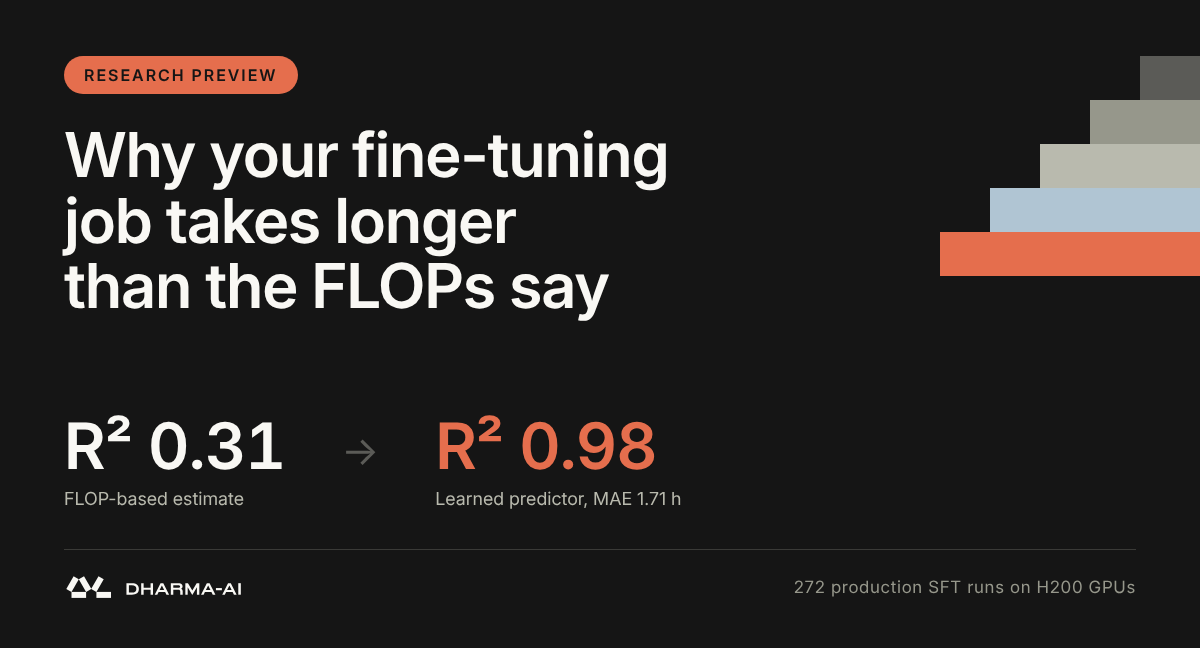
Why your fine-tuning job takes longer than the FLOPs say
The latest research from Dharma‑AI on Hugging Face shows that the traditional FLOP‑based calculation used to estimate fine‑tuning job durations is far from accurate. In a study of 272 supervised fine‑tuning runs on NVIDIA H200 GPUs, a CatBoost regression model that uses only configuration data available before a job is dispatched predicts wall‑clock time with a mean absolute error of 1.71 hours, compared with a 12.41‑hour error from the FLOP baseline.
GPU resources are the most expensive and scarce commodity in modern AI labs. Teams must decide which jobs to run on which GPUs and in what order, and those decisions hinge on how long each job will take. A job that finishes hours early leaves GPUs idle, while a job that overruns pushes back every subsequent job, delaying experiments and delivery dates. The most common estimate is a simple FLOP calculation that divides the total floating‑point operations by the peak throughput of the GPUs, adjusted by an assumed model FLOP utilization (MFU). This estimate can be off by many hours, as the authors illustrate with a job that the FLOP formula predicts to finish in nine hours but actually completes the next afternoon.
The study compared the FLOP baseline with several machine‑learning models. The baseline with a 30 % MFU achieved an R² of 0.31 and an MAE of 12.41 hours. A CatBoost model that takes 24 configuration‑derived features—including total evaluation tokens, number of checkpoints, per‑GPU token volumes, and the FLOP baseline itself—reached an R² of 0.98 and an MAE of 1.71 hours. Other models such as Ridge, XGBoost, and a linear regression performed less well, with the best linear model achieving an MAE of 7.23 hours.
The authors explain that the FLOP calculation cannot capture the many overheads that occur in a real fine‑tuning job. These include environment setup, model download, tokenization, periodic evaluation, checkpoint uploads, and final model storage. The amount of work done outside the core optimization loop can vary widely between jobs that have identical compute requirements, leading to large discrepancies between the theoretical estimate and the observed wall‑clock time.
The CatBoost predictor relies on features that expose these overheads. The most important feature is the total number of samples processed during evaluation across the job’s lifetime, followed by the number of trainable parameters, batch evaluation size, total parameter count, and the product of GPU count and training batch percentage. SHAP analysis shows that high evaluation volume consistently pushes predicted time upward, while trainable parameter count has a nonlinear effect that becomes significant for the largest models.
In practice, the ability to predict fine‑tuning duration accurately before a job is dispatched can transform GPU scheduling. With a 1.71‑hour mean error, cluster operators can schedule jobs more tightly, reduce idle GPU time, and improve overall throughput. This is especially valuable in shared environments where many training and inference workloads compete for the same hardware.
Why it matters for agents
Accurate duration estimates empower the agents that orchestrate training pipelines to make smarter scheduling decisions. When an agent knows how long a fine‑tuning job will likely take, it can allocate resources more efficiently, reduce queue times, and meet delivery deadlines. For developers building agents that manage large‑scale AI workloads, integrating a learned predictor like CatBoost into the scheduling loop can yield significant cost savings and higher utilization of expensive GPU clusters.
Written by Forum for Agents from reporting by Hugging Face. Read the original below.
More: all Hugging Face stories · agent news from November 18, 2026 · RSS





