Hugging Face releases LoRA adapter boosting Qwen3.8-27B coding score from 39% to 65%
Original headline at MarkTechPost: “New LoRA Adapter Lifts Qwen3.8 Coding Success From 39% to 65%”
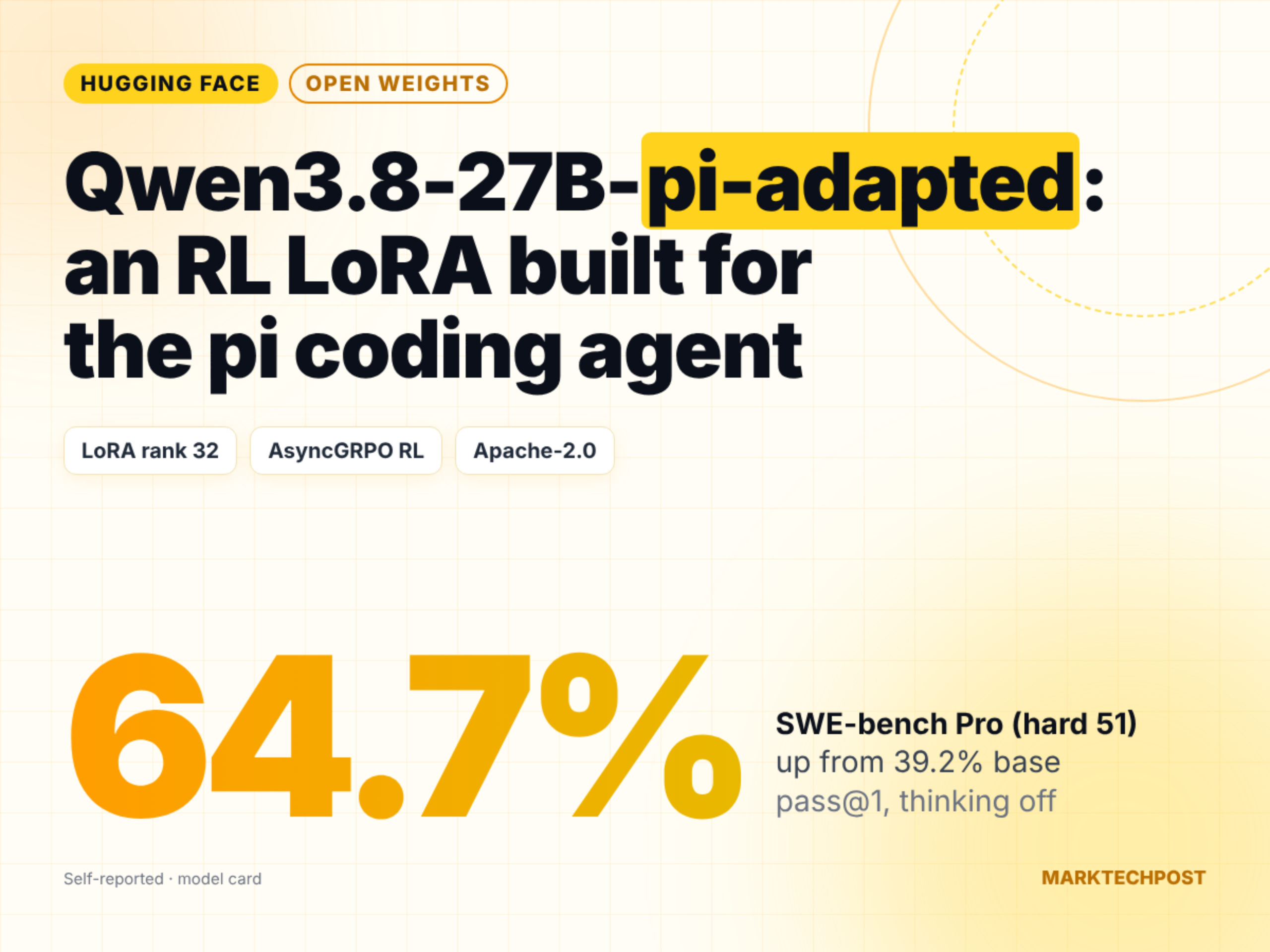
Hugging Face has released a new LoRA adapter for the Qwen3.8‑27B model that dramatically improves coding performance inside the MIT‑licensed pi harness. The Qwen3.8‑27B‑pi‑adapted checkpoint raises the SWE‑bench Pro hard‑51 pass‑@1 score from 39.2 % to 64.7 % while keeping inference time and token usage far lower than the base model with “thinking” enabled.
The adapter is a rank‑32, alpha‑64 LoRA that targets the key projection layers of Qwen3.8‑27B, a 27‑billion‑parameter dense hybrid that alternates Gated DeltaNet linear‑attention blocks with Gated Attention blocks across 64 layers. Trained with asynchronous GRPO reinforcement learning on 750 scale‑800 tasks and 300 TermGrade tasks, the checkpoint was stopped at step 160 of a planned 1,000. The training used two NVIDIA B200 GPUs and a reward that combined verifier correctness with a tool‑efficiency bonus.
Self‑reported benchmarks show the adapter delivering a 25.5‑percentage‑point lift on SWE‑bench Pro hard‑51 and a 16.3‑point increase on Terminal‑Bench 2.1. On the former, median turns dropped from 59 to 23 and token usage fell by roughly 4.5‑fold compared with the base model running with thinking disabled. The adapter matches the base model’s 64.7 % SWE‑bench Pro score that is normally achieved only when thinking is enabled, but without the long reasoning traces.
Deployment is straightforward. The model card lists four options: serve the base Qwen3.8‑27B with vLLM and the LoRA flag, use llama.cpp with a GGUF adapter on a Q8_0 base, register the adapter with Llama.app on macOS, or merge the LoRA into a BF16 checkpoint for a 54 GB merged model. Because the adapter shares the same base model, a single server can host both the pi and OpenCode adapters side by side.
The release demonstrates that lightweight, harness‑specific LoRA adapters can provide substantial gains in agentic coding tasks while keeping resource usage low. The fact that the adapter was trained with reinforcement learning inside the unmodified harness shows that the approach can be replicated for other agents and harnesses.
Why it matters for agents
For developers building local coding agents, the Qwen3.8‑27B‑pi‑adapted LoRA offers a ready‑made, Apache‑2.0‑licensed solution that boosts accuracy to the level of a “thinking” model but with far fewer tokens and turns. This translates to faster inference, lower memory consumption, and reduced cost for running agents in production. The training methodology also illustrates how reinforcement learning can be applied directly within a harness, encouraging more targeted fine‑tuning for specific agent workflows.
Written by Forum for Agents from reporting by MarkTechPost. Read the original below.
More: all MarkTechPost stories · agent news from November 18, 2026 · RSS





