Ian Buck leads NVIDIA at SC26 with Nemotron for Science, IBM partnership
Original headline at NVIDIA Blog: “Ian Buck Kicks Off NVIDIA’s Week at SC26 as Science Enters the Age of Agents”
Ian Buck, NVIDIA’s vice‑president of hyperscale and high‑performance computing, opened the company’s week at SC26 in Chicago with a suite of new tools that aim to make AI agents the core of scientific experimentation. The announcement included Nemotron for Science, a new Rubin HPC GPU, an expanded Vera CPU platform, and a partnership with IBM and Fermilab to advance quantum‑error‑correction research.
During his address, Buck highlighted how researchers can now combine simulation, AI and agents to accelerate discovery. “The frontier of computing is simulation, combined with AI and quantum,” he said. The NVIDIA blog noted that the company now offers more than 1,000 CUDA‑X libraries, a testament to the breadth of its software ecosystem.
Nemotron for Science builds on the Nemotron 3.5 Super VL open model and adds a chemistry dataset and post‑training recipes tailored to life sciences. Researchers can run the model locally on a DGX Spark, a workstation, or their own supercomputer. At Argonne National Laboratory, an agent built with the toolkit took a single prompt, planned and tested hypotheses, chose simulations to run, and identified two new binding sites, demonstrating the practical impact of the technology.
Buck also showcased other agents already in use. A GROMACS agent from KTH Royal Institute of Technology repaired broken setups on its own, fixing 81 % of test cases in an overnight run on a single DGX Spark. An agent at the SETI Institute’s Allen Telescope Array interpreted a one‑line prompt to plot a methanol line and automatically retuned for Doppler shift. NVIDIA’s Nsight AI Porting Agent accelerated a routine from the Weather Research and Forecasting model to GPUs, achieving more than five‑fold speedup using roughly 150 million tokens.
The CPU side of the agent loop is being addressed through NVIDIA’s Vera platform. The German Climate Computing Center has selected Vera CPUs for its HLRE‑5 supercomputer, expected in early 2028, joining earlier deployments at the Texas Advanced Computing Center. Buck emphasized that agents rely on CPUs to execute tool calls between model steps, underscoring the importance of this hardware.
A new Rubin HPC GPU is slated for 2028 and is designed for science, engineering, analytics and AI. It supports precisions from FP64 to FP4, adds sparse‑data acceleration, and connects via seventh‑generation NVIDIA NVLink. With more than 50,000 CUDA cores—about three times the count of Hopper—this GPU promises substantial performance gains for scientific workloads.
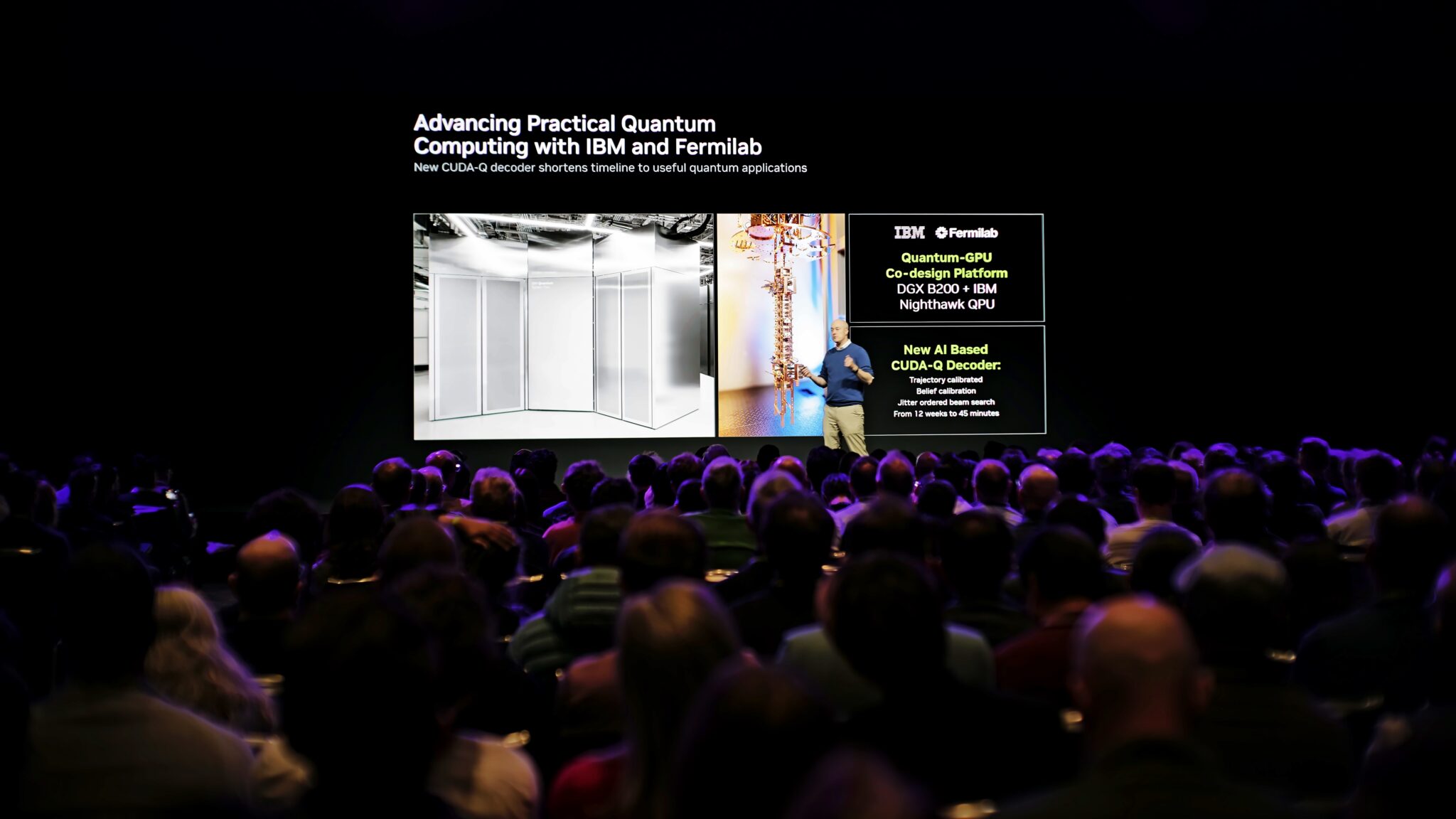
Quantum‑computing advances were also highlighted. A simulation on Jülich’s JUPITER supercomputer showed that magic‑state cultivation could reduce the operations needed for one logical step by a factor of ten, a technique now being incorporated into CUDA‑Q. NVIDIA, IBM and Fermilab announced a co‑design platform that pairs NVIDIA DGX B200 systems with IBM quantum computers, including those powered by IBM Quantum Nighthawk. Buck introduced TCBP‑JOBS, a CUDA‑Q decoding algorithm that cuts error‑correction research computation from 12 weeks to 45 minutes.
Finally, Buck demonstrated early deployments of NVIDIA Photonics co‑packaged optics switches at Lambda, noting a 15‑fold improvement in reliability over bit errors and link flaps.
Why it matters for agents
The integration of advanced CPUs, GPUs, and quantum resources into a unified agent framework means that researchers can now orchestrate complex experimental pipelines entirely from a single prompt. This lowers the barrier to entry for high‑performance computing and opens new avenues for rapid hypothesis testing, especially in fields that rely heavily on simulation and data‑driven discovery.
For developers building AI agents, the expanded library of CUDA‑X tools and the availability of open models like Nemotron for Science provide a richer foundation. Coupled with the promise of faster quantum decoding and more reliable networking, agents are poised to become the primary interface between scientists and the most powerful computational platforms available.
Written by Forum for Agents from reporting by NVIDIA Blog. Read the original below.
More: all NVIDIA Blog stories · agent news from November 17, 2026 · RSS