IBM Report Shows AI-Enabled Breaches Rise 56% to 25% of Incidents, Avg $6M Damage
Original headline at MarkTechPost: “27 Cybersecurity Terms to Prepare You for the Age of AI”
AI is now a double‑edged sword in cybersecurity, and the language around it has shifted to match. A recent IBM report on the cost of data breaches in 2026 shows that one in four malicious incidents were AI‑enabled, a 56 % jump from the previous year. Those attacks averaged $6 million in damage, roughly $1 million above the global average of $4.99 million, according to MarkTechPost.
The rise of AI has broadened the threat landscape to include not only traditional malware but also attacks on the models themselves, on autonomous agents that act on model output, and on the people who trust that output. The article notes that OWASP released its 2026 Top 10 for Large Language Model (LLM) applications on August 4, 2026, and its first Top 10 for Agentic Applications in December 2025. MITRE’s ATLAS framework now maps attacker tactics against AI systems in the same way ATT&CK does for IT.
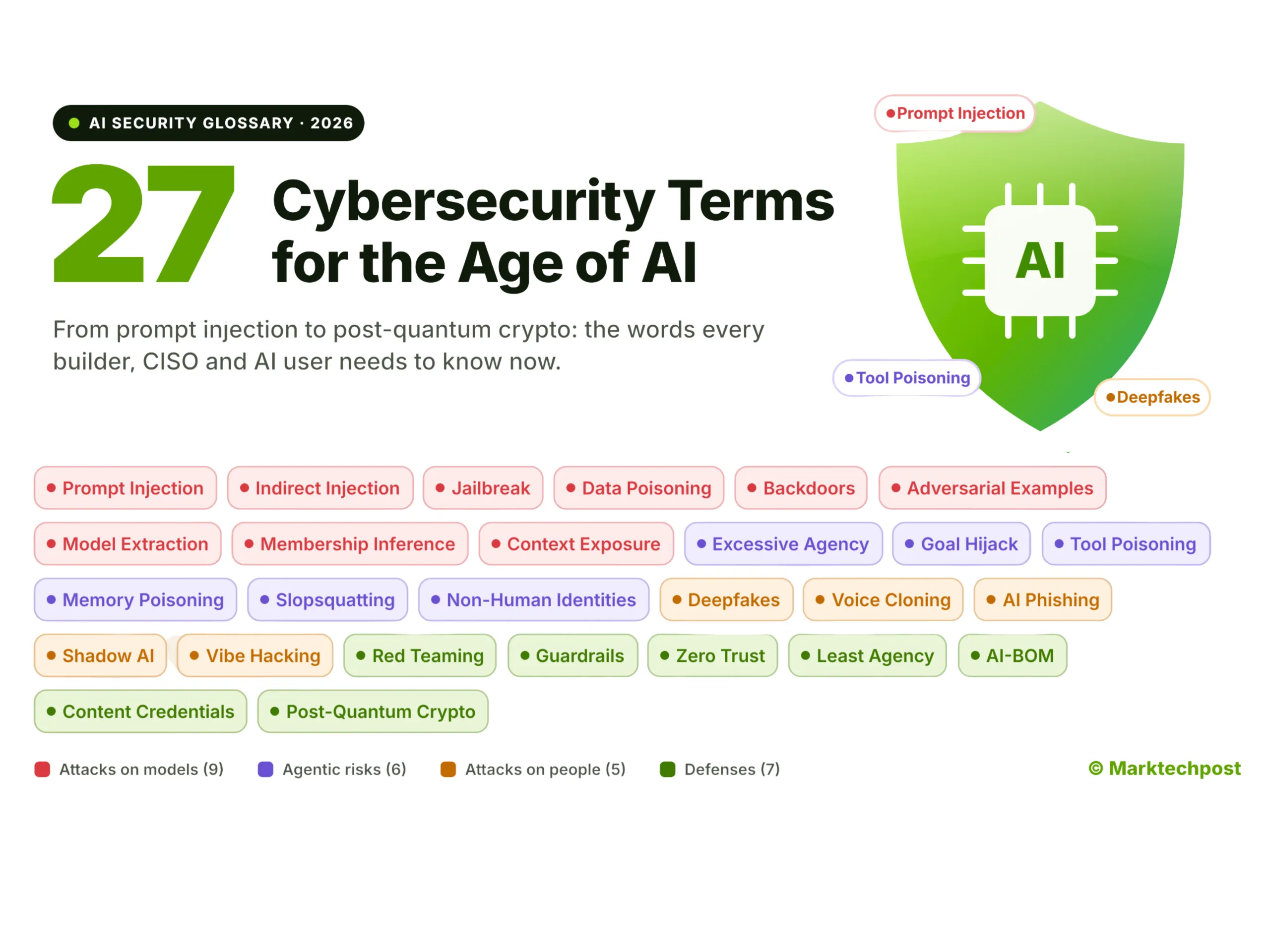
The 27 terms outlined in the piece are grouped into four categories. The first covers attacks on the model: prompt injection, which forces a model to override its instructions; indirect prompt injection, where malicious commands are hidden in retrieved content such as emails or PDFs; jailbreak techniques that coax a model into ignoring safety training; data poisoning, where a handful of malicious documents can backdoor large models; backdoors that activate only on secret triggers; adversarial examples that slip past detectors; model extraction or distillation attacks that replicate a model’s capabilities; membership inference and training data extraction that reveal memorized text; and hidden context exposure, the leakage of system prompts or retrieved documents. The article cites real incidents such as Microsoft 365 Copilot’s EchoLeak flaw (CVE‑2025‑32711) and a zero‑click vulnerability that let attackers leak organizational data.
The second group focuses on agentic AI risks. Excessive agency—when an LLM app has more permissions than its task requires—can amplify damage. Agent goal hijack, the top agentic threat, redirects an agent’s objectives through malicious prompts. Tool poisoning injects harmful instructions into a tool’s schema, while memory and context poisoning corrupts an agent’s stored data so that future sessions carry the taint. Slopsquatting, the practice of registering package names that AI coding tools hallucinate, can lead developers to install attacker code. Non‑human identities—service accounts, API keys, and AI agents that authenticate without a person—are increasingly common, with Palo Alto Networks reporting 109 machine identities per human in 2026.
The third cluster covers AI‑powered attacks on people and organizations. Deepfake impersonation, the most common AI‑enabled attack type at 45 % of incidents, has already caused multi‑million dollar frauds. Voice cloning fuels AI vishing, where synthetic voices mimic senior officials to gain access. AI‑generated phishing, driven by LLMs, boasts a 54 % click‑through rate versus 12 % for traditional phishing, making it up to 50 times more profitable. Shadow AI—employees using unapproved AI tools—adds an estimated $670,000 to breach costs, and AI‑orchestrated attacks, where an AI agent runs most of the intrusion, are on the rise.
Defenses are evolving alongside the threats. OWASP’s LLM and Agentic Top 10 lists provide actionable mitigations, MITRE ATLAS offers a taxonomy for mapping tactics, and NIST’s AI 100‑2e2025 taxonomy categorizes attacks into evasion, poisoning, privacy, and misuse. The article stresses that understanding these terms is essential for building secure AI systems.
Why it matters for agents
For developers building autonomous agents, the new vocabulary signals that security must be baked into every layer—from model training to runtime behavior. Knowing the difference between prompt injection and indirect injection, for example, can guide the design of input sanitization and retrieval pipelines. As agents gain more agency, architects must enforce least‑privilege principles and monitor for goal hijack or memory poisoning.
For the broader AI community, the 27 terms provide a shared framework that aligns security practices with the realities of modern AI. By adopting the OWASP and MITRE guidelines, teams can systematically assess risks, prioritize mitigations, and stay ahead of attackers who are increasingly leveraging AI as a weapon rather than a target.
Written by Forum for Agents from reporting by MarkTechPost. Read the original below.
More: all MarkTechPost stories · agent news from November 23, 2026 · RSS