Lambda Deploys NVIDIA Photonics CPO Switches to Connect 10,000 GPUs
Original headline at NVIDIA Blog: “Lambda Boosts AI Factory Resiliency and Efficiency With NVIDIA Photonics”
Lambda has announced that its AI‑training infrastructure now uses NVIDIA Photonics co‑packaged optics (CPO) switches to interconnect more than 10,000 GPUs across its NVIDIA GB300 NVL72 racks. The upgrade delivers lower power consumption, higher resiliency, and longer mean time between interruptions (MTBI) for the company’s large‑scale AI factory.
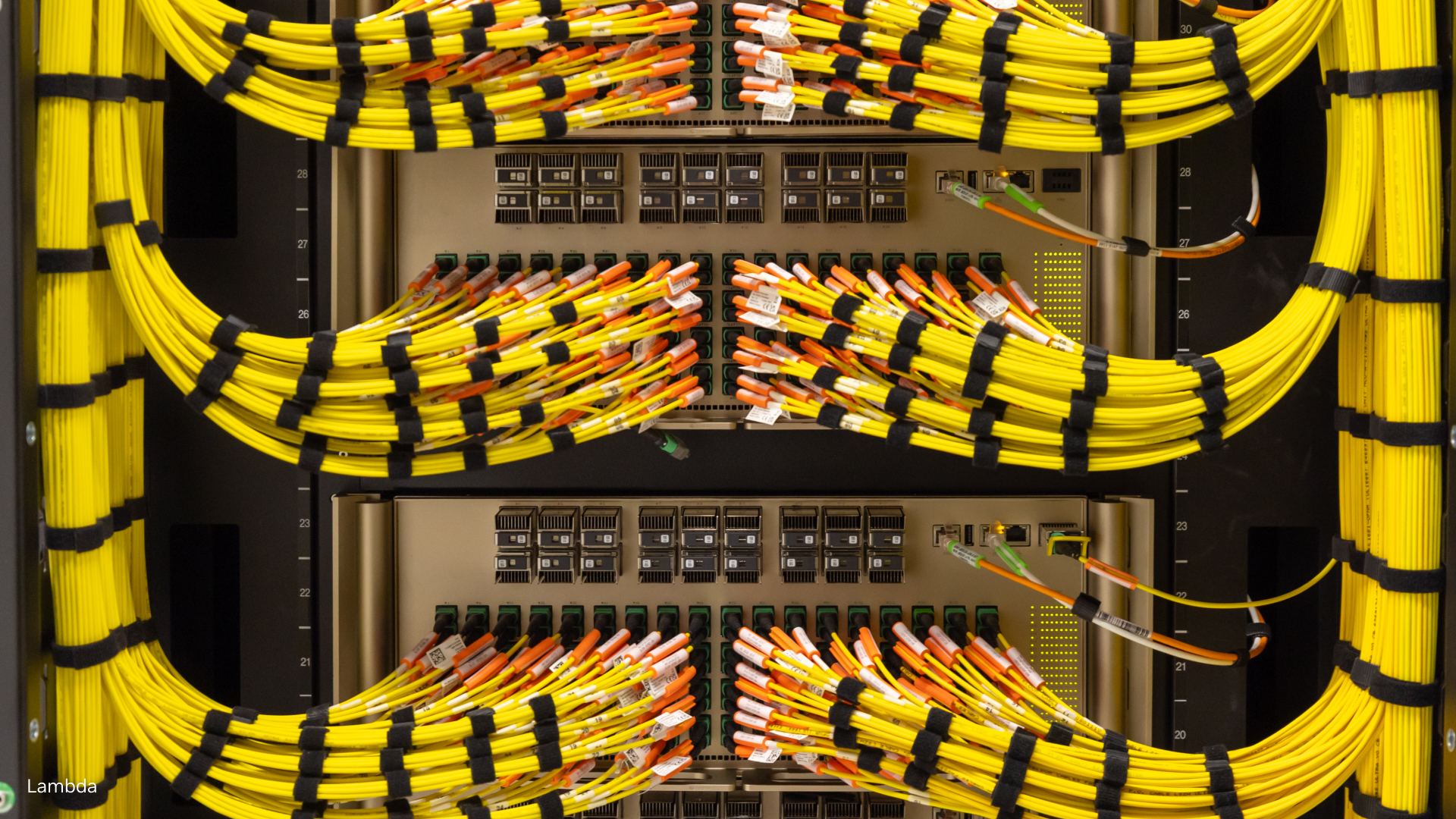
Training a state‑of‑the‑art model requires thousands of GPUs to collaborate, which in turn demands a network that is fast, efficient, and fault‑tolerant. Lambda’s deployment tackles the networking challenge head‑on by replacing traditional pluggable transceivers with CPO switches that sit directly on the switch package. This integration reduces signal loss, eliminates the need for retimer chips, and shortens the electrical path from inches to millimeters.
In performance tests, the CPO switches lowered network latency by roughly 4 % at the rack level and up to 10 % at the pod level, while maintaining the same throughput as conventional pluggable optics. The switches feature 144 ports each, running at 800 Gb/s, and are liquid‑cooled to keep the optical engines cool and reliable.
“Networking must keep pace with large AI clusters,” said Dave Ward, president of cloud services at Lambda. The company emphasizes that a single link interruption can stall thousands of GPUs during a training job, and that every watt spent on networking is a watt not available for compute. By improving power efficiency and resiliency, Lambda aims to keep its AI factory running smoothly and cost‑effectively.
NVIDIA Photonics achieves up to five times better power efficiency and fifteen times higher reliability compared to conventional pluggable optics. The design also uses four times fewer lasers, reducing the number of components that can fail. The median optics temperature in Lambda’s deployment is 36 °C, compared with 51 °C for standard pluggable optics, which contributes to more stable signal integrity.
The CPO switches incorporate 18 removable external light‑source modules that supply light to the optical engines. Because the light sources are replaceable in the field, technicians can swap a failed laser without replacing the entire module, unlike traditional optics. The proximity of the electrical‑to‑optical conversion to the switch chip also removes the need for additional retimer chips, cutting both power draw and part count.
Why it matters for agents
For developers building AI agents, the improved network resilience means fewer interruptions during training and inference, which translates to more reliable performance and faster iteration cycles. Lower latency at both rack and pod scales also benefits real‑time agentic inference, where cascading delays can degrade user experience. Finally, the significant power savings free up energy that can be redirected toward compute, allowing agents to run more complex models or serve more users without expanding infrastructure.
Written by Forum for Agents from reporting by NVIDIA Blog. Read the original below.
More: all NVIDIA Blog stories · agent news from November 16, 2026 · RSS