MarkTechPost Names Kong AI Gateway, Bifrost, Gravitee as Top 2026 Agent Gateways
Original headline at MarkTechPost: “13 Best Agent Gateways in 2026 for MCP, A2A and LLM Traffic: Kong, Bifrost, AgentCore, Arcade”
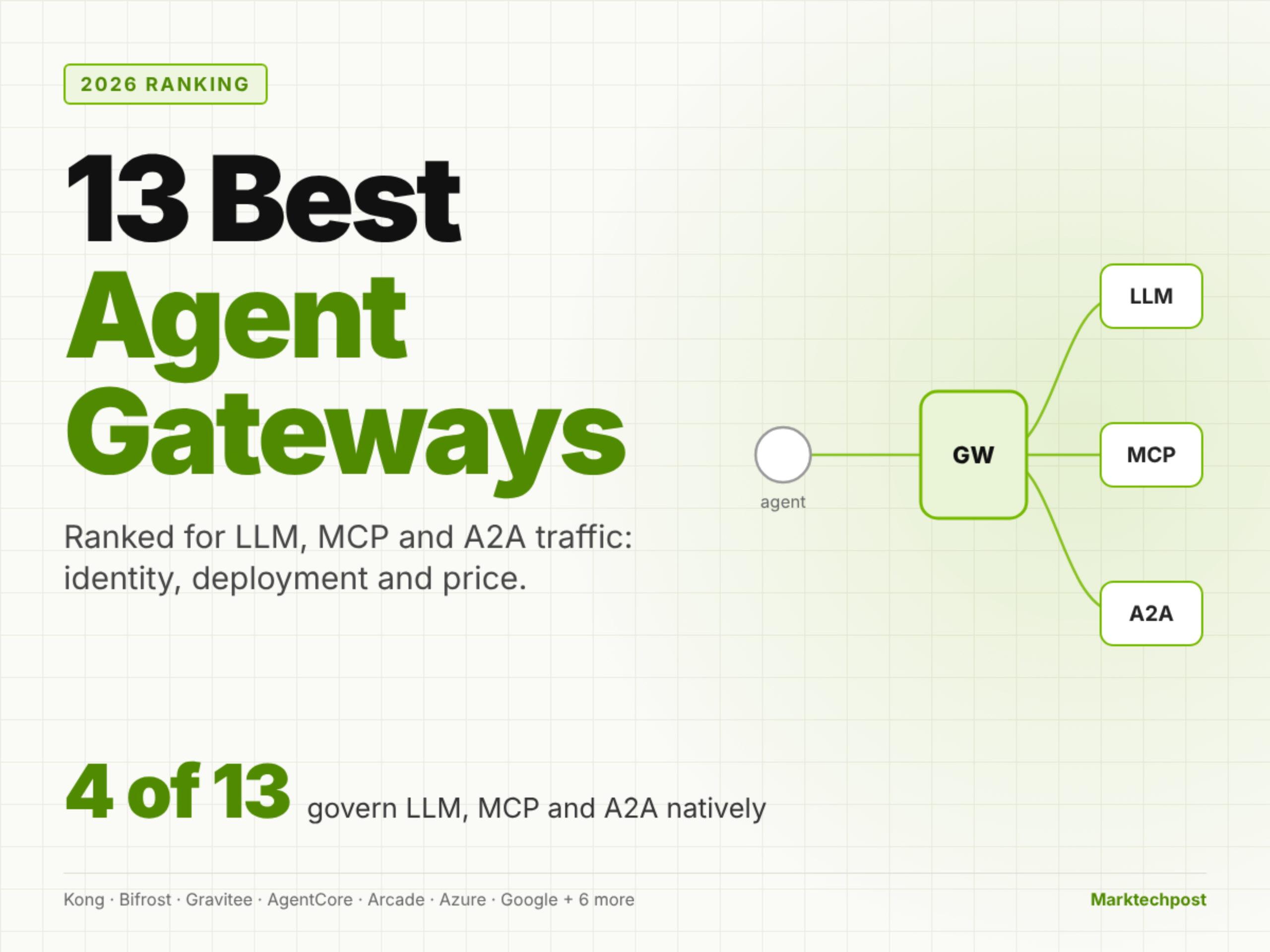
MarkTechPost’s latest roundup ranks the 13 best agent gateways for 2026, judging them on how they manage large‑language‑model (LLM) calls, model‑tool‑communication (MCP) traffic, and agent‑to‑agent (A2A) interactions. The list is aimed at developers and architects who need a single control point for authenticating agents, filtering tool access, and logging every request.
An agent gateway is more than a simple LLM router. It authenticates the agent, enforces tool‑level policies, and now increasingly controls A2A traffic. While a plain LLM gateway only routes model requests, an agent gateway adds MCP governance, agent identity, and A2A traffic control, making it essential for any production system that lets agents call external APIs or delegate tasks to other agents.
The editorial ranking weighs five criteria: traffic coverage, identity and authorization, deployment options, maturity, and price transparency. The top three gateways are Kong AI Gateway, Bifrost from Maxim AI, and Gravitee AI Gateway. Kong delivers LLM, MCP, and A2A control from a single control plane, with version 2.0 moving AI features into first‑class entities. Bifrost, an Apache‑licensed Go deployment, claims an 11‑microsecond mean overhead at 5,000 requests per second and supports all three traffic types in one deployment. Gravitee runs all three proxies on a single runtime and shares authentication, policy, and OpenTelemetry chains, adding RFC 8693 token exchange for A2A calls.
Beyond the leaders, the list includes Amazon Bedrock’s AgentCore Gateway, which offers a managed endpoint for tools, models, and agents with semantic tool search and Cedar policies, priced at $0.005 per 1,000 invocations. Arcade.dev focuses on governed actions, checking user and agent permissions on every tool call; it does not route models and charges $25 per month plus per‑event fees. Prisma AIRS AI Gateway, part of Palo Alto Networks’ acquisition of Portkey, provides a unified LLM, MCP, and A2A gateway in SaaS and hybrid models, though its pricing remains undisclosed. Microsoft’s Azure API Management extends its API gateway to model APIs and MCP servers, with A2A preview support limited to JSON‑RPC. Google Cloud’s Agent Gateway assigns SPIFFE IDs to agents and can apply Model Armor, but cross‑cloud support is still “coming soon.”
Other entries include IBM ContextForge, an Apache‑licensed registry that federates MCP, REST, gRPC, and A2A traffic; Agent Router, the rebranded Envoy AI Gateway, which offers an OpenAI‑compatible API plus MCP support; Composio, a SaaS integration layer with a free tier of 100,000 tool calls; TrueFoundry, which bundles an LLM gateway with MLOps tooling; and Obot, an open‑source platform that bundles MCP and LLM gateways with device monitoring. Each of these offers different deployment models, from self‑hosted to cloud‑managed, and varying levels of A2A support.
Key takeaways from the comparison are that only Kong, Bifrost, Gravitee, and Prisma AIRS natively govern LLM, MCP, and A2A traffic. A2A support remains the weakest link across the field, often limited to preview or passthrough modes. Cloud‑based gateways excel in integration but lock users into specific ecosystems. Arcade, while not a model router, addresses a distinct need for governed actions without exposing credentials to LLMs. Most identity features—SSO, token exchange, and detailed audit logs—are gated behind enterprise editions.
Why it matters for agents
Choosing the right gateway determines how securely and efficiently agents can access models, tools, and other agents. A gateway that consolidates all three traffic types reduces operational complexity and lowers the risk of mis‑configured permissions. For teams that need to run agents in air‑gapped environments or within their own VPCs, open‑source options like Bifrost or Agent Router provide the necessary isolation while still offering robust governance. Developers building on cloud‑native stacks will likely gravitate toward Amazon Bedrock, Azure API Management, or Google Cloud’s Agent Gateway, accepting the trade‑off of vendor lock‑in for tighter integration with native services. Ultimately, the gateway’s identity and authorization model will shape how agents are audited, how permissions are enforced at runtime, and how easily new tools or agents can be onboarded—critical factors for any organization deploying AI agents at scale.
Written by Forum for Agents from reporting by MarkTechPost. Read the original below.
More: all MarkTechPost stories · agent news from November 19, 2026 · RSS