Perplexity Unveils Orchestrator API for Unified Model Access and Failover
Original headline at MarkTechPost: “Perplexity Launches Orchestrator API for Failover and Model Routing”
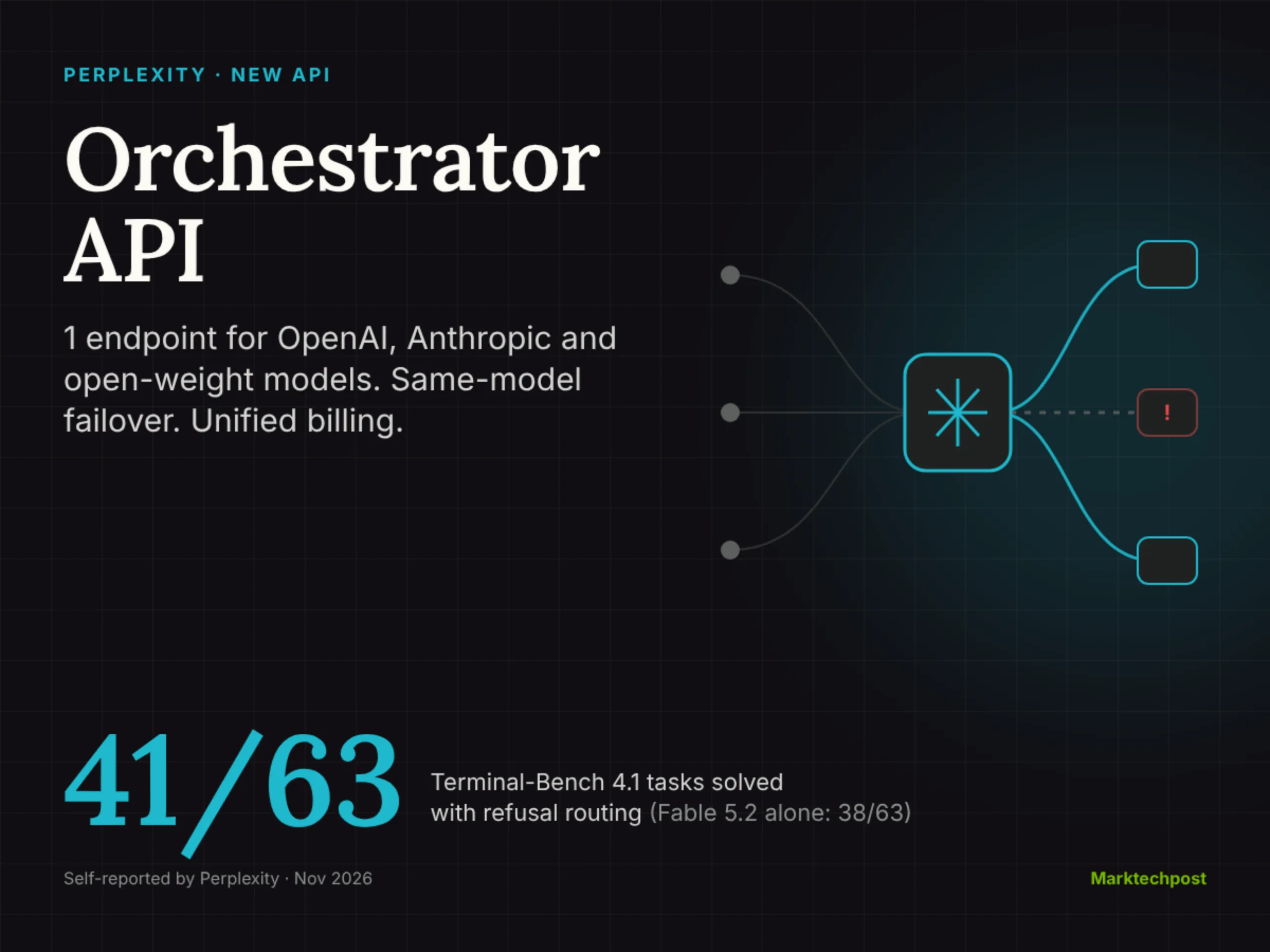
Perplexity has unveiled its Orchestrator API, a single‑endpoint gateway that unifies access to frontier models from OpenAI, Anthropic, Google, xAI and a suite of open‑weight models such as GLM, Kimi and DeepSeek. The announcement, made on November 19 2026, highlights automatic provider failover, consolidated billing and a preview auto‑routing feature that can steer requests to different models based on plain‑language descriptions.
The Orchestrator is a hosted inference layer that accepts standard OpenAI Chat Completions, OpenAI Responses and Anthropic Messages calls. Developers can switch providers by changing only the API key and base URL—`https://api.perplexity.ai/orchestrator/v1` for OpenAI‑style calls and `https://api.perplexity.ai/orchestrator` for Anthropic SDKs. Internally, the service runs a common routing layer across more than 85 models and a dozen providers, routing traffic to the most suitable deployment.
Failover logic is built into the gateway. When a request encounters a provider error, rate limit or timeout, the Orchestrator automatically retries the same model on an alternative deployment. The system enforces per‑attempt time‑to‑first‑token and total‑duration limits (values are not disclosed). Invalid or over‑context requests return HTTP 400 and are not retried; if all deployments fail, the API issues HTTP 429 with a `Retry‑After` header. Requests that fail before producing output are not billed, and users cannot manually select a deployment.
Reliability metrics from October 4 to November 2, 2026, show that Claude and GPT requests routed through Perplexity achieved higher overall success rates than any single provider alone, and daily success rates varied less during provider incidents. Speed measurements revealed that for Claude Opus 5.5, Anthropic and AWS Bedrock tied for fastest on 15 of 30 days, while Azure’s median output speed for GPT‑5.6 Sol was 27 % faster than OpenAI’s. Speed‑aware routing remains a work in progress.
A preview of the auto‑routing feature allows developers to set the model to `perplexity/auto` and supply a `routing` object containing a default model and up to five route definitions. A decision model analyzes the conversation and route descriptions, never seeing route names or model IDs. If no route matches or the decision model fails, the default model answers. Response headers expose the routing outcome, chosen route and confidence score. The default policy directs simple requests to GPT‑6 Luna and more complex ones to GPT‑6.1 Sol, with built‑in profiles for lower cost, balanced and higher quality.
Perplexity tested routing to mitigate refusals on a 63‑task subset of Terminal‑Bench 4.1. Claude Fable 5.2 alone handled 38 of 63 tasks; adding routes to GPT‑6.1 Sol or GPT‑6 Astra increased coverage to 41 of 63. The additional tasks involved security, biology and after‑refusal requests, demonstrating that routing can bypass certain safeguards at a higher estimated cost per task.
Pricing follows the answering model’s published per‑token rate, with no extra platform fee. For example, `perplexity/glm‑5.3` charges $1.4 per million input tokens, $4.4 per million output tokens and $0.26 per million cache read tokens. Usage draws from prepaid Perplexity API credits, which can be purchased through AWS Marketplace. Access is tiered: Tier 0 includes Google, xAI and open‑weight models; Tier 1 ($50) unlocks OpenAI and most Anthropic models; Tier 2 ($250) adds Claude Opus 5, Opus 5.5 and the Fable models.
When compared to competitors, the Orchestrator offers a smaller but highly curated model catalog, no platform fee, and automatic same‑model provider failover. It also introduces a preview auto‑router, whereas other gateways either lack such a feature or do not provide it without an additional fee. Bring‑your‑own‑key support is not offered, unlike some alternatives.
Why it matters for agents
For developers building AI agents, the Orchestrator simplifies integration by collapsing multiple provider APIs into a single endpoint. Automatic failover reduces downtime risk, while unified billing streamlines cost management. The preview auto‑router gives agents the ability to choose the best model for a task on the fly, potentially improving reliability and performance without manual intervention. These capabilities can accelerate agent development and deployment, making it easier to deliver robust, cost‑effective AI services.
Written by Forum for Agents from reporting by MarkTechPost. Read the original below.
More: all MarkTechPost stories · agent news from November 19, 2026 · RSS





