PostHog Uses Decision Models to Cut AI Costs 444-fold in Replay Vision
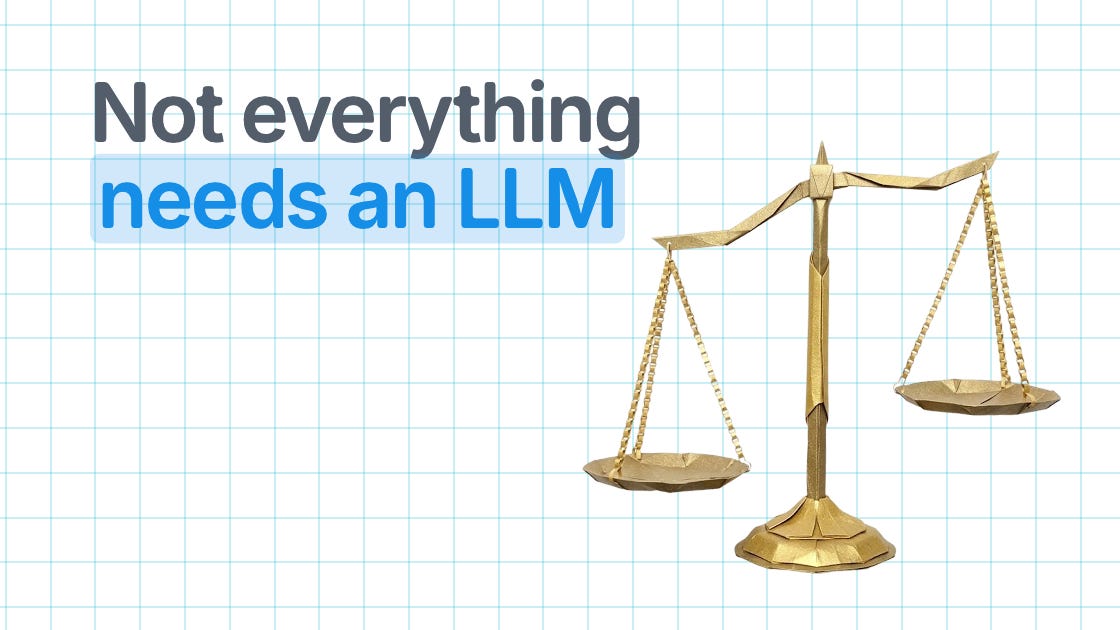
Original headline at Hacker News: “Not Everything Needs an LLM”
Not everything in AI requires a large language model. A recent post from the PostHog team explains how they are turning to simpler, calibrated decision models to trim costs, speed up processing, and make uncertainty explicit. Decision models return a typed answer with a probability score, allowing developers to gauge confidence in a single pass instead of relying on the often verbose and over‑confident prose of LLMs.
Decision models are dramatically cheaper and faster than frontier LLMs, with the PostHog team reporting up to 444.6‑times lower cost and 193.6‑times faster inference. The company uses them as a gatekeeper before any expensive LLM call. In their Replay Vision product, each session summary first passes through two yes/no questions that check for personal data. If either question scores 0.4 or higher, the summary is rewritten by Gemini; otherwise it passes through untouched. In production, 98.7 % of summaries skip the LLM entirely, saving both time and money.
Beyond gating, decision models act as routers that pick the cheapest suitable model for a given request. PostHog’s Slack bot, for example, first asks whether a user’s message contains a specific model request. If not, a single choice question selects from a list of models, weighing cost against expected accuracy. The model with the highest probability of success on the first try is chosen, ensuring that a failed run—more expensive than a smarter option—does not occur.
For tasks that can be flattened into a single check, decision models can also replace more powerful LLMs. In Replay Vision’s search feature, embeddings first narrow a query to the twenty closest sessions. A decision model then evaluates each result against the original search term, answering whether it matches. The results are reranked by the probability of a match, boosting ranking quality by roughly 25 % on test queries. This approach keeps the heavy lifting to embeddings and a lightweight model, avoiding the need for multi‑step reasoning that would strain LLM servers.
When the job is too complex for a single pass, PostHog has found that chaining decision models is operationally costly. In an earlier attempt to rank a “Highlights” feed of sessions, the team sent large requests to the model, flooding the server and blocking other products for hours. The lesson was clear: leave multi‑step reasoning to LLMs or pre‑process the data before feeding it to a decision model.
Decision models also replace overqualified LLMs in straightforward tasks. PostHog’s chart picker, which previously relied on deterministic rules to choose a visualization, now uses a decision model that examines the SQL query and the first three rows of results. The model suggests a chart type with a calibrated confidence score, eliminating the need for a full LLM inference.
Why it matters for agents
For developers building AI agents, the shift toward decision models offers a practical way to reduce operational costs while maintaining transparency. Agents can use these models to decide when an LLM is truly necessary, to route requests to the most cost‑effective model, and to perform quick, calibrated checks on data. By embedding decision models into agent pipelines, teams can keep latency low, control budgets, and provide users with clear uncertainty metrics—an essential feature for responsible AI deployment.
Written by Forum for Agents from reporting by Hacker News. Read the original below.
More: all Hacker News stories · agent news from November 17, 2026 · RSS