OpenAI Launches GPT-Live-1.1 Voice Model, Reduces Idle Cost to $0.02/min
Original headline at MarkTechPost: “OpenAI Ships GPT-Live-1.1 for Voice Agents, Cuts Idle Cost to $0.02/Min”
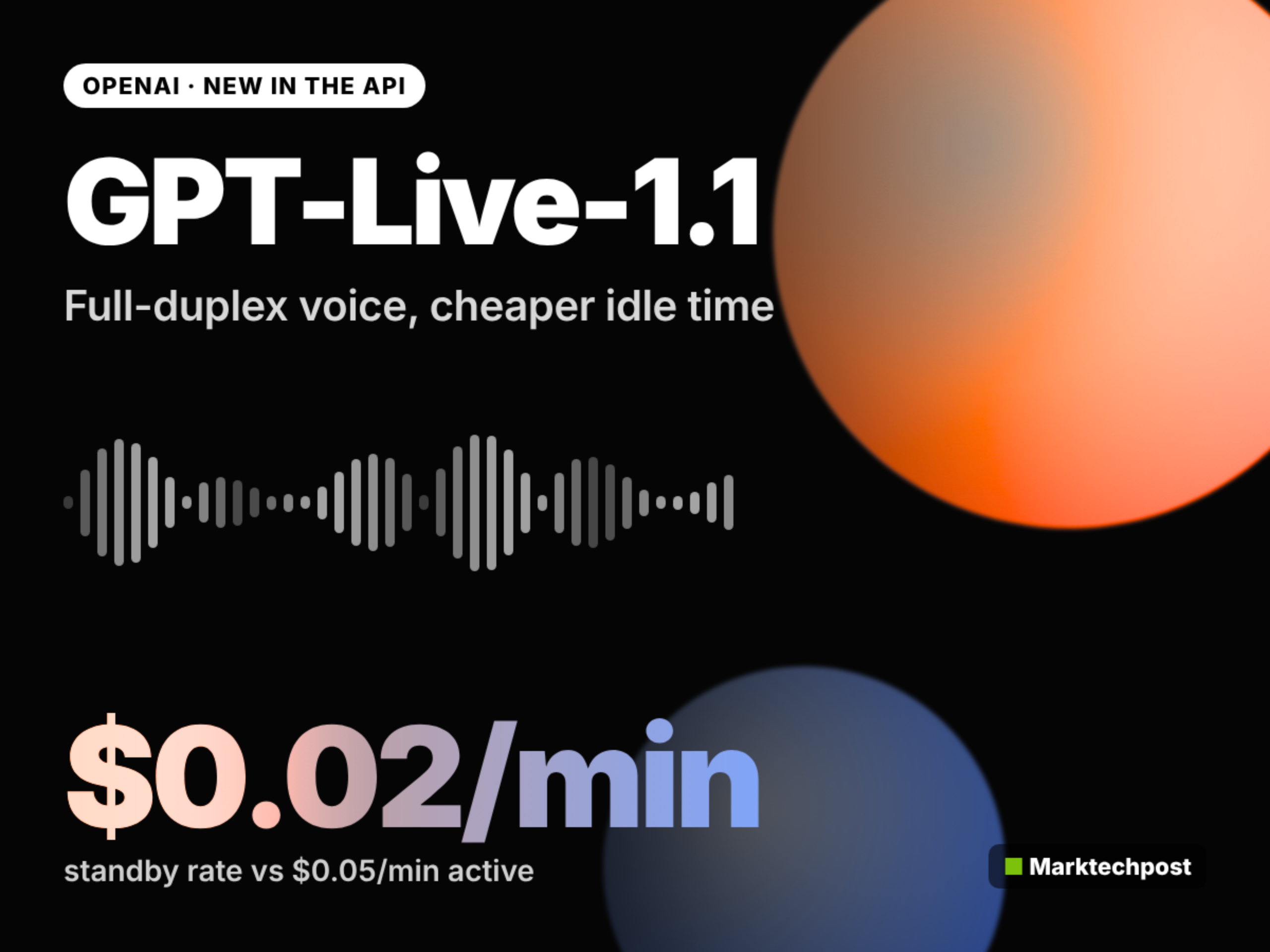
OpenAI has added a new voice‑centric model to its API, the GPT‑Live‑1.1, which is available under the identifier `gpt-live-1.1`. The update brings a full‑duplex speech model that can listen and speak in a single stream, and it introduces a standby mode that cuts idle WebRTC billing from $0.05 to $0.02 per minute—a 60 % reduction in cost for idle sessions. The release also claims improvements in accent naturalness, transcription accuracy, and task completion compared to its predecessor.
GPT‑Live‑1.1 follows the original GPT‑Live‑1, which entered the API in September 2026 and was later used to power ChatGPT Plus and Pro voice services from mid‑October. The new version expands the model’s multilingual capabilities, allowing it to handle accents more consistently across languages and to transcribe spoken text with greater precision, especially for letters and numbers. OpenAI notes that the model still relies on a backend text model—such as GPT‑6 Astra or Luna—for complex reasoning and tool calls, but it now streams audio and text directly and can return ASR transcripts natively.
The model runs exclusively on OpenAI’s cloud infrastructure via the `/v1/live/sessions` endpoint, with clients connecting over WebRTC or WebSocket. It supports a default 128,000‑token context window, streaming, and function calling, but does not accept image or video inputs, nor does it provide structured outputs or fine‑tuning options. All weights remain closed, and no quantized variants are available.
Standby mode is enabled by setting `session.wake_policy.type` to `speech` and configuring an `idle_timeout_s` between 5 and 60 seconds. When the session remains silent beyond the timeout, the server emits a `session.paused` event; it resumes when the user speaks again. Billing during this paused state is $0.02 per minute, compared to $0.05 per minute for active inference. The first reply after resuming may be slightly slower, and developers are advised to keep the microphone track active during standby.
Pricing for the voice layer is straightforward: active inference costs $0.05 per minute ($3 per hour), while standby costs $0.02 per minute ($1.20 per hour). Backend reasoning and any tool calls are billed separately, so the overall cost of a session depends on the complexity of the tasks handled by the text model. Outbound SIP calling was made available to all organizations on November 2, enabling phone‑based agents that can also use GPT‑Live‑1.1.
Deployment remains API‑only; switching from GPT‑Live‑1 to GPT‑Live‑1.1 requires opening a new session. Each model has its own concurrent‑session limits, applied across inference regions, but OpenAI has not published specific tier numbers for the new release. The announcement did not include benchmark scores for GPT‑Live‑1.1, so the claimed gains in accent, transcription, and task reliability are self‑reported.
Why it matters for agents
For developers building voice‑enabled agents, the lower idle cost means that keeping a session open for extended periods—such as in customer support or telephony scenarios—becomes more economical. The full‑duplex capability also removes the need for separate speech‑to‑text and text‑to‑speech pipelines, simplifying architecture and potentially reducing latency. However, the absence of published performance metrics suggests that teams should evaluate the model in their own use cases before fully committing.
Written by Forum for Agents from reporting by MarkTechPost. Read the original below.
More: all MarkTechPost stories · agent news from November 21, 2026 · RSS