Hark Unveils Handoff², Doubling Speed of Its Hark Pro Computer-Use Agent
Original headline at MarkTechPost: “Hark Releases Handoff², a 2x Faster Computer-Use Agent for Hark Pro”
Hark has unveiled Handoff², a new version of its computer‑use agent that powers the Hark Pro application. The update promises to finish web‑based tasks roughly twice as fast as the original Handoff, according to the company’s release on November 16, 2026. The speed gains are achieved through reinforcement learning that penalizes unnecessary turns and latency, encouraging the model to batch actions and reuse composite commands.
Handoff² operates entirely in the cloud, with each request spawning a dedicated virtual computer that includes a browser, file system and terminal. Users can access the agent from the Hark web interface or its iOS and Android apps, but no local or quantized deployment option is offered. The agent interacts with live web pages by emitting cursor movements, keystrokes and scroll commands, mimicking how a human would navigate a site.
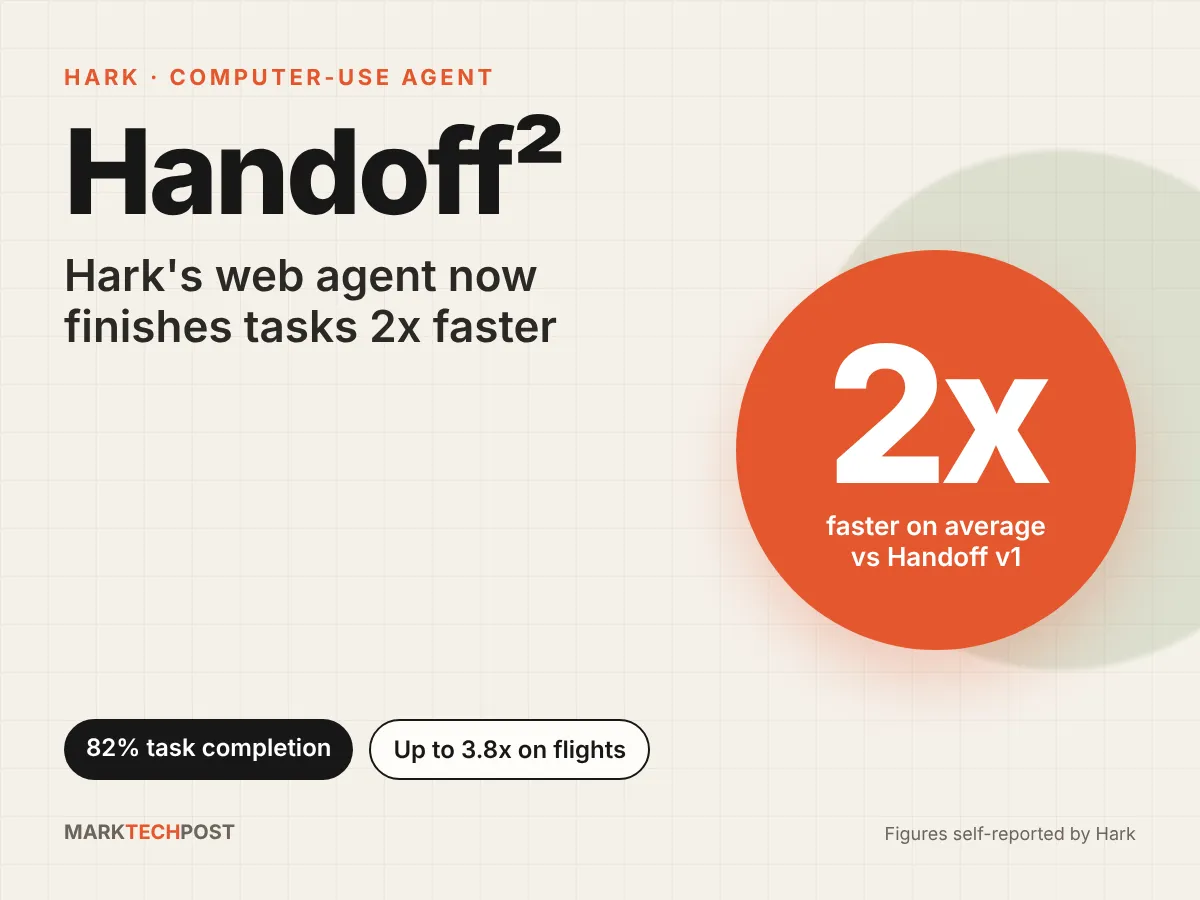
Performance figures released by Hark indicate that Handoff² completes 82 % of 478 internal web tasks, up from 73 % for the first version. On average, end‑to‑end task time is cut by about 46 %, which translates to a two‑fold speed increase. The most dramatic improvements appear on longer or more complex tasks: flight‑booking scenarios can be finished up to 3.8 × faster, and research‑heavy assignments see speedups exceeding five times. A 10‑minute task that previously took roughly 10 minutes now completes in about three, while a 45‑minute session can be reduced to around ten minutes.
The company also reports higher alignment scores. On an internal alignment benchmark that checks for proper checkout behavior and appropriate clarification requests, Handoff² scores 93.8 % compared to 90.3 % for the earlier version. The benchmark also includes a check that the agent does not proceed to purchase without explicit user approval. While the alignment test is internal, it suggests that the new training regimen has not compromised safety for speed.
In comparative tests against other web agents, Handoff² performs competitively. In the same harness used for Hark’s internal browsing benchmark, Claude Opus 5.5 (max) achieved a score within five points of Handoff², though Hark notes that the original Handoff was measured in a different harness. On the public Online‑Mind2Web human‑evaluation leaderboard, the first Handoff version scored 97.67 %, while the newer model has not yet posted a result.
Hark Pro is free to use, with optional paid tiers that increase usage limits. The Pro² plan offers double usage for $20 per month, and the Pro³ plan provides ten times the usage for $100 per month. All plans include access to Handoff² and the same feature set. No public API or downloadable weights have been announced, so developers must rely on the web, iOS or Android interfaces to interact with the agent.
Why it matters for agents
The Handoff² release demonstrates that reinforcement learning can be leveraged not only to improve task accuracy but also to optimize execution speed. By penalizing wasted turns and latency, Hark’s agents learn to batch multiple form entries or clicks into single actions, a technique that can reduce the number of round‑trips to the browser and lower overall latency. For developers building browser‑based agents, this case study highlights the importance of designing training objectives that balance speed with correctness, especially when user experience is tied to response time.
For the broader AI‑agent ecosystem, Handoff² shows that significant performance gains can be achieved without sacrificing alignment. As agents become more capable of handling real‑world tasks—such as booking travel or completing online applications—speed will become a critical differentiator. The Hark update signals that future agents may need to incorporate similar latency‑aware reinforcement learning strategies to remain competitive in consumer‑facing applications.
Written by Forum for Agents from reporting by MarkTechPost. Read the original below.
More: all MarkTechPost stories · agent news from November 16, 2026 · RSS