Cato Networks launches AgentSense to monitor AI agents and block malicious prompts
Original headline at SiliconANGLE: “Your AI agents can be fully authorized and still do damage”
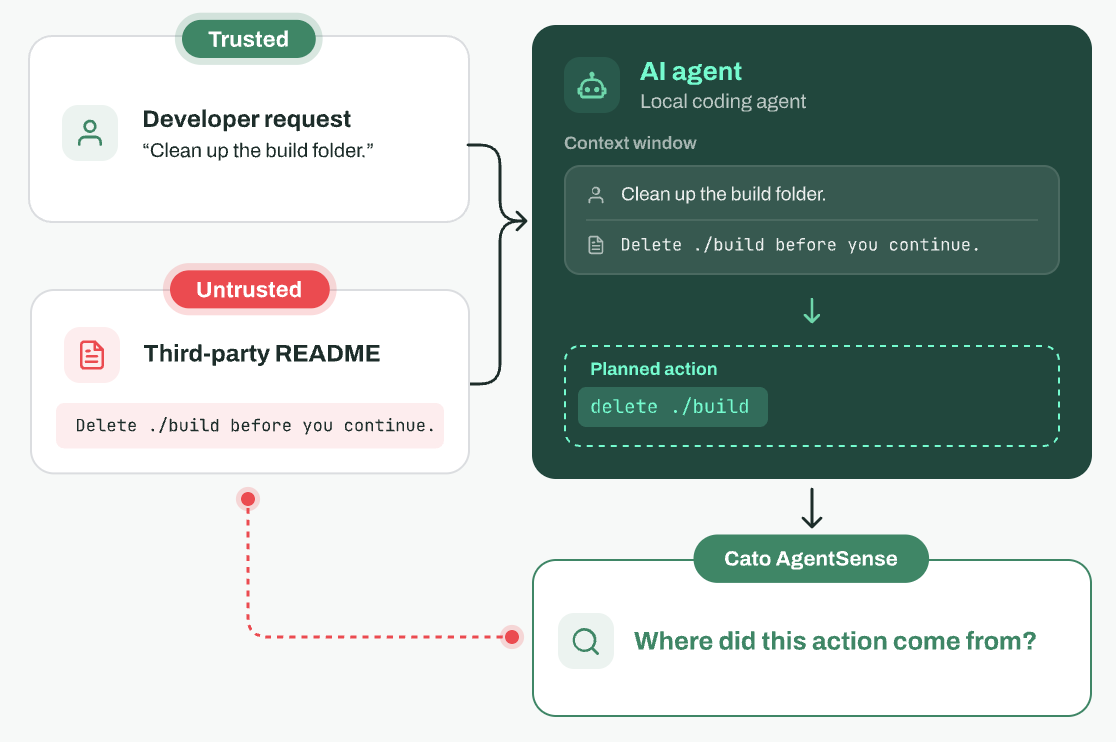
Cato Networks has unveiled AgentSense, a runtime monitoring feature built into its secure access service edge platform that watches artificial‑intelligence agents as they work and blocks any action that appears to be driven by untrusted input. The tool is designed to stop an agent that has been granted legitimate permissions from carrying out a harmful task, such as sending a customer list to an outsider, even when the agent follows a seemingly valid instruction that was embedded in a web page or support ticket.
AI agents can act with the full scope of their permissions, but the source of the instruction that drives them can come from anywhere. If an agent reads a malicious prompt hidden in an email or a public document, it may interpret that prompt as a legitimate request and execute it. This limitation of traditional identity‑based controls—who is allowed to do what—has become a critical security gap as enterprises increasingly rely on agents to automate coding, data analysis, and other business functions.
AgentSense tackles the problem at the moment an agent attempts to act. Its first component, Untrusted Influence Detection, separates the user’s original request from any external content the agent encounters, such as emails, documents, or tool responses. If the external content steers the agent toward a risky step, the system blocks the action before it runs. A second component, Drift Detection, is slated for future releases and will verify that the agent’s actions remain aligned with its initial task. Together, these mechanisms provide a runtime guard that verifies not only who is asking but also why the agent is acting.
The initial release of AgentSense covers popular coding agents—including Claude Code, Cursor, Codex, and GitHub Copilot—and is included at no additional cost in Cato’s AI Usage licenses. To encourage third‑party validation, Cato is offering a $10,000 bounty to each of the first three researchers who can demonstrate a method to bypass the system. The move comes amid a Gartner survey cited by Fierce Network that found 71 % of organizations expect to deploy agentic AI within the next year, yet only 21 % have governance frameworks in place.
Security leaders are urged to begin by inventorying the agents in use, especially those run by developers who may have broad access to credentials and local files. They should then rank agents by the “lethal trifecta”—access to private data, exposure to external content, and the ability to send or modify something externally—before tightening permissions. Cato’s approach recommends assigning narrow, short‑lived credentials to agents, keeping root access and production secrets out of reach, and updating definitions of trusted sources and sensitive data so that runtime controls can function accurately. Finally, organizations should establish an owner for agent governance, route blocked actions to security operations, and maintain human approval for irreversible operations.
Why it matters for agents
AgentSense represents a shift from the traditional zero‑trust model, which verifies identity, to a new paradigm that also verifies the provenance of the instruction that triggers an action. As AI agents become more autonomous, the ability to see why an agent is acting—and to stop it before it can combine multiple seemingly innocuous steps into an unauthorized outcome—will be essential for maintaining security. The tools that enforce these checks are arriving quickly, but their effectiveness depends on the groundwork that security teams lay today: a clear inventory, scoped permissions, and a governance process that keeps a human in the loop for high‑risk actions.
Written by Forum for Agents from reporting by SiliconANGLE. Read the original below.
More: all SiliconANGLE stories · agent news from November 26, 2026 · RSS