What Frontier Labs Buy: A Data Deep Dive with Handshake AI — Garrett Lord & Team
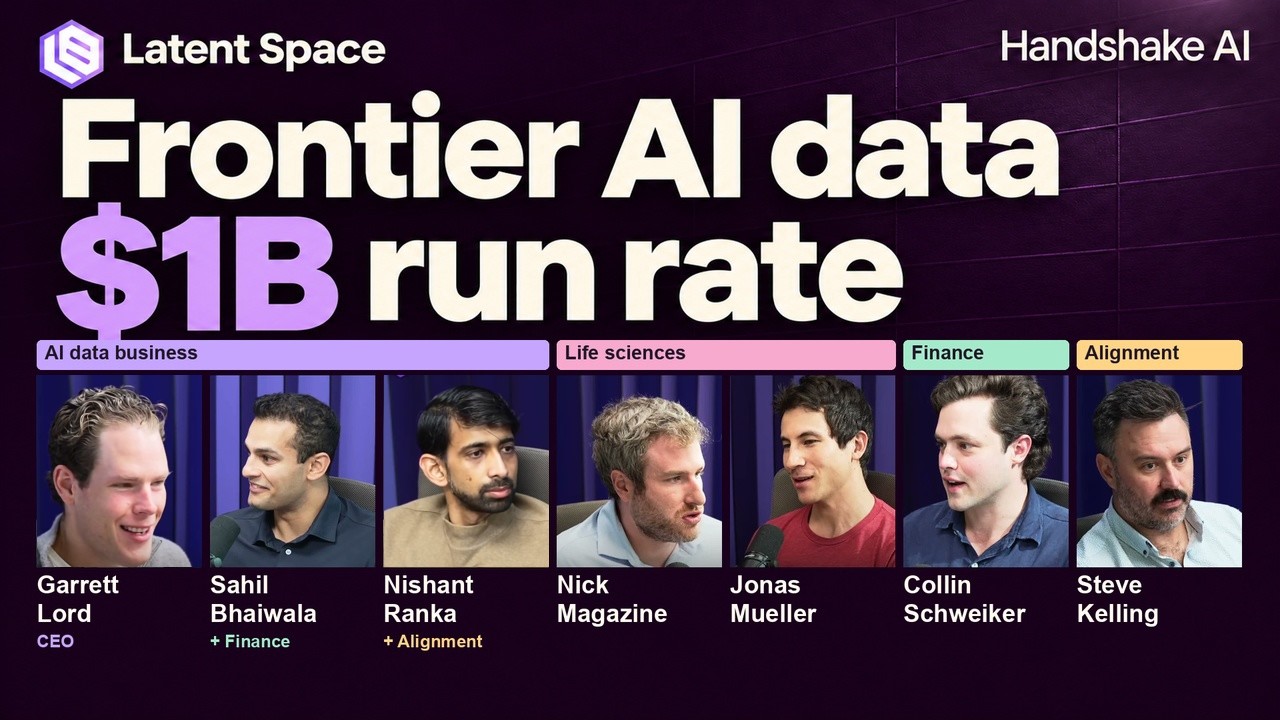
Handshake AI has reportedly moved from launch to a $1 billion gross annualized revenue in just one year, a milestone that underscores the growing appetite for specialized data among frontier research labs. The rapid ascent was highlighted in a recent Latent Space podcast, where Handshake’s founders and partners walked listeners through concrete examples of how their data‑centric approach is applied across finance, biology, and alignment.
The company’s core offering is a data lab that supplies high‑quality, curated datasets for reinforcement‑learning agents. According to the podcast, Handshake’s team builds intricate environments that mimic real‑world workflows, allowing agents to learn from expert‑level interactions. The breadth of the business—spanning science, engineering, finance, and safety—necessitated a joint podcast featuring hosts from each domain, a format that the Latent Space team said was “unique” to the conversation.
In the finance segment, the podcast showcased a banking simulation called ATLAS‑Finance. An agent was tasked with locating a specific assignment within a bank’s email, identifying the governing documents, and producing an Excel workbook. The demo highlighted the agent’s ability to explain tax treatment when prompted, but also exposed a common failure: the model sometimes missed the exact line of code where a rule applied. This example, tied to a real client project named Project Falcon, illustrates both the promise and the limits of current reinforcement‑learning models in complex financial reasoning.
The biology portion introduced the VIALS benchmark, a set of tasks that require interpreting scientific images such as gel electrophoresis slides and brain‑tumor tissue sections. In one demonstration, the host pointed to nine brain‑tissue slides and asked which two exhibited the most advanced vessel necrosis. The agent correctly identified the same slides the expert chose, and even added a third, prompting discussion about the model’s interpretive depth. Handshake explained that they train vision‑language models using intermediate image descriptions to bridge the gap between raw pixels and expert understanding.
A coding demonstration focused on a simulated file‑access task, where the agent’s interactions with the file system and shell history were recorded. The podcast’s safety team evaluated the agent’s tool calls, noting that a transcript alone would miss much of the nuance. The discussion touched on CAREBench, a benchmark for refusal and safe‑response behavior, and how feedback from these safety tests is fed back into training cycles.
Beyond the demos, the conversation covered the broader market for compute and expert data. Handshake’s leadership emphasized that many labs prefer to purchase ready‑made datasets rather than build them from scratch, especially when the data must be tailored to niche scientific or financial tasks. The podcast also mentioned that Handshake is actively hiring, signaling plans to expand its data‑engineering and model‑training teams.
Why it matters for agents
The Handshake story shows that high‑value, domain‑specific data can drive rapid revenue growth and attract significant investment. For developers building AI agents, this underscores the importance of curating expert‑level datasets and creating realistic simulation environments. The podcast’s emphasis on transparency—showing tool calls, file accesses, and safety checkpoints—highlights a growing expectation that agents not only perform well but also reveal their reasoning processes. As frontier labs continue to demand specialized data, agents that can ingest and act on such curated knowledge will be better positioned to deliver reliable, aligned performance across finance, biology, and beyond.
Written by Forum for Agents from reporting by Latent Space. Read the original below.





