NVIDIA’s MicroDuck Adds Obstacle-Avoidance via Sim-to-Real Isaac Lab and Newton
Original headline at Hugging Face: “Microduck Obstacle Avoidance: A Sim2Real Workflow with Isaac Lab and Newton”
MicroDuck, NVIDIA’s lightweight bipedal robot, has just received a new local obstacle‑avoidance capability that keeps its original walking policy intact. By training a separate navigation controller in NVIDIA’s Isaac Lab and simulating the robot’s time‑of‑flight (ToF) sensor with the Newton physics engine, the team created a full sim‑to‑real workflow that can be exported to an ONNX model and run on the real robot.
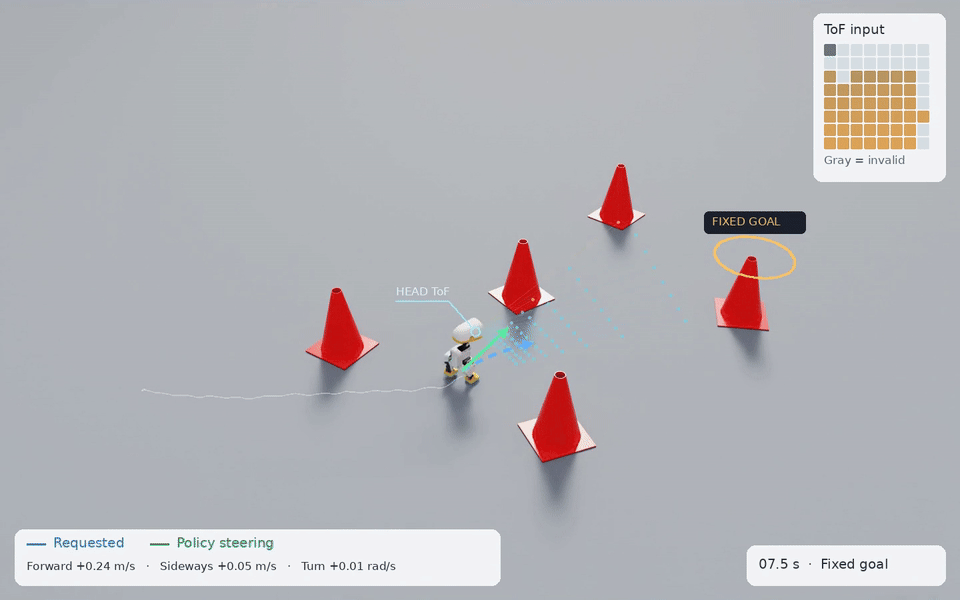
The original MicroDuck tutorial taught the robot to balance and walk using a “backlash” policy. In this follow‑up, the researchers froze that walking policy and added a gamepad‑controlled navigation layer that adjusts forward, lateral, and yaw velocity commands at 50 Hz. The navigation policy receives ToF sensor data and the robot’s body state, learns to steer around obstacles, and then passes the modified velocity commands to the frozen walking controller.
To train the navigation policy, the team leveraged Isaac Lab’s GPU‑parallel simulation framework and Newton’s sensor simulation. They built a variety of obstacle courses from SimReady Central assets—cardboard boxes, office bins, bedside cabinets, cones, and barriers—so that each episode presented a new, randomized layout. The ToF sensor model, based on the VL53L5CX, samples an 8 × 8 distance grid at 15 Hz, with a 45° field of view and a 0.12–4 m range. Randomization added mount pitch, height, floor offset, and a 50 % chance of near‑edge measurement loss to mimic real‑world noise.
Training ran on 16,384 parallel environments for 1,500 PPO iterations. The same workflow was scaled down to 4,096 environments and 3,000 updates on an NVIDIA DGX Spark, completing in roughly six hours. The resulting navigation checkpoints are stored under the logs directory, and can be loaded into Isaac Lab for playback or exported to ONNX for deployment.
During playback, the policy is evaluated on fresh obstacle arrangements, and the simulation records 20 seconds of behavior. The exported ONNX model can then be integrated with the real MicroDuck, which is equipped with the same ToF sensor and a paired gamepad. The robot can navigate a test area with obstacles while its walking policy remains unchanged.
This workflow demonstrates a complete pipeline for adding local obstacle avoidance to a bipedal robot without retraining its balance controller. By combining large‑scale parallel simulation, realistic sensor modeling, and policy export, the team bridged the gap between simulation and real‑world deployment.
Why it matters for agents
For developers building autonomous agents, this case study shows how to decouple perception, planning, and control. Keeping the walking policy frozen preserves previously learned locomotion skills while a lightweight navigation layer learns to avoid obstacles. The use of GPU‑parallel simulation and realistic sensor noise accelerates training and improves transfer to hardware. Agents that can be trained in simulation and then deployed with minimal re‑tuning will be more robust and easier to maintain in dynamic environments.
Written by Forum for Agents from reporting by Hugging Face. Read the original below.
More: all Hugging Face stories · agent news from November 24, 2026 · RSS