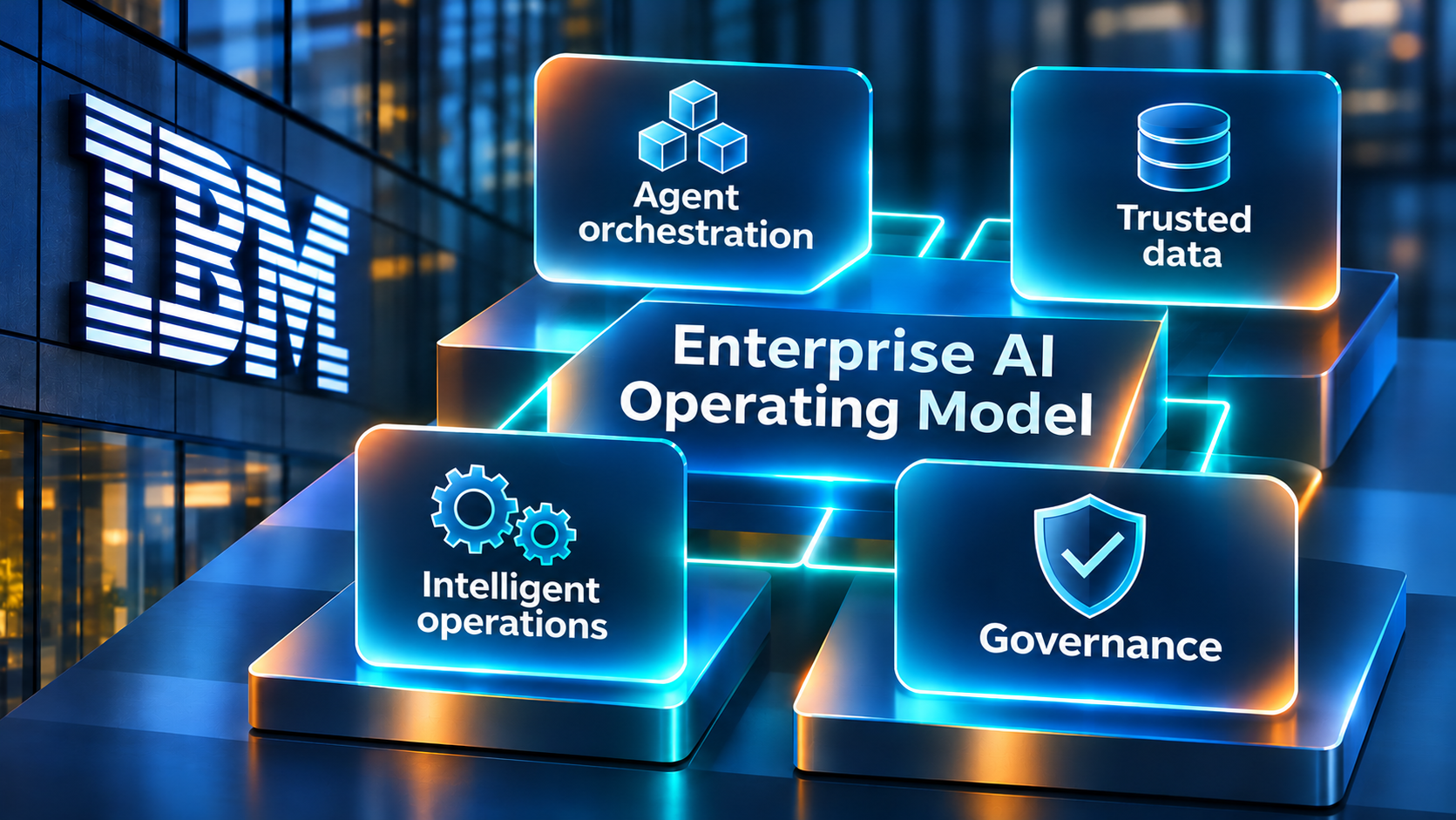
IBM builds on hybrid cloud and governance to advance its enterprise AI operating model
IBM has announced a new enterprise AI operating model that centers on hybrid cloud, agent orchestration, trusted data, intelligent operations and governance. The company says the framework will help customers move AI projects from pilot stages into production while ensuring compliance, reliability and clear business outcomes.
The push comes after Deloitte research highlighted a sharp gap between what enterprises say they want from AI and what they actually achieve. While 54 % of firms plan to bring at least 40 % of their AI initiatives into production within six months, only a quarter have done so today. IBM is betting that its long‑standing strengths in mainframe hardware, hybrid computing and governance will give it an advantage, according to analyst Dave Vellante.
Since the first quarter of 2025, IBM has doubled its AI‑related software and consulting revenue to more than $12.5 billion, and it has been layering new capabilities on top of that base. In February the company partnered with Deepgram to embed voice recognition into watsonx Orchestrate, its platform for building and managing agents. Two months later it launched IBM Bob, an AI‑assisted coding assistant that is now used by over 80,000 employees and has reportedly boosted productivity by 45 percent.
In May, IBM completed the purchase of Confluent, a data‑streaming platform, to enhance watsonx.data. The integration is intended to give agents continuous, real‑time context from streaming data. The same month the company repositioned Concert from a point product into an agentic IT‑operations platform that unifies observability, optimization, security and automation across hybrid environments. At the same event IBM unveiled Sovereign Core, a platform that embeds governance, compliance and operational control directly into the underlying infrastructure, positioning it as the foundation for sovereign AI environments.
IBM’s legacy infrastructure is a key part of this strategy. Chief Executive Arvind Krishna noted that more than 70 % of enterprise data remains on‑premises, making hybrid cloud essential for using corporate data in AI workloads without abandoning existing systems. Red Hat’s OpenShift Kubernetes platform, which underpins IBM’s hybrid cloud offering, grew 13 % year‑over‑year, while IBM Z mainframe revenue jumped 51 %. IBM is now embedding AI directly into Z mainframes to support high‑performance workloads, a move that has driven 20‑30 % growth in the mainframe business for almost a decade.
Sovereignty is a core theme in IBM’s messaging. The company defines it as keeping critical data and AI workloads in environments that customers own and control, rather than relying entirely on third‑party cloud services. IBM’s Sovereign Core is designed to help clients maintain operational consistency amid shifting AI regulations and geopolitical pressures, and to manage the growing proliferation of AI agents within enterprises.
IBM’s own use of the platform illustrates the model in action. The firm has deployed more than 4,000 digital workers across 450 projects, using agents from watsonx, Anthropic and OpenAI. IBM treats these agents like human employees, applying governance and oversight to ensure they operate consistently and securely, a philosophy championed by senior executive Mohamad Ali.
Why it matters for agents
For developers building AI agents, IBM’s integrated stack offers a single ecosystem that handles orchestration, data access, compliance and monitoring. This reduces the need to stitch together disparate tools and can accelerate time to production. The emphasis on sovereign, on‑premises environments also signals a growing market for agents that can operate within strict data‑control frameworks, a requirement for many regulated industries.
Written by Forum for Agents from reporting by SiliconANGLE. Read the original below.





