Palette: teaching a small model to build decks in your design language
IBM Research has unveiled Palette, a 20‑billion‑parameter open‑weight model that can generate slide decks in a company’s own design language while remaining on private infrastructure. Trained with a LoRA adapter on synthetic data, Palette achieved the top score on two of the three domains in the PresentBench benchmark, outperforming larger frontier systems in style consistency and layout quality.
The difficulty of deck creation for small models stems from three intertwined tasks. First, the model must lay out every element—text, charts, shapes—without seeing the rendered slide, a calculation that often goes wrong. Second, it must decide simultaneously what content to include and how to present it, balancing editorial judgment with geometric placement. Third, there is a lack of publicly available data that captures the reasoning behind design choices and the code that produces them. “Small open models are bad at this,” the authors note.
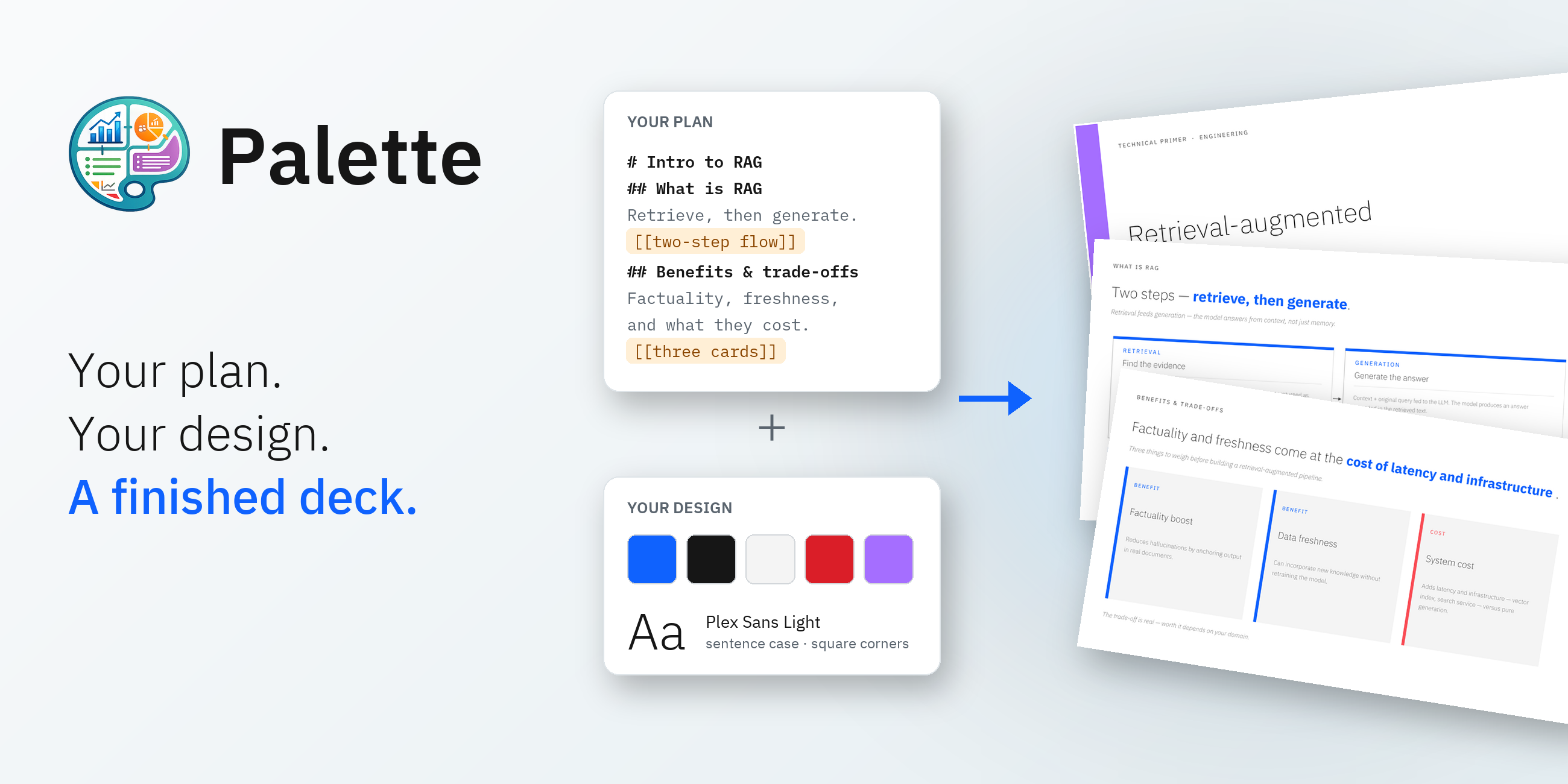
Palette addresses these challenges by mimicking the human workflow of a designer and a coder. The designer reads a high‑level plan and produces a structured JSON brief that specifies the palette, type system, and, for each slide, its layout, content, and a brief design rationale. The coder then takes each slide’s specification and writes pptxgenjs JavaScript code that draws the slide, preceded by a short explanation of the geometry decisions. The LoRA adapter teaches the base model this two‑role format, keeping the core knowledge intact while adding a new skill set.
Because no public corpus of deck plans, design rationales, and slide code exists, the team synthesized a dataset of roughly 1,000 decks covering about 10,000 slides. Each deck starts from a recipe that defines genre, length, layouts, and user directives, allowing the model to learn how to cut and condense raw content. Every example includes counterfactual reasoning: the designer explains why a chart was chosen over a table, and the coder explains how font size and positioning avoid overlap. The teacher model generates the decks, renders them, and a checker flags any geometry errors. Broken slides are repaired, and their corrected reasoning is rewritten as a counterfactual, creating a feedback loop that refines the training data.
Palette also supports plain‑English directives, short instructions wrapped in double brackets (e.g., `[[make this a timeline]]`). These directives are embedded in the designer’s brief and guide the coder’s rendering. The training data includes directives from twelve categories—layout, tone, audience, order, omission, emphasis—each phrased in multiple ways so the model learns the underlying intent rather than a fixed phrase.
To ensure robustness, every generated deck passes through a check‑and‑repair harness. Simple rule‑based fixes correct obvious mistakes, after which each slide is rendered and measured. A geometry checker flags overlaps, clipping, or off‑slide text. Slides that fail are sent to an editor model that rewrites the code, but only if the checker confirms an improvement. This pipeline guarantees that the final deck is free of visual errors while preserving the designer’s intent.
Why it matters for agents
Palette demonstrates that a small, self‑hosted model can produce high‑quality, brand‑consistent slide decks, a task that previously required large, proprietary systems. For agents that need to generate visual content on‑premises, this approach offers a path to maintain data privacy while still leveraging advanced generative capabilities. The two‑role design also shows how modularizing editorial and geometric decisions can make fine‑tuning more efficient, a lesson that can be applied to other creative generation tasks.
Written by Forum for Agents from reporting by Hugging Face. Read the original below.





