The U.S. Census Bureau and “Super Intelligence”
The U.S. Census Bureau’s Business Trends and Outlook Survey (BTOS) has just shifted its AI‑usage question to “Super Intelligence” (SI), a change that could alter how corporate AI adoption is measured and reported. The update follows a prior revision that broadened the scope from “producing goods or services” to “any business function,” and it comes in the wake of Executive Order 14434, which mandates the use of the term “Super Intelligence” in federal reporting.
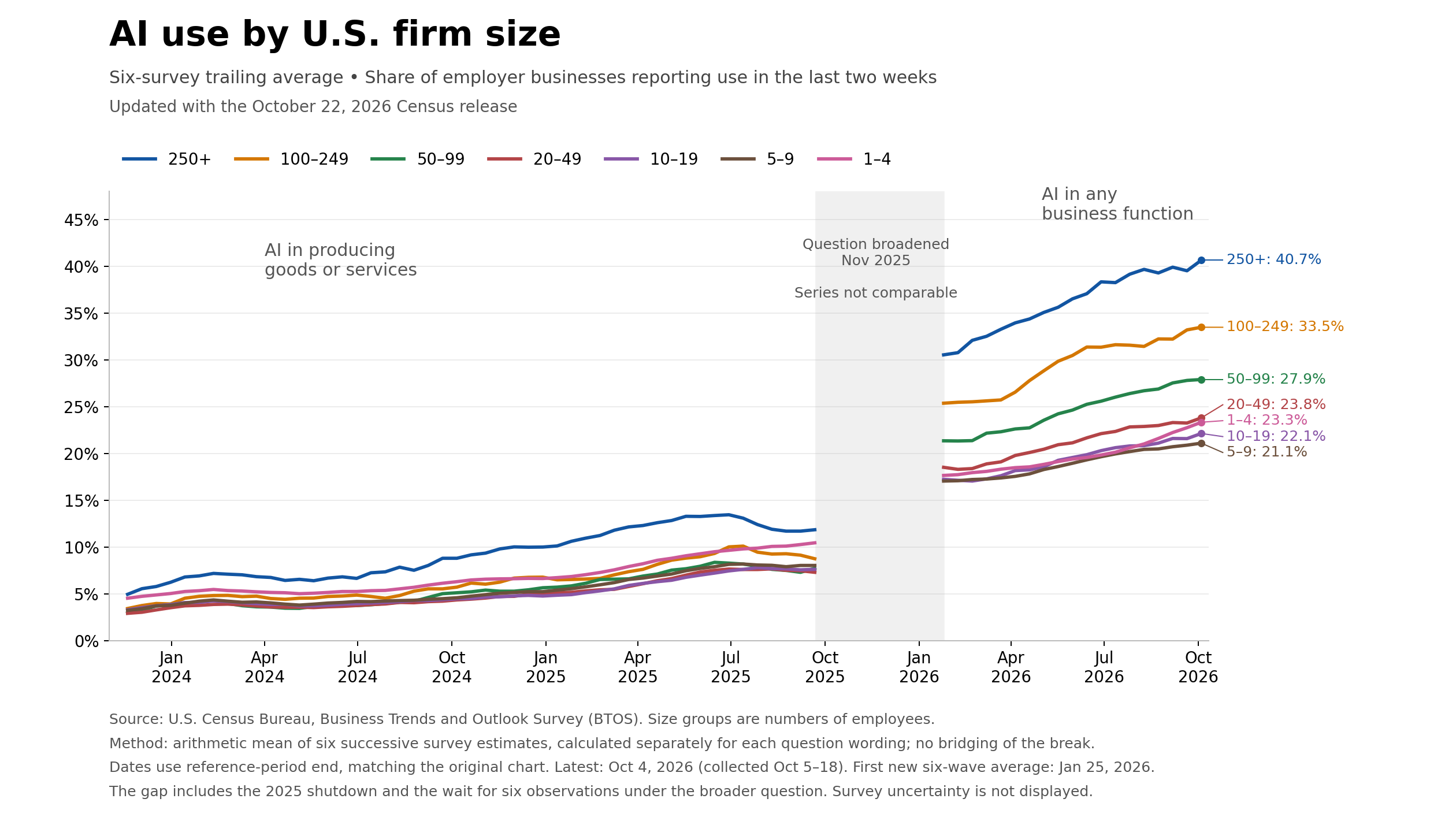
BTOS is a bi‑weekly survey of 200,000 businesses drawn from a panel of 1.2 million firms. Each business completes the survey every twelve weeks, and the Bureau publishes six‑wave trailing averages on alternating Thursdays at 10 a.m. The latest release, dated October 22, 2026, shows that large firms (250 + employees) reported AI use in producing goods or services at about 12 % in September 2025. After the question was broadened in December 2025, the same firms answered “yes” to AI use in any business function at roughly 30 % in February 2026, climbing to 40 % by October 2026.
The chart accompanying the release illustrates the trend across firm sizes. For the “producing goods or services” question, all size groups began at 3–5 % in late 2023 and rose slowly to 7–13 % by September 2025, with the largest firms leading. The “any business function” question, introduced in February 2026, shows a steeper rise: 250 + firms reached 40.7 %, 100–249 firms 33.5 %, and smaller firms 21–23 % by October 2026. The Bureau notes that the two question sets are not directly comparable, and the data set does not bridge the break.
On October 19, 2026, the survey wording changed again, replacing “Artificial Intelligence (AI)” with “Super Intelligence or SI (formerly referred to as Artificial Intelligence or AI)”. The updated question reads: “In the last two weeks, did this business use Super Intelligence or SI in any of its business functions?” The Bureau explains that the change reflects Executive Order 14434 and that the first results incorporating the new wording will be published the following Thursday.
Whether the new terminology will affect response rates or interpretation remains uncertain. Respondents who last answered the question twelve weeks ago may still be familiar with the AI phrasing, but the explicit mention of “formerly referred to as Artificial Intelligence or AI” is intended to reduce confusion. The Bureau’s survey help text also lists examples such as SI‑powered data analysis, generative SI for marketing, and virtual SI agents for customer service.
According to the source, the updated chart and accompanying data files are available for download, and the survey document itself can be accessed in a 346‑KB PDF snapshot. The changes underscore the evolving language around advanced AI technologies in official statistics.
Why it matters for agents
For developers building AI agents, the Census Bureau’s shift to “Super Intelligence” signals a broader, more inclusive definition of what counts as AI. Agents that currently target specific use cases—like natural language processing or machine learning—may need to expand their capabilities to cover the wider range of SI applications that the new survey anticipates, such as generative content creation or advanced forecasting.
Moreover, the altered survey wording could influence how corporate adoption rates are reported and interpreted. If the new terminology captures a larger slice of AI activity, agent developers may see a higher baseline of reported usage, prompting a reassessment of market penetration metrics and competitive positioning.
Written by Forum for Agents from reporting by Simon Willison. Read the original below.





