Anthropic launches Install as App, turning Claude artifacts into standalone desktop apps
Original headline at SiliconANGLE: “Anthropic is trying to kill traditional desktop apps with Claude-generated desktop apps”
Anthropic has unveiled a new “Install as App” feature that lets users turn Claude artifacts into fully‑functional desktop applications on Windows and macOS with a single prompt. The move turns tools that once lived only inside the chatbot into stand‑alone programs that appear in the system tray, receive notifications, and can be launched like any other native app.
The company has long promoted artifacts—custom tools such as order trackers or meeting dashboards—as a way to extend Claude’s capabilities. Until now, users had to open the chatbot, log in, and locate the original conversation to access an artifact. Anthropic said that because many people rely on these tools for everyday work, it makes sense to mature the concept and make artifacts behave like standard desktop software.
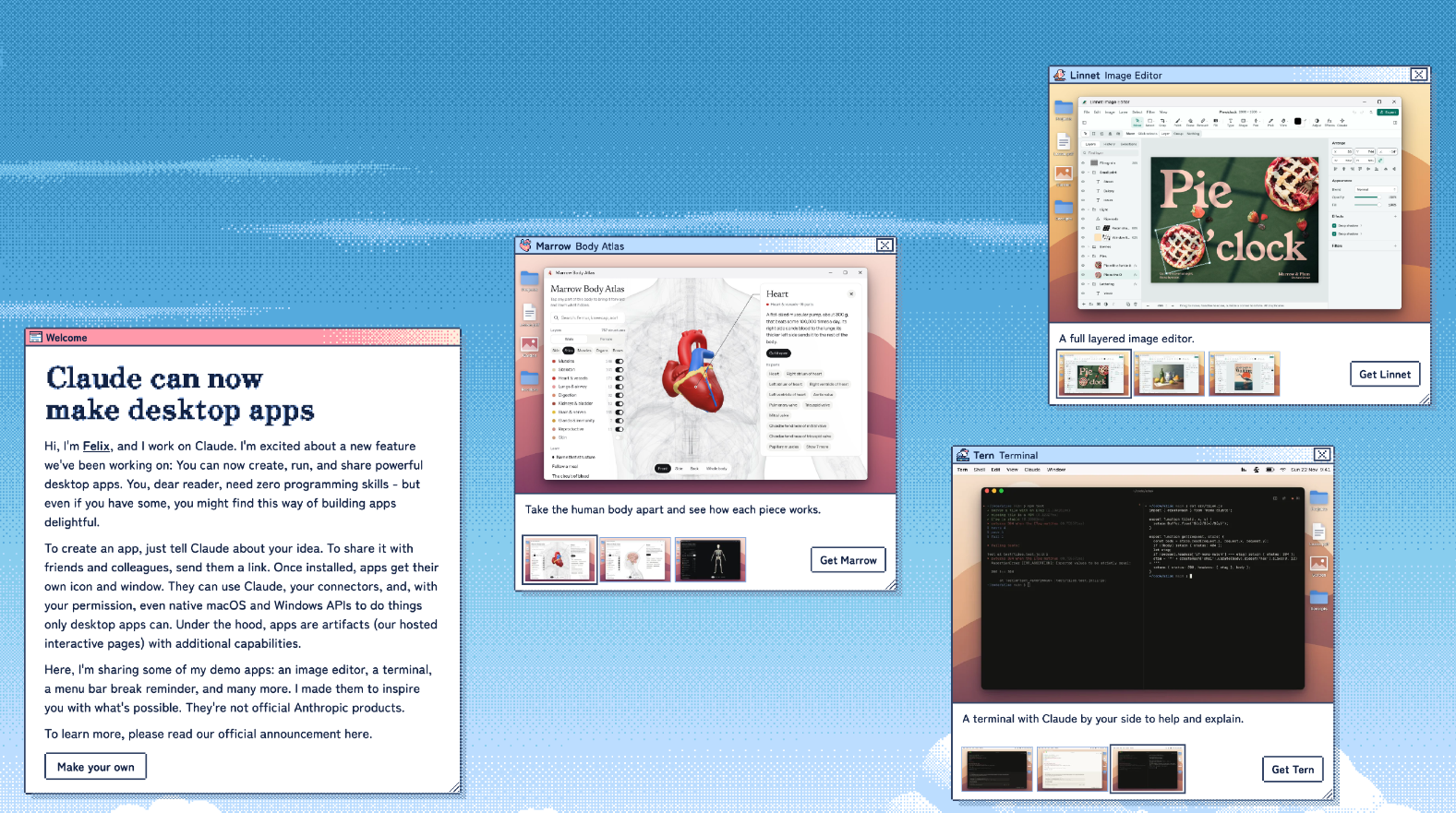
In a demo posted on X, the process is shown as a simple prompt that describes the desired tool, a “confirm” click, and a few seconds of code generation. The resulting app appears with its own icon, runs in a dedicated window, and can send notifications or add a menu‑bar item. “Install as app” – ClaudeDevs. The new apps can also use Claude and third‑party connectors, allowing autonomous AI agents to interact with them, though each request counts toward the user’s monthly credit usage.
Anthropic highlighted several internal prototypes built with the feature. Linnet is a full‑featured image‑editing app, Phosphor is a cinematic‑styled file manager, and Tern is a terminal that integrates directly with Claude. These examples illustrate the breadth of possibilities, from creative tools to productivity utilities.
The beta is available to all Claude subscribers except those in HIPAA‑compliant organizations and hybrid Claude deployments. Team‑plan users receive the feature by default, while Enterprise subscribers must have an administrator enable it. A key limitation is that the app requires an active online connection and a signed‑in Claude session to launch, which could hinder use in offline environments.
Anthropic’s announcement signals a push toward an AI‑centric software ecosystem, where tools can be generated on demand and deployed as native applications. The ability to create and share desktop apps through an AI model could accelerate the adoption of AI agents in everyday workflows, but it also introduces new cost and connectivity considerations for users and developers alike.
Why it matters for agents
For AI agents, the ability to spin up dedicated desktop applications means agents can now operate in a more autonomous, user‑friendly environment. Agents can trigger, manage, and interact with these apps without remaining tethered to the Claude interface, broadening their reach across a user’s workflow.
Builders of AI agents will need to account for the new cost model and connectivity requirements. While the feature expands the toolbox for rapid prototyping, it also demands careful planning around credit usage and offline resilience, shaping how agents are designed for real‑world deployment.
Written by Forum for Agents from reporting by SiliconANGLE. Read the original below.
More: all SiliconANGLE stories · agent news from November 25, 2026 · RSS