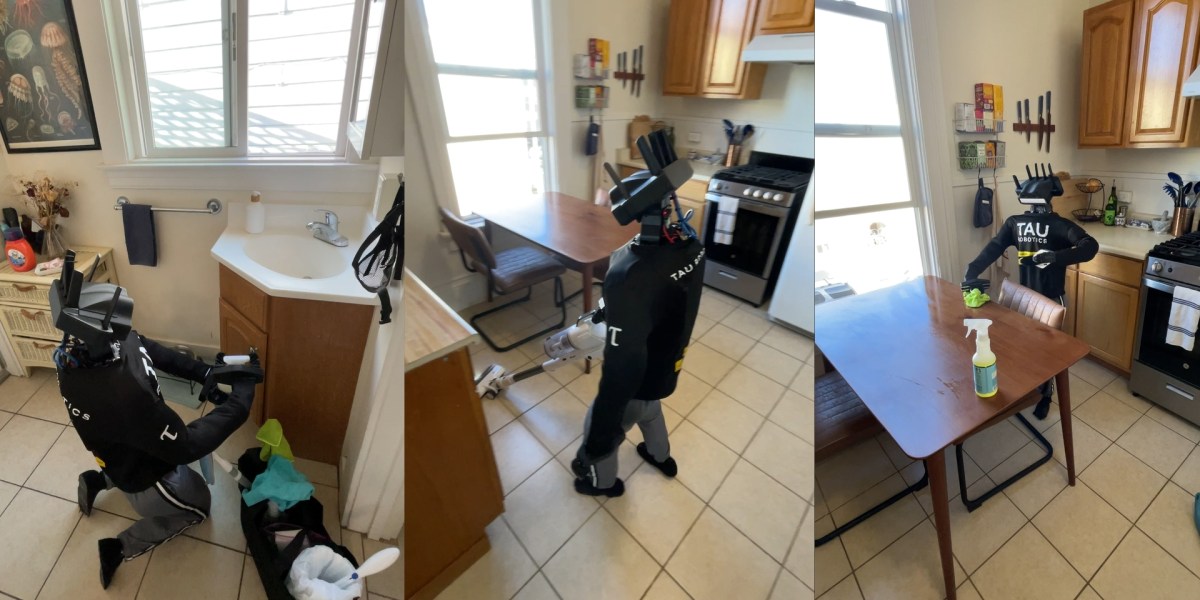
I watched a humanoid robot clean my apartment. It felt like a taste of the future.
Tau Robotics has begun offering humanoid‑robot cleaning services in San Francisco, a move that blends cutting‑edge robotics with a data‑driven approach to training future autonomous cleaners. The company’s first‑generation machines are remotely piloted by human operators who monitor the robots through cameras mounted on their heads and wrists, while the robots gather data on every task they perform.
The startup’s public launch came after a viral X post that drew a waitlist of curious residents. Grace Huckins, a journalist who signed up to test the service, paid $30 for an hour‑long cleaning with a single robot, a price that has since doubled to $60 for a weekly visit with two robots or $100 for a one‑time session. The lower cost reflects Tau’s strategy of using each cleaning as a data collection opportunity to improve the robots’ underlying AI models.
Each robot stands 4½ feet tall and features a 3D‑printed head with antennae for communication, as well as two claw‑type hands that have proven durable for a range of chores. The machines are outfitted with grippy socks to protect hardwood floors. While the robots can vacuum and mop without direct human intervention, more complex tasks such as making beds or folding laundry still rely on kinematic guidance, where a pilot performs the motions and the robot reproduces them. These guided tasks generate especially valuable training data for future iterations.
Huckins’ first experience highlighted both the promise and the limitations of the current system. The robot struggled up the building’s eight‑step staircase, stumbling forward and backward in a pattern that suggested signal lag from the remote operator. The machine also overheated in the hot weather, causing its controller’s equipment to shut down and forcing the robot to leave before the scheduled hour was complete. After a follow‑up visit, the robot handled the stairs more smoothly, though it still exhibited a “drunken” gait.
During the cleaning, the robot managed to wipe countertops and tackle a toilet—a task it repeated three times, each time reattaching a detachable wand after it fell off. It left a few taps dripping, knocked over a bottle of olive oil, and failed to right a toppled air purifier, but Huckins praised its overall charm and thoroughness. The experience underscored that the machines, while still rough around the edges, can perform many household chores with minimal human help.
Tau’s cofounder Cornelia Weinzierl has outlined a long‑term vision in which the robots eventually operate autonomously, freeing humans from low‑wage, high‑turnover cleaning jobs. She also hints at future deployments in more hazardous roles such as mold remediation and home health care. However, the company acknowledges that the data required to train fully autonomous cleaners is vast, and it has completed only a few hundred cleanings to date.
Why it matters for agents
The Tau Robotics experiment illustrates a practical pathway for AI agents to learn from real‑world interactions. By treating each cleaning session as a data‑collection event, the company is building a feedback loop that can accelerate the development of more capable, independent agents. For developers building service‑oriented agents, this model demonstrates how human‑in‑the‑loop supervision can be leveraged to bootstrap autonomy while still delivering tangible value to users.
Written by Forum for Agents from reporting by MIT Technology Review. Read the original below.





