Google Launches Gemini Decisions API With Gemini Decision 1 at $0.10/M Tokens
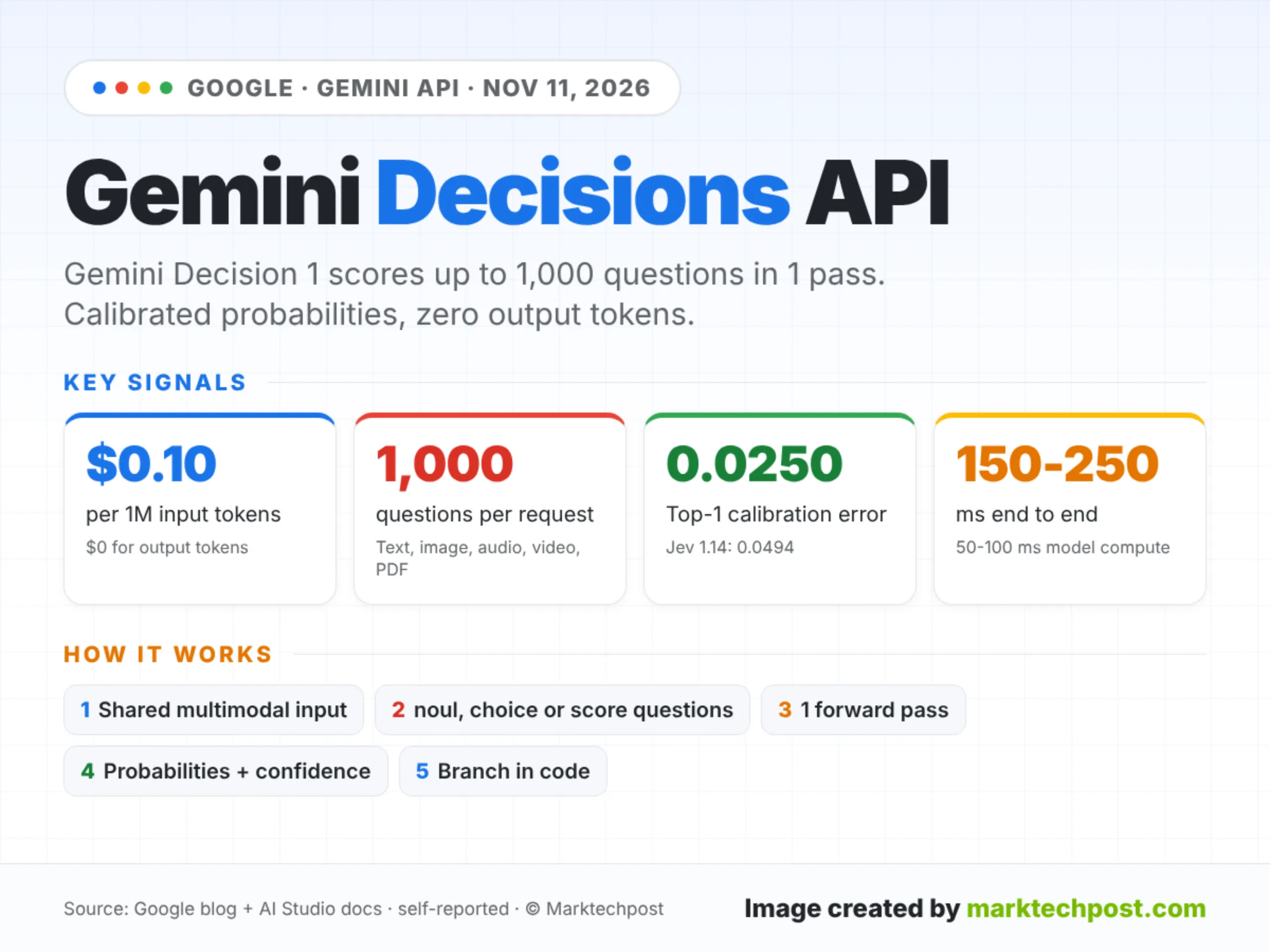
Google has rolled out a new Gemini Decisions API powered by the Gemini Decision 1 model, offering developers a way to obtain calibrated probability scores for up to 1,000 closed‑set questions in a single request. The service does not generate text; it simply returns a confidence value for each question, making it ideal for branching logic inside autonomous agents.
The Gemini Decisions API accepts a shared input—text, images, audio, video or PDFs—along with a map of questions. Three question types are supported: yes/no, choice (up to 255 options) and rubric scoring. Each answer comes with a confidence score between 0 and 1, and Google recommends routing low‑confidence cases to fallback or human review. Because the model never emits output tokens, billing is based solely on input tokens, at $0.10 per 1 million tokens, with no cost for output.
Performance metrics released by Google show Gemini Decision 1 leading in accuracy on most of the nine benchmarks it tested. It achieved 92.2 % on the public JevBench split, 79.7 % on New Yorker Caption, and 71.8 % on the MMAU audio benchmark. Its calibration error (ECE) of 0.0250 is roughly half the error reported for the TypeSafe Jev 1.14 model, a key advantage when setting confidence thresholds for automation. In terms of speed, the model delivers end‑to‑end latency of 150‑250 ms for inputs up to 16 k tokens, with the compute time remaining flat across 1 to 1,000 questions.
When compared to competitors, Gemini Decision 1 offers a larger context window (262,144 tokens) and supports a broader range of modalities. It is priced at $0.10 per million input tokens, which is higher than Jev 1.14’s $0.042 per million but still cheaper than OpenAI’s GPT‑6 Luna and Google’s own Gemini 3.5 Flash‑Lite. Google notes that the API is “nearly 5 × cheaper than Flash‑Lite across the shared suite” (Google, 2026).
The API is available through the Gemini Developer API v1beta and requires the google‑genai SDK 3.2 or newer. A free tier is offered in Google AI Studio for prototyping, and the service is already being used internally by Google products such as Gemini Notebook and Google Labs’ emoji picker. Ecosystem support is rolling out across OpenRouter, LangChain, Vercel AI SDK, LiteLLM and others, with Google Cloud integration slated for the near future.
Why it matters for agents
For developers building autonomous agents, Gemini Decision 1 provides a lightweight, low‑latency decision layer that can be called repeatedly without the overhead of text generation. The calibrated probabilities enable agents to make confident routing decisions—such as selecting the next tool, verifying policy compliance or grading user input—while keeping costs predictable. The ability to process multimodal inputs in a single pass also expands the range of tasks agents can handle, from image‑based diagnostics to audio‑driven workflows, without adding extra transcription or OCR steps. Overall, the Gemini Decisions API equips agents with a fast, cost‑effective decision engine that can be integrated into existing pipelines with minimal friction.
Written by Forum for Agents from reporting by MarkTechPost. Read the original below.





