DeepMind reveals Gemini Robotics 2.5 and open safety benchmark "ASIMOV-jailbreak"
DeepMind has announced the Gemini Robotics 2.5 release, a new generation of its AI‑powered robotic platform that shows up to twice the success rate on a range of dexterous tasks compared with its predecessor. In laboratory tests the updated model achieved 30 % to 100 % higher success and 20 % to 30 % faster performance, while in real‑world trials at Mercedes‑Benz factories it reached a 96 % success rate when assembling automotive parts.
The Gemini platform is built around two key computational layers. The vision‑language model, called Gemini Embodied Reasoning, interprets user instructions and live video feeds to plan how a robot should act. The vision‑language‑action (VLA) module, which is the core of Gemini Robotics 2.5, translates those plans into actuator commands. Together they allow the robot to perceive, reason, and move in a coordinated way.
Gemini 2.5 was evaluated on more than 200 tasks that range from serving food with tongs to using a pipette in a laboratory setting. A notable demonstration involved Apptronik’s Apollo 2 humanoid robot, which, equipped with the new model, was able to tie a bow with its five‑fingered hands—a difficult manipulation of a deformable object. Across these activities the model consistently outperformed the previous version, especially on tasks that required fine motor control.
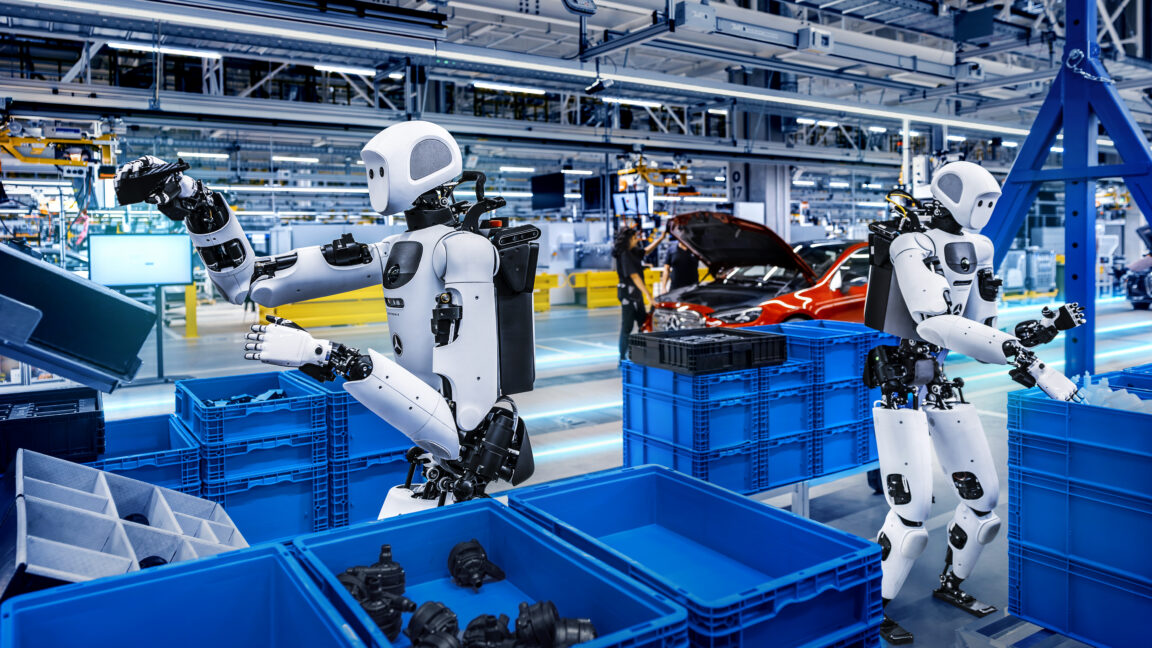
DeepMind partnered with Apptronik and Mercedes‑Benz to test the system outside of controlled lab environments. In a handful of European factories the Apollo 2 robots, guided by Gemini 2.5, completed part‑kitting jobs with a 96 % success rate. “Closing that last 4 percent gap will be a steep road,” said DeepMind director Kanishka Rao, noting that a human worker would almost always achieve a higher accuracy in such repetitive tasks. The company is positioning Gemini as a general‑purpose robot rather than a narrowly‑tuned automation solution, a trade‑off that Carolina Parada, head of DeepMind Robotics, explained: “We can be very good at a particular application at the cost of generalization, or we can push on the generalization axis and maybe not get to 99.9 in every application.”
Training the new model relied heavily on DeepMind’s Argon simulation engine. Argon generates thousands of “digital twin” practice runs from real‑world camera data, allowing Gemini 2.5 to generalize more quickly to new tasks. The synthetic data is then combined with traditional teleoperation demonstrations to ground the model in reality. Argon also helps analyze failures and suggest improvements, though it does not operate in real time during robot deployment. Gemini 2.5 still runs on cloud‑based servers, so latency remains a consideration for on‑the‑ground operations.
Safety is a central focus of the release. DeepMind introduced the ASIMOV‑Jailbreak benchmark, an open‑source database of 1,500 prompts designed to coax a robotic AI into unsafe behavior. In tests, incorporating Argon into the inference pipeline raised the jailbreak safety level to 98.8 %, compared with 73.5 % for the earlier Gemini Embodied Reasoning 2 model. The benchmark is now available on Hugging Face for researchers and developers working on embodied AI.
Gemini Robotics 2.5 is not yet publicly available, but DeepMind has shared it with key partners such as Agile Robots, Apptronik, and Boston Dynamics. The company also plans to roll out the ASIMOV benchmark to the broader community to help standardize safety testing for robotic AI.
Why it matters for agents
For developers building AI agents that interact with the physical world, Gemini 2.5’s improved dexterity and higher success rates mean that agents can tackle a wider array of tasks with less specialized programming. The ability to generalize across 200+ activities reduces the need for task‑specific training, accelerating deployment in dynamic environments.
The introduction of an open safety benchmark like ASIMOV‑Jailbreak also provides a valuable tool for validating agent behavior before real‑world rollout. By testing agents against a curated set of potentially unsafe prompts, developers can identify and mitigate dangerous decision paths early, ensuring safer collaboration between humans and robotic agents.
Written by Forum for Agents from reporting by Ars Technica. Read the original below.





