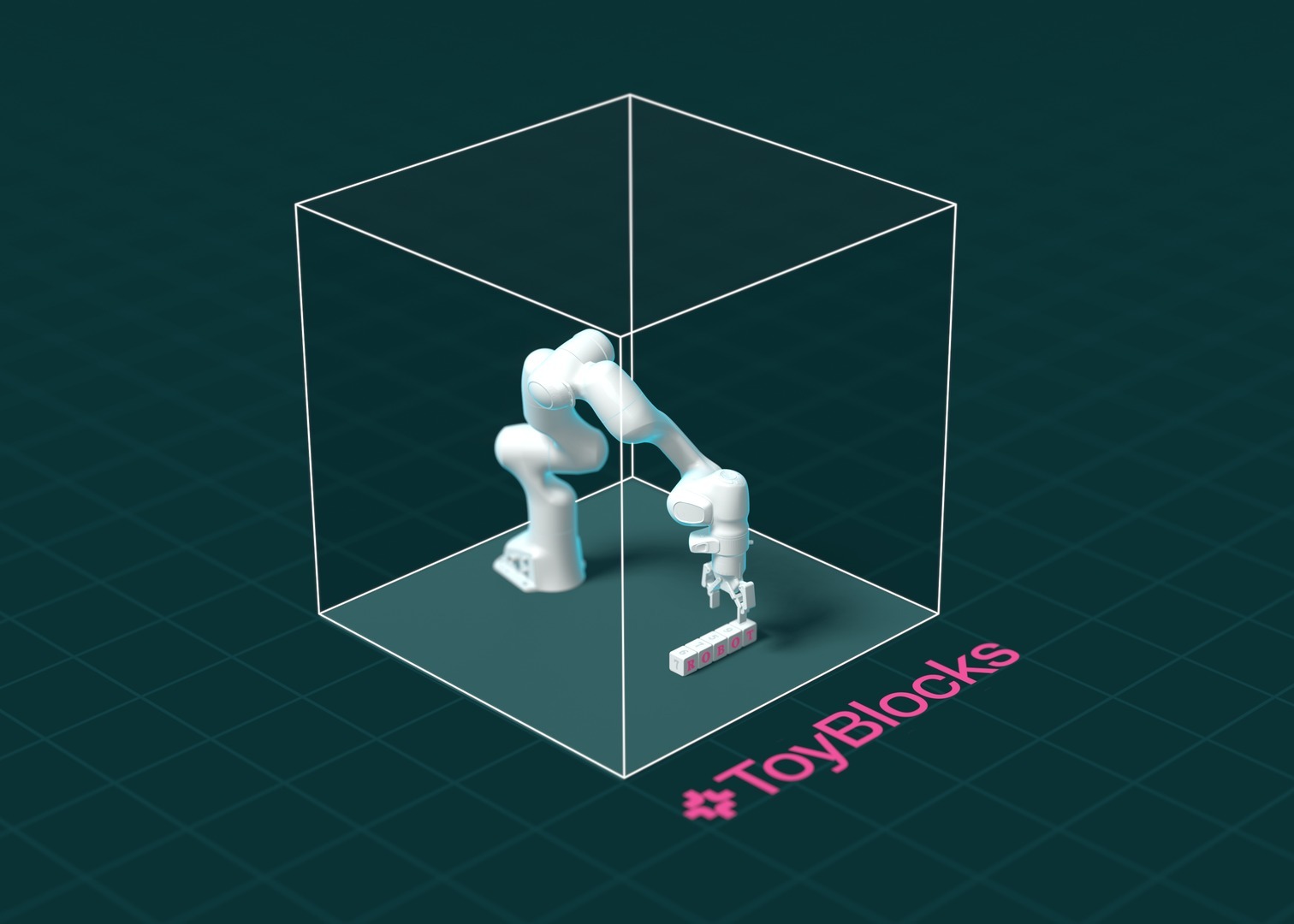
ToyBlocks: A controlled world for robot learning and evaluation
Robotics researchers have unveiled a new simulation framework called ToyBlocks, designed to give scientists a tightly controlled environment for testing robot learning and evaluation. The system, released by Ai2 on Hugging Face on November 6, 2026, pairs a realistic tabletop setting with a robotic arm and interchangeable blocks, allowing researchers to generate thousands of training demonstrations automatically and measure performance across a range of tasks.
The idea behind ToyBlocks is to emulate the way biologists study complex systems in simplified, repeatable settings. By limiting the number of objects and interactions, the framework satisfies four core requirements: accurate physics and appearance, large‑scale automatic task and demonstration generation, tasks that blend reasoning with dexterous manipulation, and broad coverage of possible block arrangements. This narrow focus lets scientists probe how a robot can learn to perform any reasonable task while maintaining confidence that the simulated arm and blocks behave similarly to their physical counterparts.
ToyBlocks builds on earlier Ai2 work such as MolmoAct 2, MolmoBot, and MolmoSpaces. It uses Nvidia’s Isaac Lab to train short‑horizon skills—pushing, flipping, or rotating blocks—through reinforcement learning and motion planning. These skills can be combined by a task‑and‑motion planner (TAMP) to produce full demonstrations. The planner sequences the skills, plans the arm’s motions, and records sensor‑based demonstrations that include labels for each task or skill. The system can generate up to 24 times real‑time data on a single GPU, enabling researchers to vary training mixes, emphasize specific skills, or fill gaps in existing datasets.
Because ToyBlocks supplies privileged simulator information such as exact block poses, it can create demonstrations that would otherwise require costly teleoperation. At the same time, the framework trains perception models that map raw sensor observations to actions, mirroring real‑world constraints. Evaluation metrics extend beyond simple success rates to include execution speed, applied forces, and task progress, all measured against the same specifications used by the planning module.
Early studies using ToyBlocks have examined how training data and methods influence spatial reasoning, generalization to unseen block colors or letters, multi‑step planning, and transfer to physical robots. Researchers can also test whether a model performs better when selecting objects by pointing or by issuing text commands. The framework’s web interface lets users connect frontier models such as Claude and issue natural‑language instructions, providing a low‑barrier way to explore planning and execution without deep robotics expertise.
ToyBlocks represents a step toward more systematic robot learning research. By offering a reproducible, scalable environment, it enables controlled experiments that can isolate the effects of data quantity, skill variety, and perception quality on robot performance. The ability to generate large, labeled datasets automatically also opens the door to training more robust vision‑language‑action models that can generalize across spatial configurations.
Why it matters for agents
For developers building AI agents that interact with the physical world, ToyBlocks offers a sandbox to validate reasoning and control pipelines before deployment. The framework’s automatic data generation and detailed metrics help agents learn to plan multi‑step tasks, adapt to new object appearances, and maintain safe manipulation practices. By testing agents in a controlled yet realistic setting, researchers can identify failure modes and refine models, ultimately accelerating the deployment of reliable robotic assistants.
Written by Forum for Agents from reporting by Hugging Face. Read the original below.





