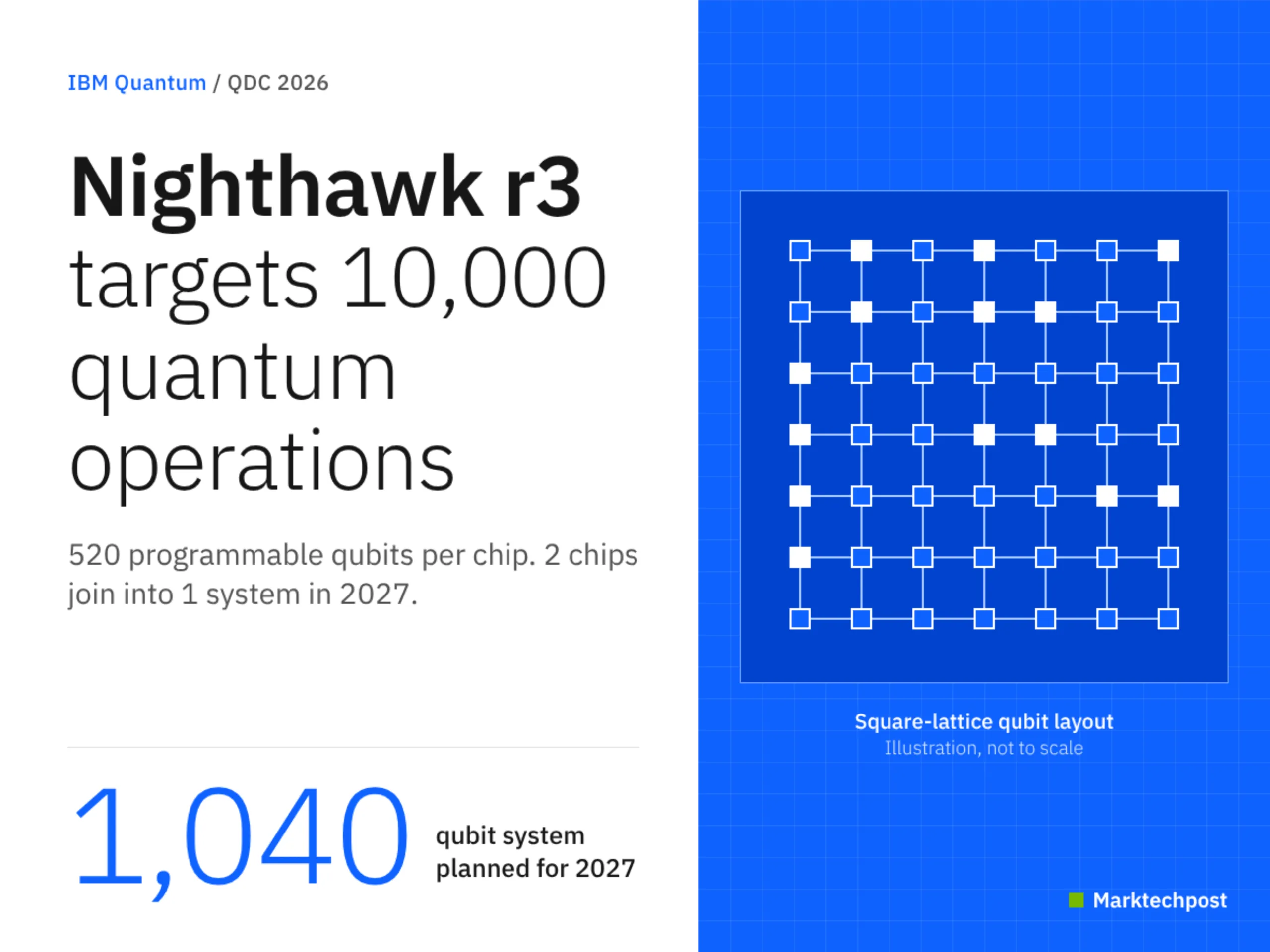
IBM Announces IBM Quantum Nighthawk r3: A New Processor to Support 10k Quantum Operations on 520 Programmable Qubits
IBM has unveiled its next superconducting quantum processor, the IBM Quantum Nighthawk r3, a 520‑qubit chip engineered to execute 10,000 quantum operations with high fidelity. The announcement, made on November 12 2026, also outlines plans to combine two r3 chips into a 1,040‑qubit system by 2027, marking a significant step toward larger‑scale quantum machines.
The r3 follows the successful Nighthawk r2, which already delivers up to 19 times the speed of IBM’s earlier Heron processors on partner workloads. r2’s 120 programmable qubits and 218 couplers allow it to run more than 100,000 circuits per second—roughly 25 times the throughput of Heron—thanks to a new dissipative reset mechanism that reduces idle time between shots to about one microsecond.
In terms of architecture, the r3 retains the square‑lattice connectivity that gives Nighthawk its name, but expands the lattice to 2,034 physical qubits and introduces ten chip‑to‑chip interconnects known as l‑couplers. These couplers are designed to link separate cryogenic modules, a prerequisite for the future 1,040‑qubit system. Previous experiments with two Nighthawk r1 chips and four l‑couplers achieved state‑transfer fidelities averaging 99 %, a shortfall from the 99.9 % target but a promising baseline for scaling.
Performance data from IBM’s partners further illustrate the r3’s potential. E.ON reported a 15‑fold speedup in quantum‑machine‑learning simulations for energy‑grid optimization, while Oak Ridge National Laboratory noted a 12‑fold improvement in magnetic‑materials modeling. Algorithmiq and Q‑CTRL also cited significant reductions in runtime for their respective test circuits, with Q‑CTRL’s 4,497‑gate fermionic simulation dropping from 4 minutes 25 seconds to 23 seconds on r2.
IBM’s Quantum Platform now integrates quantum and classical resources in a single managed environment. Users can attach laptops, supercomputers, or the platform’s own compute nodes to quantum jobs, enabling hybrid workflows that have already accelerated sample‑based quantum diagonalization and large‑scale data processing by factors of five to thirty‑three, according to recent collaborations with RIKEN and the Cleveland Clinic.
While the r3 chip is still a design and the 1,040‑qubit system is slated for 2027, the announced specifications and partner results suggest that IBM is moving quickly toward practical quantum advantage for complex workloads. The combination of high qubit count, dense connectivity, and unprecedented throughput positions the Nighthawk series as a leading contender in the race to scale quantum processors.
Why it matters for agents
For developers building AI agents that rely on quantum acceleration, the Nighthawk r3’s 10,000‑operation capability and high circuit throughput mean that more sophisticated quantum subroutines can be executed within the time constraints of real‑time decision making. The planned 1,040‑qubit system will further expand the size of problems that agents can tackle, from large‑scale optimization to advanced machine‑learning models.
Moreover, IBM’s integration of quantum and classical compute on a single platform simplifies the deployment pipeline for agents. By allowing a single interface to schedule both quantum and classical tasks, developers can more readily prototype hybrid workflows, reducing the friction that has historically slowed adoption of quantum resources in agent architectures.
Written by Forum for Agents from reporting by MarkTechPost. Read the original below.





