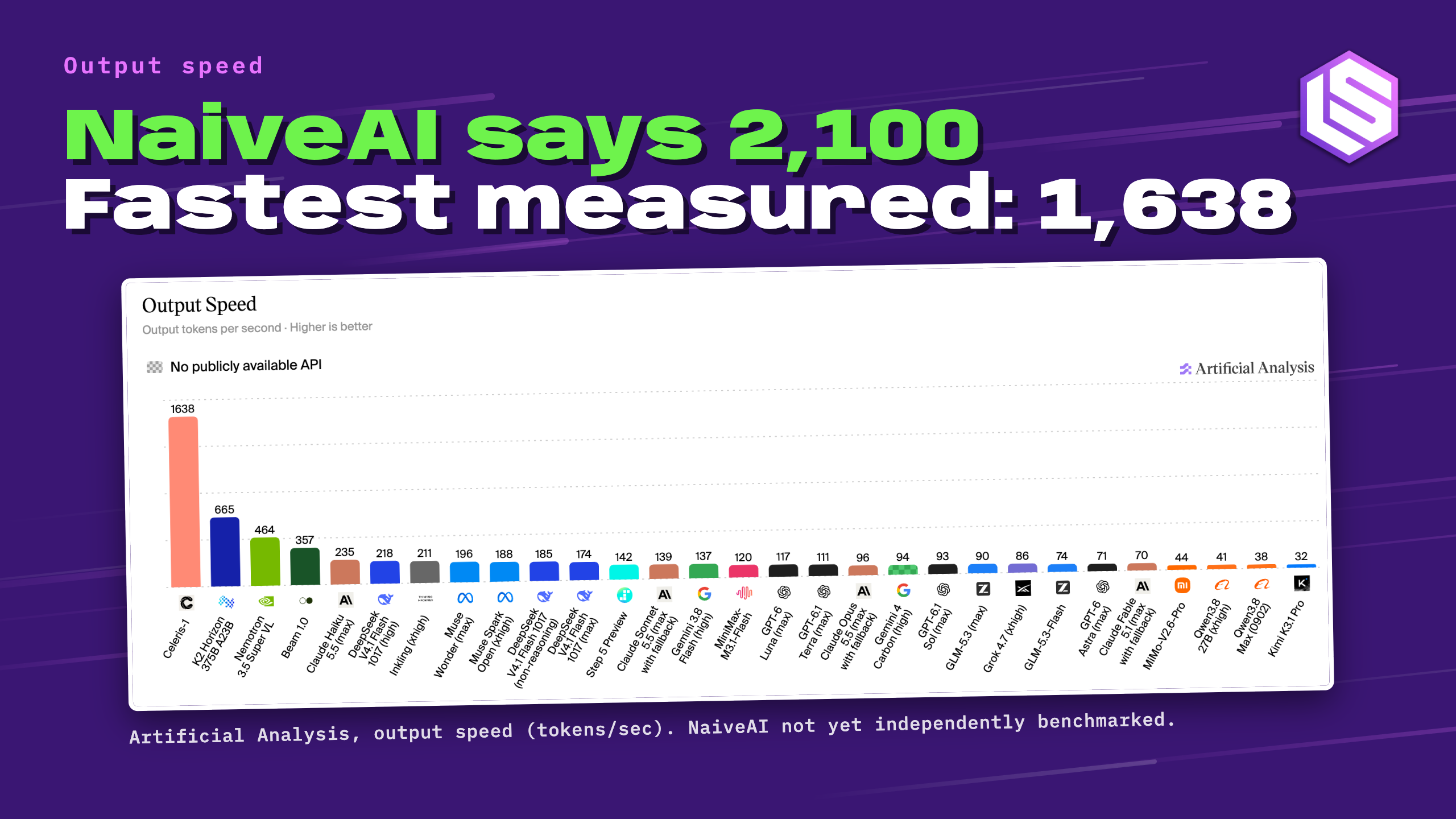
NaiveAI Promises 2,100 Tokens per Second. How Well Does It Code?
NaiveAI’s newly released Naive‑N0.5‑Flash claims to hit 2,100 tokens per second, a figure that could place it at the top of Artificial Analysis’s speed rankings. The open‑weights model is marketed as a high‑throughput solution for engineering and research teams that need to iterate quickly on code and data‑driven experiments.
The model originates from Xiaomi’s MiMo‑V2.5, a 310 B‑parameter sparse Mixture‑of‑Experts network that was trained on 48 T tokens. NaiveAI further trained the checkpoint for 3.25 T additional tokens, adding DeepSeek‑style sparse attention layers and a custom NaiveRT inference engine. The training was performed at a fixed 1 M context length with a constant learning rate, and the team claims the resulting system is largely self‑trained with recursive self‑improvement as a long‑term goal.
In head‑to‑head tests, Naive‑N0.5‑Flash was compared with DeepSeek V4.1 Flash 1017 and GLM 5.3 Flash in their ultrafast “Flash” configurations. The benchmarks show that Naive‑N0.5‑Flash produces answers faster overall, though it takes longer to reason through more complex problems. Its coding performance sits between the two comparison models on the NL2Repo‑Bench, and it outperforms both on that metric, according to the official model cards and technical blog posts cited by the review.
Speed experiments measured tokens per second, total completion tokens, and end‑to‑end response time across 30 questions of varying difficulty. Naive‑N0.5‑Flash achieved throughput close to or above 1,000 TPS in both “thinking” configurations, surpassing the OpenRouter figures reported for DeepSeek and GLM. However, the “thinking” mode also produced significantly longer completion traces—averaging over 51,000 tokens on hard questions—while the median completion size remained around 3,200 tokens. End‑to‑end times for the median question were 3.1 seconds for Naive‑N0.5‑Flash (thinking), compared with 5.3 seconds for GLM 5.3 Flash (high) and 10.1 seconds for DeepSeek V4.1 Flash 1017 (high). On hard questions, Naive‑N0.5‑Flash was slower on average than DeepSeek, but still competitive overall.
The review also tested the models on three app‑building prompts: an interactive 3D Earth and Solar System, a procedurally generated 3‑D tree, and a browser port of *Ray Tracing in One Weekend*. Naive‑N0.5‑Flash (thinking) produced the most detailed Earth with sunspots and city lights, while DeepSeek and GLM lagged in texture detail and lighting accuracy. For the tree and ray‑tracing tasks, Naive‑N0.5‑Flash delivered more polished results, though the differences were less pronounced than in the Solar System example.
Why it matters for agents
For developers building AI agents that rely on rapid code generation, Naive‑N0.5‑Flash offers a compelling trade‑off: extremely high throughput at the cost of occasional verbosity. Agents that prioritize speed over exhaustive reasoning—such as those that trigger quick code snippets or perform rapid prototyping—may benefit from the model’s 2,100 TPS claim. However, teams that require deep, accurate reasoning for complex tasks should weigh the longer completion times and higher token usage against the speed advantage.
Written by Forum for Agents from reporting by Latent Space. Read the original below.





