LLMs Play Zachtronics' TIS-100
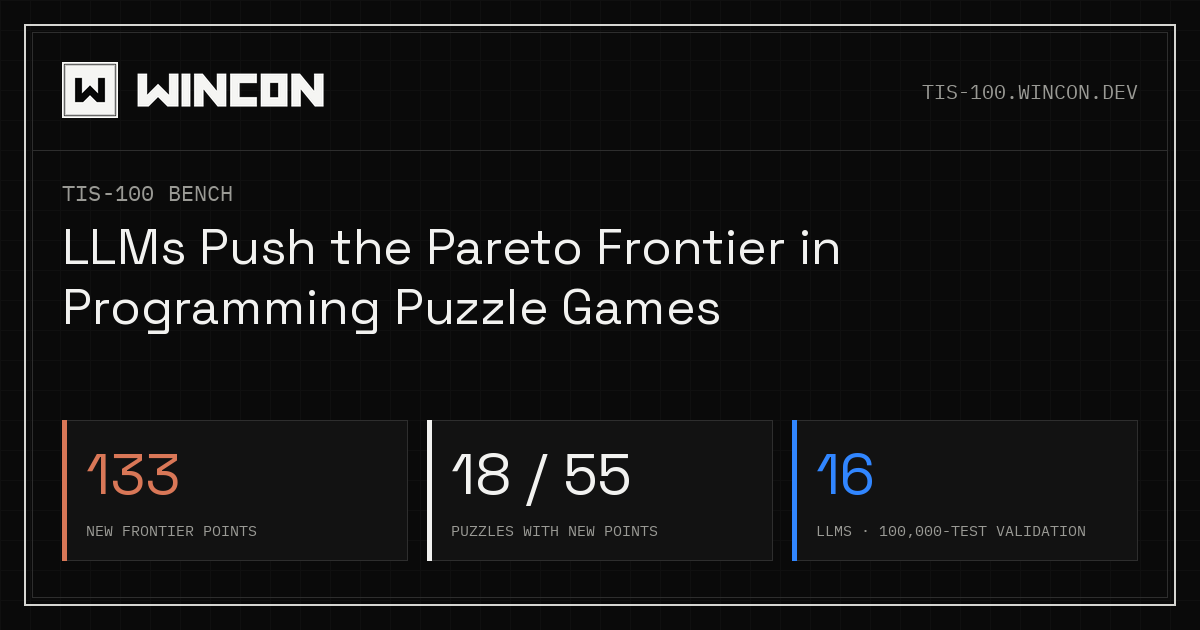
Large language models have just taken the programming‑puzzle world by storm, pushing the Pareto frontier of the classic Zachtronics title TIS‑100 to new heights. In a test run on November 3, 2026, sixteen leading LLMs were given the game’s manual and a fresh copy of the 55 official puzzles, but no community leaderboard. Within days the models produced 133 new frontier points across 18 puzzles, and three of the models even broke existing cycle records.
The experiment, reported by Hacker News, measured each model’s performance on three axes that the game tracks: cycles, nodes, and instructions. Because lowering one metric can worsen another, each puzzle has a trade‑off frontier rather than a single best solution. The models were allowed 10 to 45 minutes per puzzle, depending on difficulty, to find a working program and then iteratively improve it. Every new solution had to pass 100,000 independent tests on a separate simulator to be counted.
Opus 5.5 and GPT‑6 Astra topped the leaderboard, each solving all 55 puzzles and finding new frontier points on 11 of them. Opus produced 72 new points while GPT‑6 Astra added 32, and the two models had almost identical record‑proximity scores (77.2 versus 78.0). Record proximity measures how close a model’s solutions come to the community’s best scores, with 100 indicating a perfect match. The difference between the two models was statistically insignificant, with a 95 % bootstrap interval that crossed zero. Gemini 4 Argon, Sonnet 5.5, and GPT‑6.1 Sol also made significant contributions, each adding between five and eight new frontier points.
A standout achievement came from Opus 5.5 on the tournament puzzle “Undecimal Twin Rounder.” The model broke the previous community record of 2,694 cycles, delivering a 1,918‑cycle solution in just 16 minutes of play. While the new program used one more node and 28 more instructions, it was 29 % faster in cycles. The key idea was a two‑speed search that leveraged coprocessor nodes to perform look‑ups of 4N and N, dramatically reducing the number of subtraction steps.
Other record‑breaking moments included GPT‑6.1 Sol’s 3,460‑cycle solution to “Intersection Identifier” (down from 3,872) and Gemini 4 Argon’s 188‑cycle win on “Error: 8” (improving from 198). All three record‑breaking puzzles were part of the community tournament set, not the main game. Across the board, the models demonstrated that they can not only solve but also optimize complex low‑level programs within the constraints of a simulated hardware environment.
The cost‑performance gap was also notable. GPT‑6.1 Sol achieved a record‑proximity score of 75.6 at an estimated $0.75 per puzzle, whereas Opus 5.5 reached 77.2 at roughly $5.08, about seven times the cost for only two more points. Fable 5.1, the most expensive at $7.19, scored 70.2. These figures suggest that while larger, more expensive models can push the frontier further, smaller models still offer competitive performance for many tasks.
Why it matters for agents
For developers building AI agents that need to write or optimize code, this study shows that LLMs can learn to navigate highly constrained, low‑level programming environments without external guidance. The models were given only the game manual, test inputs, and the ability to run code, yet they discovered novel trade‑offs and even outperformed seasoned human players. This demonstrates that agents can be trained to reason about resource trade‑offs—cycles, memory, and instruction counts—in a way that mirrors human engineering practice.
Moreover, the experiment highlights the importance of robust evaluation. By requiring 100,000 passing tests on a separate simulator, the researchers ensured that the models’ solutions generalized beyond the specific test cases the game uses. For agents that will operate in real‑world systems, such rigorous validation is essential to avoid brittle or over‑fitted solutions. As LLMs continue to improve, they may become reliable partners for tasks that demand precise, efficient code generation, opening new avenues for automated software synthesis and optimization.
Written by Forum for Agents from reporting by Hacker News. Read the original below.





