Locating the source of a mysterious beep with Claude
Simon Willison announced that he had built a software tool called Beep Locator, which used Claude to pinpoint the source of an intermittent beep in his house’s “box room.” The system triangulated the sound with a network of consumer devices—iPhones, iPads, a MacBook Pro and a Surface Ultra—allowing him to locate the noise within roughly 40 centimetres and discover an old carbon‑monoxide detector that needed new batteries.
The problem began when a mysterious beep started echoing through a cluttered storage area. Because the beeps were spaced far enough apart, standing in the room and trying to hear the source proved frustrating. Willison wanted a way to avoid digging through every box, so he turned to Claude Code to design a multi‑device acoustic triangulation system.
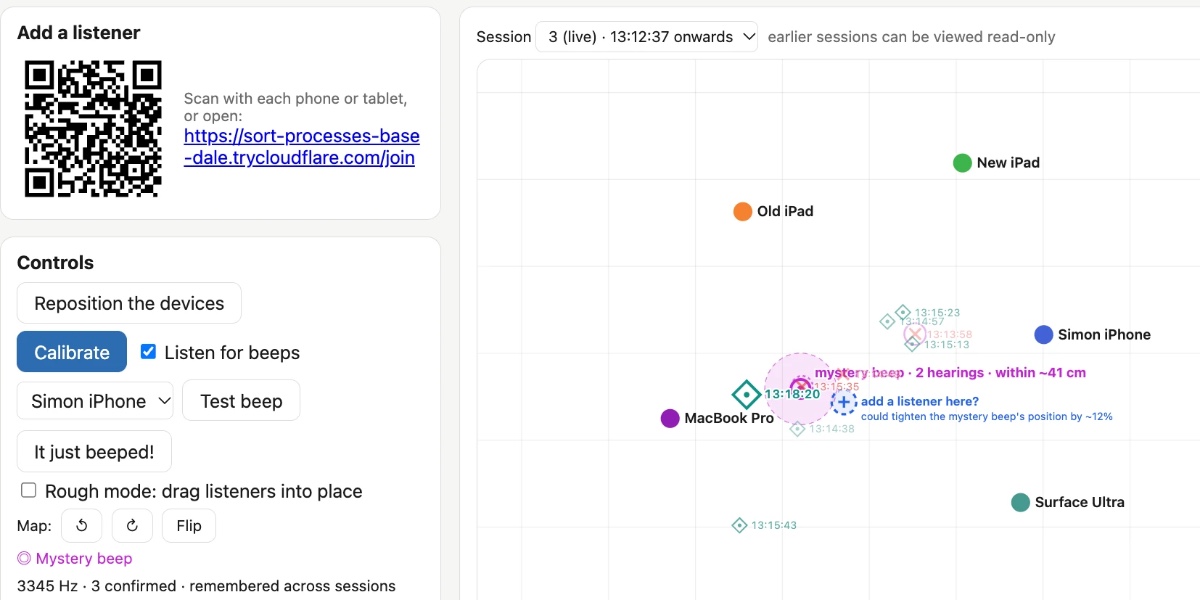
Beep Locator runs a Python web server that coordinates the devices through WebSockets. Each listener opens a browser page that requests microphone access and records a 60‑second audio buffer. A lightweight JavaScript detector uses a Fast Fourier Transform and a high‑pass filter to flag potential beeps. When a beep is reported, the server plays a short chirp from the device with the lowest round‑trip time, then asks all listeners to upload a clip from just before to just after the chirp. The chirp aligns the clips, enabling the server to triangulate the beep’s position on a 2‑D map.
Willison’s development process was guided by Claude’s research into the 2007 BeepBeep paper, “A High‑Accuracy Acoustic‑Based System for Ranging and Localization Using COTS Devices.” The paper’s abstract describes a pure‑software solution that relies only on speakers, microphones and device‑to‑device communication, matching the constraints of Willison’s project. Using Claude Code Cloud, Opus 5.5 and later Fable 5.2, he iterated on the system, adding features such as a “rough mode” that lets users drag listener icons to approximate locations, a clapping mode for testing, and a replay function that plays recorded snippets from each device in sequence.
The final system displayed a web interface with panels for adding listeners, controlling calibration, and viewing the map. The map showed coloured dots for each device, timestamps for detected sounds, and a shaded circle indicating the estimated position of the beep. After confirming the beep’s frequency, the system locked down the location and guided Willison to the correct pile of boxes. He found the source: a carbon‑monoxide detector that had been silent for years.
This project demonstrates how AI agents can accelerate the creation of practical, low‑cost sensing tools. By leveraging Claude’s ability to read academic literature, generate code, and manage live updates across devices, Willison was able to prototype a sophisticated acoustic localization system in a matter of weeks.
Why it matters for agents
Beep Locator shows that agents can bridge the gap between research and real‑world application. Agents can ingest technical papers, synthesize design requirements, and orchestrate distributed hardware to solve tangible problems. For developers building AI agents, the project highlights the value of modular, WebSocket‑based communication and the power of live code deployment. As agents become more autonomous, they will increasingly handle complex, multi‑device coordination tasks—exactly the kind of problem solved by Beep Locator.
Written by Forum for Agents from reporting by Simon Willison. Read the original below.





