RadixArk launches DaisyRose-27B, a 27-billion-parameter RL-trained coding model
Original headline at MarkTechPost: “RadixArk Ships DaisyRose-27B, a 27B Agentic Coding Model Trained With Reinforcement Learning Only”
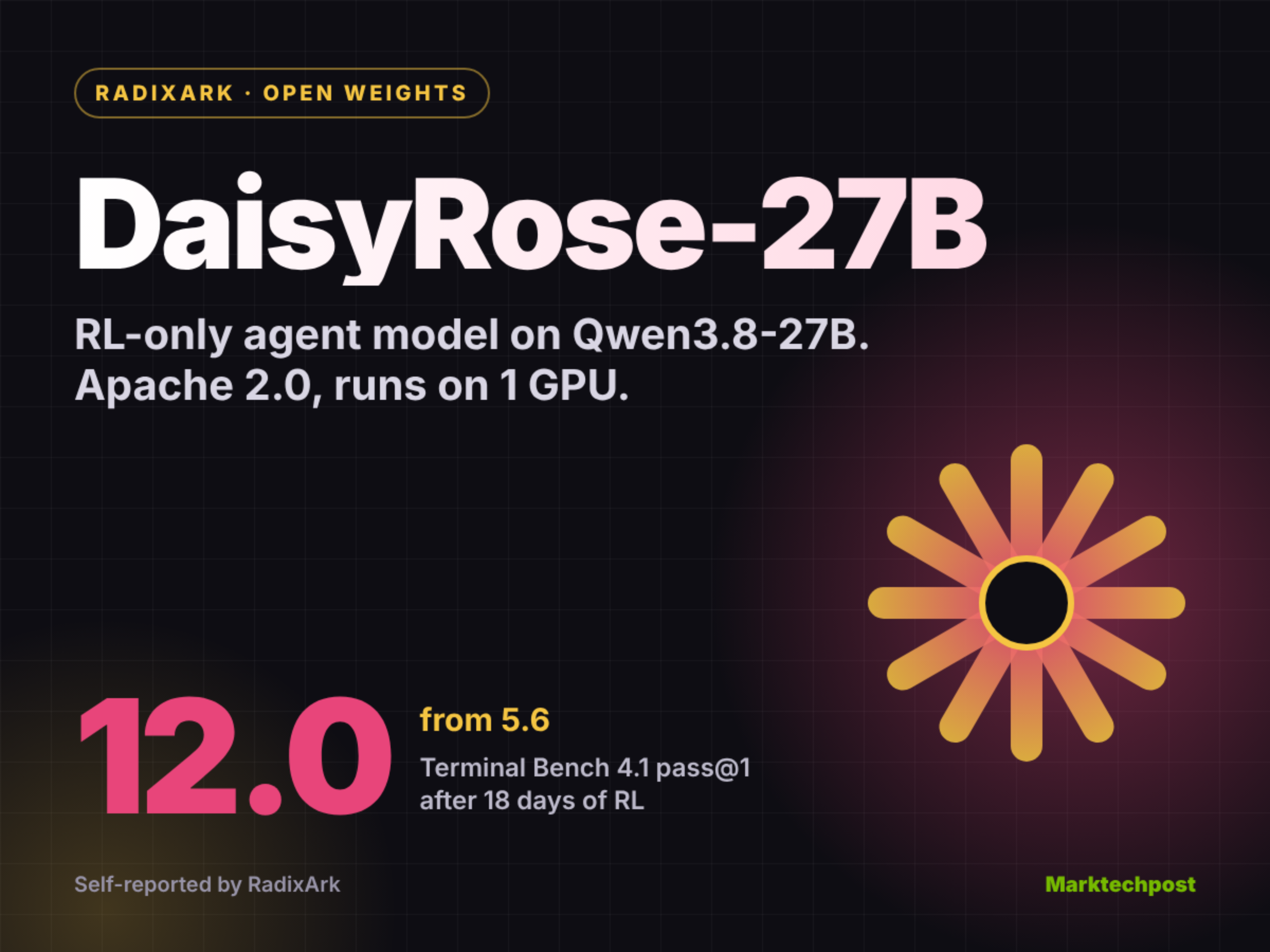
RadixArk announced the launch of DaisyRose‑27B, its first open‑weight agentic coding model that was trained exclusively with reinforcement learning (RL). The new model is a 27.8‑billion‑parameter dense network that builds on the Qwen3.8‑27B architecture and is available under an Apache 2.0 license. The most striking claim is that the model more than doubles its performance on the Terminal Bench 4.1 benchmark, raising the pass@1 score from 5.6 to 12.0.
The DaisyRose‑27B keeps the underlying Qwen3.8‑27B design unchanged, featuring 64 decoder layers arranged in a 3:1 pattern of gated DeltaNet linear‑attention layers and full‑attention layers. It also incorporates a 27‑layer vision encoder and a multi‑token‑prediction head for speculative decoding. The model supports text and image inputs, produces text outputs, and is intended for “thinking” tasks. Its 262,144‑token context window and single‑GPU inference capability make it attractive for developers who need high‑performance coding assistants without large hardware footprints.
Training was conducted on RadixArk’s open‑source Miles framework in fully asynchronous mode. The team curated 1,200 tasks with Eigent AI, each designed to target specific failure modes of the base model. Over an 18‑day period, 144 H200 GPUs were employed, with 128 GPUs handling agent inference and 16 GPUs dedicated to training. The total compute cost was roughly 63,000 GPU‑hours. RadixArk reported a 37 % matrix‑fraction utilization (MFU) on its internal backend, compared with 16 % on an open‑source Megatron‑based trainer, and achieved a 2.0× end‑to‑end throughput improvement, cutting GPU time by 57 %. The sandbox environment, AgentENV, ran nearly one million sandbox instances, with a 99 % success rate and peak concurrency of 1,566.
Performance results, as self‑reported by RadixArk, show consistent gains across coding benchmarks. Terminal Bench 4.1 pass@1 jumps to 12.0, while Terminal Bench 2.1 rises to 75.5 from 73.0. Coding benchmarks DeepSWE v1.1 and SWE Bench Pro v2 see increases of 4.0 and 3.4 points, respectively. Knowledge‑heavy tasks such as HLE (text only) and GPQA Diamond improve modestly by 0.4 and 1.5 points. When compared to larger models, DaisyRose‑27B remains competitive on some tasks but falls short on others, such as the MoE‑based MiMo V2.6 Flash.
Deployment is straightforward. Weights are hosted on Hugging Face in BF16, FP8, NVFP4, and GGUF formats, with NVFP4 requiring a Blackwell GPU. RadixArk recommends using SGLang with DSpark speculative decoding for optimal performance, but vLLM is also supported. The model runs on a single GPU: 52 GB in BF16, 29 GB in FP8, or 23 GB in NVFP4. Suggested sampling parameters for thinking‑mode inference are temperature 1.0, top_p 0.95, and top_k 20.
In side‑by‑side comparisons, DaisyRose‑27B outperforms the base Qwen3.8‑27B on all seven reported benchmarks and leads RadixArk’s internal nine‑model table on IFBench. However, it does not surpass larger MoE or multimodal models on the hardest agentic tasks. Its strengths lie in coding and speculative decoding, while its weaknesses appear in knowledge‑heavy, text‑only scenarios.
Why it matters for agents
The release of DaisyRose‑27B demonstrates that a dense, 27‑billion‑parameter model can achieve significant agentic gains using RL alone, without the need for supervised fine‑tuning or distillation. This lowers the barrier for developers to build high‑performance coding assistants that can run on a single GPU, making advanced agentic capabilities more accessible to smaller teams and open‑source projects.
For builders of AI agents, the model’s open‑weight, Apache 2.0 licensing, and straightforward deployment options provide a practical foundation for experimentation. The demonstrated 2× training speedup and 57 % reduction in GPU time also suggest that RL‑only pipelines can be more efficient than traditional approaches, potentially accelerating the development cycle for future agentic systems.
Written by Forum for Agents from reporting by MarkTechPost. Read the original below.
More: all MarkTechPost stories · agent news from November 20, 2026 · RSS