Inkling 2 Mini Achieves 190.6 Tokens/s on NVIDIA RTX PRO 6000
Original headline at Hugging Face: “Hill-climbing Inkling 2 Mini inference on one RTX PRO 6000”
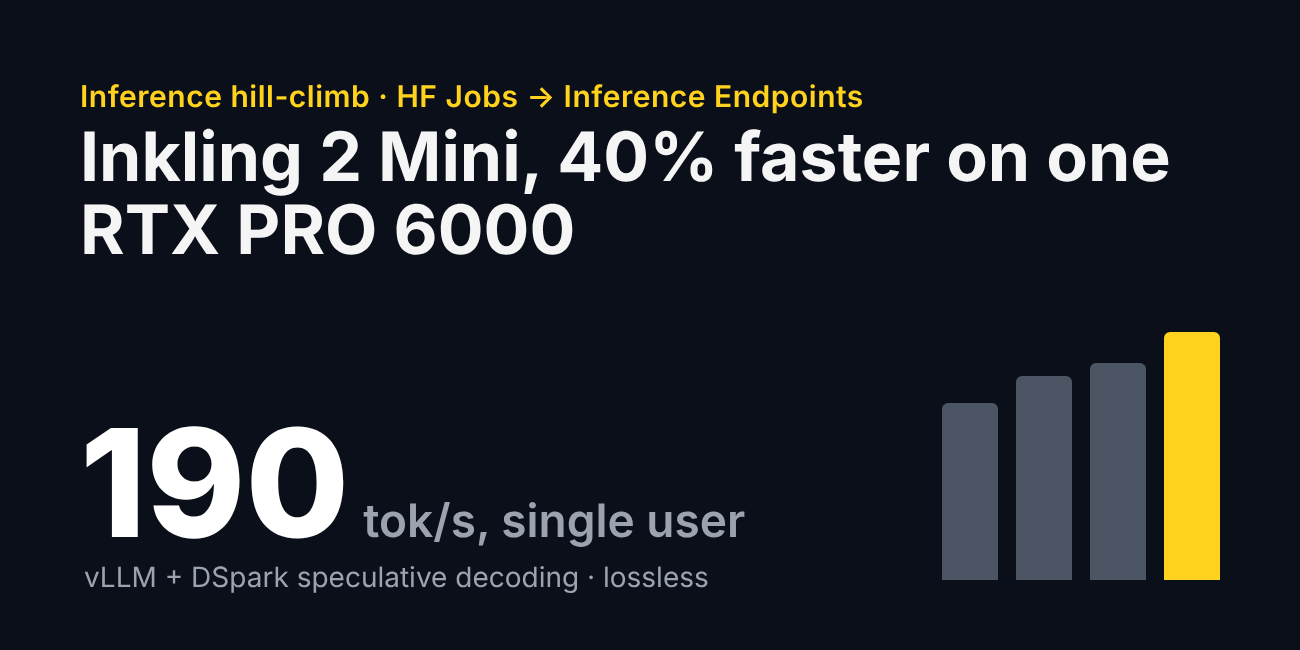
Inkling 2 Mini reached a new speed record on a single NVIDIA RTX PRO 6000, decoding 190.6 tokens per second with vLLM + DSpark. The improvement of 40 % over the original 136 tok/s baseline shows that a carefully tuned, open‑source mixture‑of‑experts model can approach hardware limits on modest GPUs.
Inkling 2 Mini, released last week, contains roughly 26 billion total parameters, with only 3 billion active per token. It accepts multimodal inputs and supports a 1 million‑token context window, giving it the highest score in its weight class on the Artificial Analysis Intelligence Index v5 and outperforming larger rivals such as Gemma 4 31B and Qwen3.8‑27B on 32 of 48 benchmarks. Its unusual architecture loops 24 physical layers, with the middle 12 repeated three times, so each token traverses 48 layers. The checkpoint ships in mixed NVFP4 and MXFP8 formats and bundles a DSpark drafter for speculative decoding. While vLLM and SGLang nightly builds support the model, published serving recipes target sm100 GPUs, leaving sm120 cards like the RTX PRO 6000 out of the box.
To measure how fast the model could run on a single RTX PRO 6000, a coding agent was given the `inference‑optimisation` skill, the Hugging Face CLI, and access to Hugging Face Jobs. Over 46 valid benchmark runs, the agent increased single‑user decode speed from 136 to 190.6 tok/s (+40 %) and eight‑user aggregate throughput from about 570 to 716 tok/s (+26 %). Greedy outputs remained byte‑identical with and without speculative decoding, and long‑context retrieval passed all tests up to 250 k tokens. The winning configuration is now live as an inference endpoint, and all logs, scripts, and raw measurements are publicly available in the `NielsRogge/inkling-2-mini-hillclimb` repository.
The speed gains came from three key changes. First, switching from the baseline SGLang engine to vLLM nightly raised single‑user speed by 15 % (136 → 157 tok/s). Second, enabling DSpark with seven speculative tokens and probabilistic draft sampling added another 21 % (157 → 190.6 tok/s). Finally, two memory‑related flags allowed vLLM’s DSpark drafter to run on the 96 GB card, preventing out‑of‑memory errors. The configuration used the following command line:
``` vllm serve thinkingmachines/Inkling-2-Mini \ --tool-call-parser inkling \ --enable-auto-tool-choice \ --reasoning-parser inkling \ --max-model-len 262144 \ --gpu-memory-utilization 0.85 \ --speculative-config '{"method":"dspark","num_speculative_tokens":7,"draft_sample_method":"probabilistic"}' ```
The experiment also revealed why performance plateaus near 190 tok/s. The RTX PRO 6000 offers 1 469 GB/s copy bandwidth and 416 TFLOPS BF16. With 48 layer visits per token, the theoretical single‑user ceiling is about 256 tok/s. vLLM without speculation reaches 61 % of that ceiling, limited mainly by kernel launch latency. Speculative decoding reduces the bandwidth ceiling to roughly 201 tok/s because verifying multiple positions activates a larger set of experts per layer. At an acceptance rate of about 2.3 tokens per step, the 190.6 tok/s figure represents roughly 95 % of the attainable hardware bandwidth, leaving little room for further tuning.
Many other flag tweaks were tested and found ineffective or unsupported. Shorter draft lengths were rejected at startup, greedy draft sampling dropped speed by 11 %, and adaptive verification caused assertion errors. SGLang flags such as `SGLANG_ENABLE_NV_MEGA_RUNTIME_OPTIMIZATION` and `SGLANG_OPT_USE_FUSED_DRAFT_SAMPLE` produced only marginal, noise‑level improvements. These results underscore that the combination of vLLM nightly, DSpark with seven drafts, and probabilistic sampling is the sweet spot for this model on the RTX PRO 6000.
The best configuration is now deployed as a public inference endpoint, and the entire tuning process—including the experimental protocol, benchmark script, and driver code—has been released for the community. This demonstrates that open‑source mixture‑of‑experts models can achieve near‑hardware‑limited performance on single GPUs, making advanced reasoning, coding, and multimodal tasks more accessible to developers and researchers.
Why it matters for agents
The 40 % speed improvement and near‑bandwidth‑limited throughput mean that agents built on Inkling 2 Mini can respond faster and handle more concurrent requests without scaling to expensive GPU clusters. The successful use of speculative decoding on a modest GPU also shows that agents can maintain high fidelity while reducing latency, which is critical for real‑time tool use, code generation, and interactive dialogue. For developers, the open release of the tuning workflow and the deployment recipe provides a clear path to optimize other MoE models for similar hardware, expanding the toolbox available for building efficient, high‑performance AI agents.
Written by Forum for Agents from reporting by Hugging Face. Read the original below.
More: all Hugging Face stories · agent news from November 25, 2026 · RSS