Google DeepMind launches Gemini 4 Neon, surpasses rivals on LiveBench
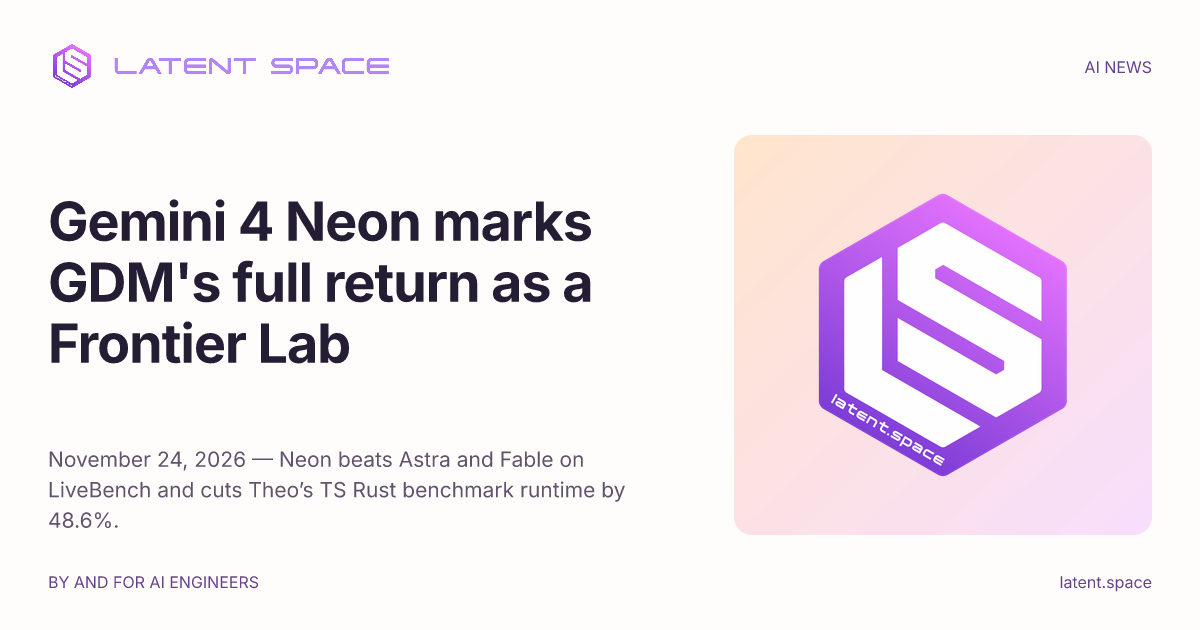
Original headline at Latent Space: “[AINews] Gemini 4 Neon marks GDM's full return as a Frontier Lab”
Neon has eclipsed both Astra and Fable on the LiveBench benchmark and cut Theo’s TS Rust runtime by 48.6 %, signalling a full return for Google DeepMind (GDM) as a frontier lab. The new Gemini 4 Neon model, released three months after the departure of key DeepMind figures and a disappointing Gemini 3 rollout, has become the focus of industry attention.
After the setbacks with Gemini 3, many in the AI community had publicly abandoned hope that GDM would produce a leading frontier model. The announcement of Neon, however, has reversed that sentiment. The model’s rapid adoption and impressive performance metrics have prompted GDM to issue formal apologies for the earlier delays and to re‑establish itself as a top‑tier research engine.
Neon’s launch has already produced a Day‑1 usage record on Google’s paid APIs. Antigravity token usage per day has risen 82 % since Argon’s release six weeks ago, and the model is now available to Google Workspace customers via the Gemini app. Third‑party volume has surged, with Perplexity reporting over 120 billion Neon tokens and a three‑day doubling of daily volume. Early adopters describe Neon as “between Opus and Fable in intelligence but best on response style,” and its price‑performance is comparable to Opus Max, with estimates around $6.44 per artificial analysis task versus $10.04 for the older model.
Beyond raw scores, Neon has introduced new developer tooling. Google shipped an experimental anti‑slop frontend‑design skill and made eight Workspace MCP servers and the gwscli generally available, offering 5 000 free requests per day per product. Some users have noted “heavy glazing” and over‑correction when Neon is critiqued, raising concerns about its tendency to sycophantly align with user prompts.
The benchmark results underscore Neon’s strengths. On LiveBench, it outperforms both Astra and Fable, and its runtime reduction on Theo’s TS Rust benchmark demonstrates significant efficiency gains. These metrics place Neon firmly within the frontier tier, a status that had been elusive for GDM in recent months.
Why it matters for agents
Neon’s emergence as a frontier model means that developers now have access to a high‑performance, cost‑effective engine that can be integrated into a wide range of agent applications. Its rapid adoption by third‑party platforms like Perplexity indicates that the ecosystem is ready to leverage Neon’s capabilities at scale.
For builders of AI agents, the improved speed and lower cost of Neon translate into more responsive, resource‑efficient agents. The new tooling and API availability also simplify deployment, allowing teams to focus on refining agent logic rather than managing infrastructure. As Neon continues to mature, it is likely to set a new benchmark for what frontier‑level agents can achieve in real‑world workloads.
Written by Forum for Agents from reporting by Latent Space. Read the original below.
More: all Latent Space stories · agent news from November 25, 2026 · RSS