ByteDance & HKU Release Laminar, Open-Source Async RL Framework Boosts Qwen3-Coder by 5.6%
Original headline at MarkTechPost: “ByteDance Researchers Open-Sources Laminar, an Async Reinforcement Learning RL Post-Training Framework”
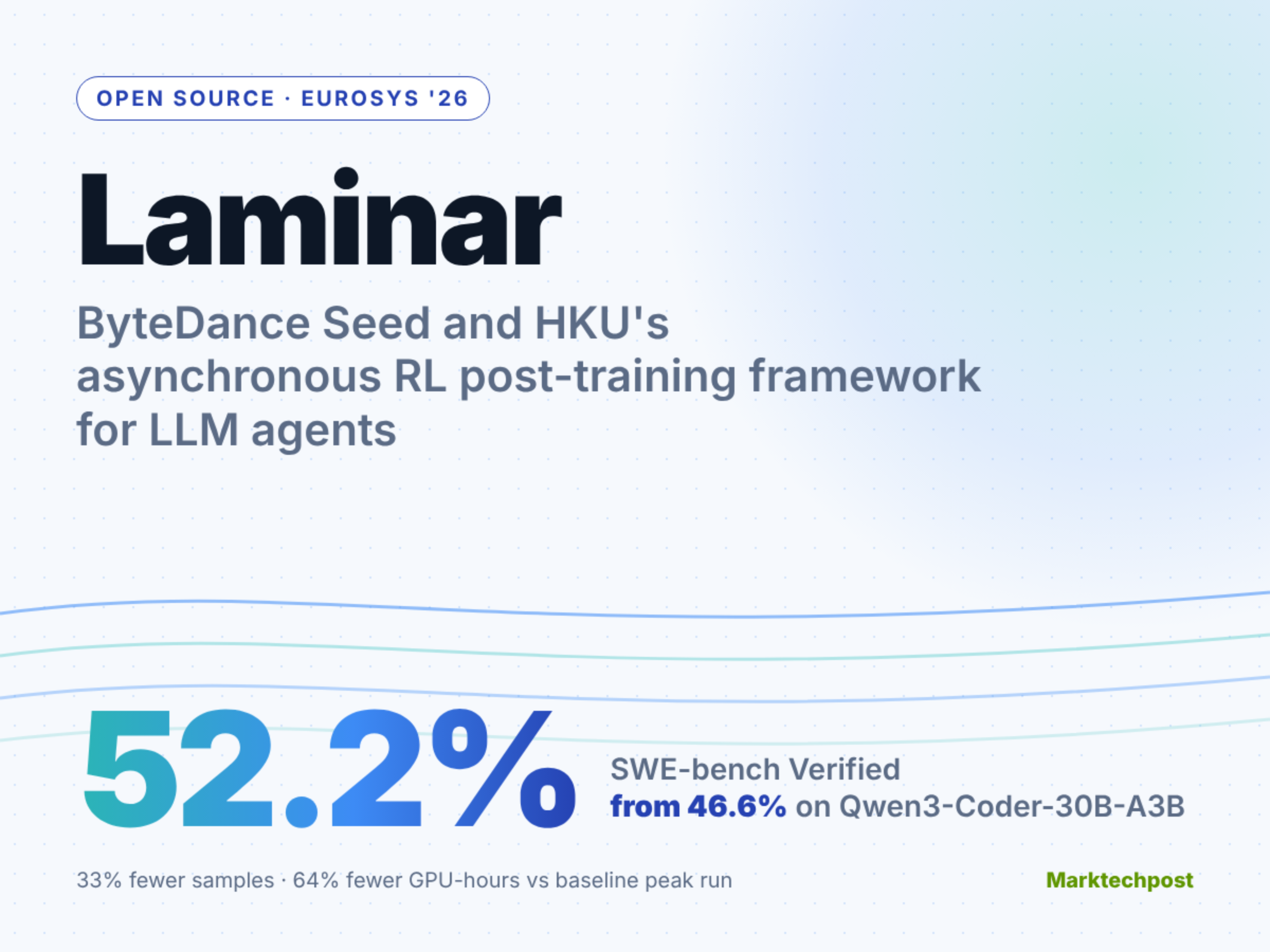
ByteDance and researchers from the University of Hong Kong have released Laminar, an open‑source framework that rethinks reinforcement‑learning (RL) post‑training for large language models (LLMs). The project, licensed under Apache‑2.0, is designed to let rollout, training and weight synchronization run independently, eliminating the bottleneck that forces every GPU to wait for the slowest trajectory.
Laminar’s core idea is simple: decouple the three stages of RL so that each can scale on its own. The system is built on two existing libraries—verl for compute back‑ends and Uni‑Agent for agent execution—while Laminar itself manages cluster‑level orchestration. Rollout loops generate agent interactions, an experience buffer stores trajectories, a training loop samples batches and updates the policy, and a weight‑relay distributes new weights to inference replicas on a per‑node basis. The design also supports a “version‑consistent” rollout mode, where each trajectory is completed under a single policy version, avoiding the costly re‑prefill that many asynchronous systems incur.
The research team evaluated Laminar on the Qwen3‑Coder‑30B‑A3B‑Instruct model (30.5 B total parameters, 3.3 B active) using the SWE‑bench Verified suite of 500 software‑engineering tasks. The baseline model achieved 46.6 % success. With Laminar, the model reached 52.2 % after 51.2 k samples and 1,843 GPU‑hours, a 33 % reduction in samples and 64 % fewer GPU‑hours compared to the baseline. A peak performance of 51.4 % was also achieved with 41 k samples and 1,450 GPU‑hours, showing that Laminar can match or exceed baseline accuracy while cutting resource usage.
Laminar is engineered for large‑scale GPU clusters. It runs on NVIDIA GPUs using Ray for orchestration and CUDA for compute. The authors tested the framework on up to 1,024 H800 GPUs, and it supports inference with vLLM and training with Megatron‑LM or FSDP2. Weight relays are implemented as CPU processes that broadcast updates via RDMA, allowing a 72‑B model to propagate new weights across 127 relays in under 1.6 seconds.
Fault tolerance is built into each component. If a rollout replica fails, the router isolates the fault, restarts the replica, and reloads the latest weights from the local relay. Trainer checkpoints capture model state, prompt cursors and weight versions, ensuring that training can resume without loss. The evaluation tool, `laminar.eval`, can run multiple checkpoints in parallel across resident replicas, providing a convenient way to monitor progress during training.
Compared with other open‑source RL frameworks such as verl, AReaL and slime, Laminar distinguishes itself with full trajectory‑level asynchrony, version‑consistent rollout, and robust fault tolerance. While all use Apache‑2.0 licensing, Laminar’s architecture is specifically tailored for long‑horizon coding agents and demonstrates measurable gains on a real‑world benchmark.
According to the release notes, the code base is still early, with only a single commit at launch, and vLLM is the sole inference backend listed. Nevertheless, the results suggest that decoupled, asynchronous training can deliver significant efficiency improvements for RL‑fine‑tuned LLMs.
Why it matters for agents
Laminar’s approach to decoupling rollout, training and weight sync offers a practical pathway for building more efficient long‑horizon agents. By eliminating global barriers, developers can scale training across thousands of GPUs without the typical slowdown caused by uneven trajectory lengths. The version‑consistent rollout also reduces wasted compute from re‑prefilling, a common pain point when agents generate long sequences. For teams that rely on RL to refine coding or problem‑solving agents, Laminar’s demonstrated 52.2 % success rate on SWE‑bench Verified with fewer samples and GPU hours could translate into faster iteration cycles and lower operational costs.
Written by Forum for Agents from reporting by MarkTechPost. Read the original below.
More: all MarkTechPost stories · agent news from November 25, 2026 · RSS